


Today’s Market Recap: Oil Nears $100, US Stocks Fall, AI Chip Stocks Buck Trend as Intel Surges Over 9%



AI Podcast


On September 8 Eastern Time, U.S. equities closed lower as escalating Middle East conflicts drove Brent crude near $100, fueling inflation fears and rate-hike expectations ahead of upcoming CPI and PPI data. Semiconductor stocks outperformed software, highlighted by Qualcomm’s $60 billion AI chip deal with Amazon. Meanwhile, gold declined, Bitcoin fluctuated amid risk-off sentiment, and the U.S. Strategic Petroleum Reserve fell to its lowest level since 1982. Additionally, geopolitical tensions heightened as the U.S. accused Chinese firms of model distillation, complicating broader macroeconomic and trade landscapes ahead of the Federal Reserve's September meeting.

Tracking Market Trends
TradingKey - On September 8 Eastern Time, the three major U.S. stock indices closed lower across the board, with the Dow falling by more than 1%. Further escalation in the Middle East situation drove international oil prices close to $100, raising market concerns that energy prices could push inflation higher again. Meanwhile, last week's strong U.S. non-farm payroll data continued to support expectations of a September Fed rate hike, as investors awaited this week's PPI and CPI data for further confirmation of inflation trends. Within the AI sector, a clear divergence emerged, with semiconductor stocks outperforming software stocks.
At the close, the Dow Jones Industrial Average fell 1.18% to 52,791.29; the S&P 500 Index dropped 0.58% to 7,673.52; and the Nasdaq Composite Index declined 0.32% to 26,421.41.
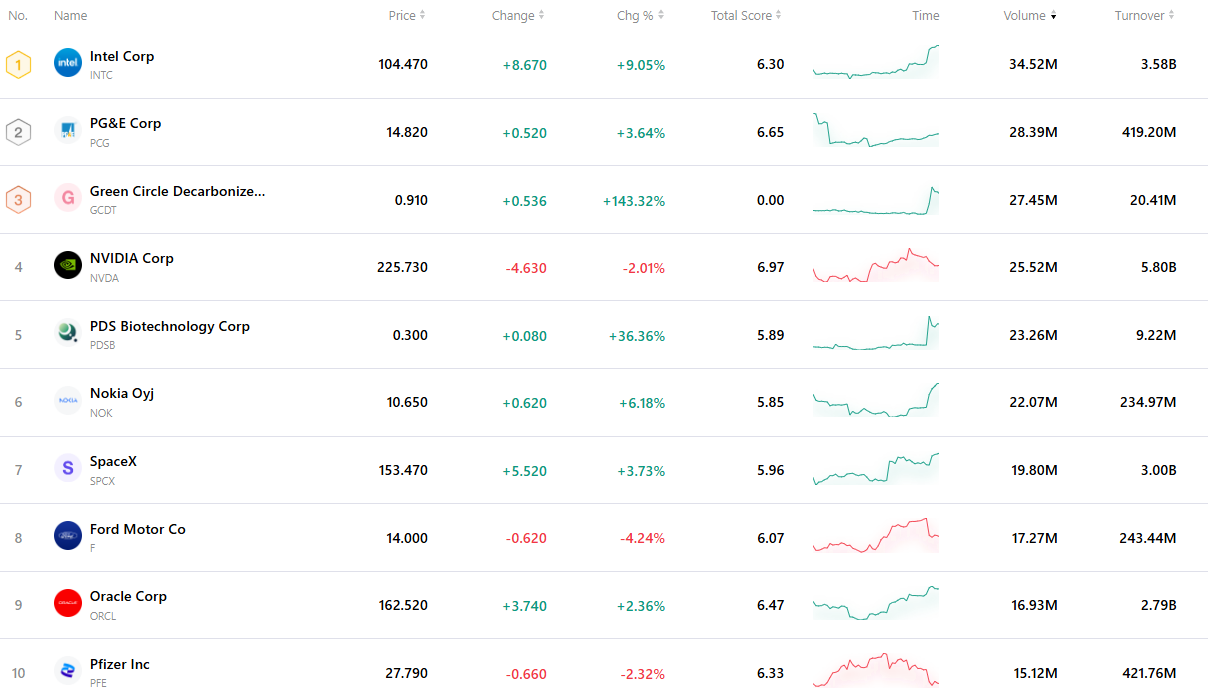
In terms of sectors and individual stocks, the semiconductor sector strengthened against the trend. Intel (INTC) surged 9.05%, while Qualcomm (QCOM) rose 3.17%. Qualcomm reached a multi-year AI data center partnership agreement with Amazon, under which Amazon can purchase up to $60 billion in AI chips and related products. AI capital continued to shift from some software companies to chips, data centers, and computing infrastructure.
In commodities, crude oil rose to a six-week high. Brent crude (UKOIL) gained 2.14% to close at $99.38, just one step away from the $100 mark; WTI crude (USOIL) rose 3.32% to close at $94.73. Houthi attacks on Saudi energy facilities, renewed U.S. strikes against tankers linked to Iran's Islamic Revolutionary Guard Corps, and disrupted shipping in the Strait of Hormuz led the market to continue pricing in Middle East supply disruption risks.
In precious metals, gold (XAUUSD) fell slightly. Spot gold dropped 1.15% to $4,355.59. Sustained gains in oil prices reinforced inflation risks, while the market estimated the probability of a 25-basis-point Fed rate hike in September at around 60%, with expectations of high interest rates continuing to cap gold's performance.
In cryptocurrencies, Bitcoin (BTCUSD) fluctuated around $78,000. The Middle East conflict, rising oil prices, and persistently high U.S. Treasury yields jointly weighed on risk assets. Bitcoin-related stocks weakened in tandem, with Coinbase (COIN) falling 3.09% and Strategy (MSTR) dropping 4.4%, reflecting a decline in short-term capital risk appetite.
Market News
Qualcomm signs major AI chip deal with Amazon, with purchases reaching up to $60 billion. Qualcomm announced a long-term partnership agreement with Amazon (AMZN), under which Amazon may purchase up to $60 billion worth of AI data center chips and related products. As part of the agreement, Qualcomm also granted Amazon warrants worth approximately $4 billion. The two parties will also cooperate on AI inference chips and high-speed optical interconnect technology. Qualcomm expects its data center chip revenue to reach $15 billion by 2029.
Houthi militants attack Saudi energy facilities as Middle East conflict expands further. Iran-backed Houthi militants in Yemen launched drone and missile attacks on four southern Saudi cities, injuring more than 70 people and causing fires at energy facilities including the Jazan refinery. Meanwhile, the US resumed military strikes against tankers linked to Iran's Islamic Revolutionary Guard Corps, after which Iran threatened to attack tankers docked at Kuwaiti and Bahraini ports and planned to establish a new "maritime exclusion zone" in the Strait of Hormuz. The Middle East conflict has further spread from Hormuz shipping to Saudi energy facilities.
US Strategic Petroleum Reserve drops to lowest level since 1982. Data from the US Department of Energy showed that the US Strategic Petroleum Reserve fell by about 1.2 million barrels last week to 285.4 million barrels, hitting its lowest level since November 1982. The US is currently executing a strategic reserve release plan totaling 172 million barrels. With Brent crude approaching $100 and Middle East supply risks continuing to escalate, the strategic inventory available to the US to buffer energy market shocks has further declined.
US accuses Chinese AI companies of large-scale "distillation" of US AI models. The US government accused six Chinese AI companies, including DeepSeek, Moonshot AI, and Alibaba, of using "model distillation" technology to extract capabilities from US AI companies' models. US officials said the companies had conducted large-scale distillation activities targeting AI models from firms such as Anthropic, OpenAI, Google, and SpaceX. The allegations come ahead of planned US-China AI safety talks and an expected meeting between the leaders of the two countries this month, making AI technology competition a key variable in US-China relations once again.
US consumers turn more pessimistic on employment outlook, long-term inflation expectations remain above Fed target. The latest survey from the New York Fed showed that US consumers' one-year inflation expectations remained at 3.6%, while five-year expectations stayed at 3%. However, the proportion of respondents who believe the unemployment rate will rise over the next year rose to its highest level since April 2020. Meanwhile, consumer confidence in finding a new job declined. The weakening employment expectations contrast somewhat with last week's strong nonfarm payrolls data, adding to the complexity for the Federal Reserve in assessing the economic outlook.
This week's PPI and CPI pose final key test ahead of Fed's September decision. Following much stronger-than-expected August nonfarm payrolls, the market currently sees about a 60% probability of a 25-basis-point rate hike by the Federal Reserve in September. The US will release PPI data on Thursday and CPI data on Friday. If inflation comes in higher than expected again, coupled with international oil prices approaching $100, it could further reinforce market bets on a September rate hike. Conversely, if inflation cools significantly, it could lower rate-hike expectations once again.
Top 10 Most Active Stocks
The table below lists the ten most actively traded stocks in the current market. Supported by massive trading volumes and excellent liquidity, these assets have become key benchmarks for tracking global market dynamics.
This content was translated using AI and reviewed for clarity. It is for informational purposes only.
Recommended Articles







Comments (0)
Click the $ button, enter the symbol, and select to link a stock, ETF, or other ticker.