


Today’s Market Recap: Nvidia Earnings Take Center Stage as Micron and Broadcom Drag Down Memory Chip Sector



AI Podcast


On August 24 Eastern Time, U.S. stock indices closed mixed as tech stocks faced valuation pressures ahead of Nvidia’s earnings and escalating U.S.-Canada trade tensions. The Dow rose 0.26% on financial stock strength, while the S&P 500 and Nasdaq declined 0.28% and 0.76%, respectively. Crude oil fell on profit-taking, whereas spot gold rose 1.02% to $4,651.88 amid safe-haven demand and Treasury buyback expectations. Key upcoming catalysts include Nvidia’s quarterly results, Federal Reserve Chairman Warsh’s speech at Jackson Hole, and developments in U.S.-Iran and U.S.-Canada geopolitical and trade relations.

Tracking Market Trends
TradingKey - On August 24 Eastern Time, the three major U.S. stock indices closed mixed. The market continued to digest valuation pressures on tech stocks, wait-and-see sentiment ahead of earnings from Nvidia (NVDA), expanding U.S. economic pressure on Iran, and escalating U.S.-Canada trade tensions. A sharp pullback in oil prices pushed U.S. Treasury yields lower, but tech and semiconductor sectors remained under pressure, dragging the Nasdaq and S&P 500 lower; meanwhile, strength in financial stocks supported a modest gain in the Dow.
At the close, the Dow Jones Industrial Average rose 0.26% to 53,422.35; the S&P 500 Index fell 0.28% to 7,652.86; and the Nasdaq Composite Index declined 0.76% to 25,980.19.
In terms of sectors and individual stocks, tech stocks were the primary drag for the day. Nvidia fell 2.9%, Micron Technology (MU) dropped 5.83%, and Broadcom (AVGO) fell 2.63%, weighing on the Philadelphia Semiconductor Index. As Nvidia is set to report earnings this week, investors chose to trim positions in AI and chip-related stocks ahead of the results, significantly raising the market's demand for verification regarding AI capital expenditures, data center demand, and chip order growth.
Financial stocks performed relatively strong. JPMorgan Chase (JPM) rose 1.4%, and Visa (V) gained 3%, helping the Dow maintain its gains. By contrast, auto and transportation-related stocks came under pressure. Trump stated that if U.S.-Canada trade negotiations fail to make progress, the U.S. will raise tariffs on Canadian cars, trucks, and auto parts to 50% starting January 1, 2027. Following the news, shares of Ford (F) and General Motors (GM) weakened.
In commodities, crude oil snapped its previous winning streak. WTI crude (USOIL) closed down 1.89% at $84.99, while Brent crude (UKOIL) fell 3.45% to close at $90.36. The drop in oil prices was mainly driven by investor profit-taking and a retreat in U.S. Treasury yields. Although the U.S. continued to signal tougher sanctions against Iran, the market in the short term focused more on pullback pressure after oil hit high levels. However, over the medium term, Iranian supply, transit through the Strait of Hormuz, and Middle East shipping security remain core variables supporting oil's risk premium.
In precious metals, gold (XAUUSD) continued to strengthen. Spot gold rose 1.02% to $4,651.88. Gold's rally was mainly driven by the U.S. Treasury Department's recent expansion of long-term Treasury buybacks, previous weakness in the U.S. dollar, and market concerns over uncertainties surrounding this week's inflation data and the Jackson Hole symposium. Against the backdrop of long-end U.S. Treasury yields remaining elevated and rising fiscal and policy uncertainties, gold continues to be favored by capital seeking safe-haven assets and protection against currency debasement.
In the crypto market, Bitcoin (BTCUSD) consolidated at high levels, trading near $79,000. Previously, the U.S. Treasury's expansion of long-term Treasury buybacks briefly improved liquidity expectations, driving a simultaneous rally in both Bitcoin and gold. However, as tech stocks and AI assets face pressure, further short-term upside for Bitcoin will still require support from ETF inflows, a declining U.S. dollar, and a recovery in risk appetite.
Market News
Nvidia earnings report becomes the biggest test for AI trades this week. Nvidia will report its quarterly results this week, with the market closely focusing on Data Center revenue, AI chip orders, progress on the Rubin platform, and whether customer capital expenditures continue to sustain high growth. Amid the recent ongoing pullback in the semiconductor sector, Nvidia's earnings report will not only impact the company's own stock price, but also influence market judgments on the AI infrastructure investment cycle. If the results and guidance fail to significantly beat expectations, AI chip stocks may continue to face valuation compression pressure.
Countdown to the Jackson Hole symposium begins as the market focuses on policy signals from Warsh. Federal Reserve Chairman Warsh will deliver a speech at this week's Jackson Hole Economic Symposium, marking his most closely watched policy communication since taking office. With long-dated U.S. Treasury yields fluctuating sharply recently and the 30-year yield briefly rising to a multi-year high, the market is looking for the Fed's latest assessments on inflation, fiscal pressures, and the future interest rate path. As Warsh previously reduced forward guidance, market sensitivity to this speech has heightened significantly.
The U.S. expands economic pressure on Iran, but has yet to directly implement new sanctions. The Trump administration announced on Monday that it may expand secondary sanctions on countries doing business with Iran, referring to it as an "Economic D-Day." Although specific punitive measures were not immediately implemented that day, the statement indicates that U.S. economic pressure on Iran continues to escalate. The energy market pulled back in the short term due to profit-taking, but as long as risks surrounding Iranian supply and the Strait of Hormuz do not significantly ease, crude oil prices may remain volatile at elevated levels.
U.S.-Canada trade tensions escalate, putting pressure on the automotive supply chain. Trump warned that the U.S. will raise tariffs on Canadian cars, trucks, and auto parts to 50% after trade talks between the two countries broke down over the weekend. Canada previously stated that it would impose retaliatory tariffs on certain U.S. goods starting September 8. If U.S.-Canada trade frictions continue to escalate, they could drive up North American costs in automotive, parts, logistics, and manufacturing, putting pressure on related companies such as Ford and General Motors.
U.S. Treasury bond buybacks remain a key focus for the market. Market reports indicate that the U.S. Treasury may deploy nearly $1 trillion from the Treasury General Account to support long-term Treasury buybacks in an effort to ease upward pressure on long-end yields. Although Treasury Secretary Bessent stated that the government will proceed with long-term bond issuances as planned, the issue of bond buybacks has become a crucial variable affecting the U.S. dollar, gold, Bitcoin, and Treasury yields. Investors will continue to watch whether the Treasury takes further measures to stabilize the bond market.
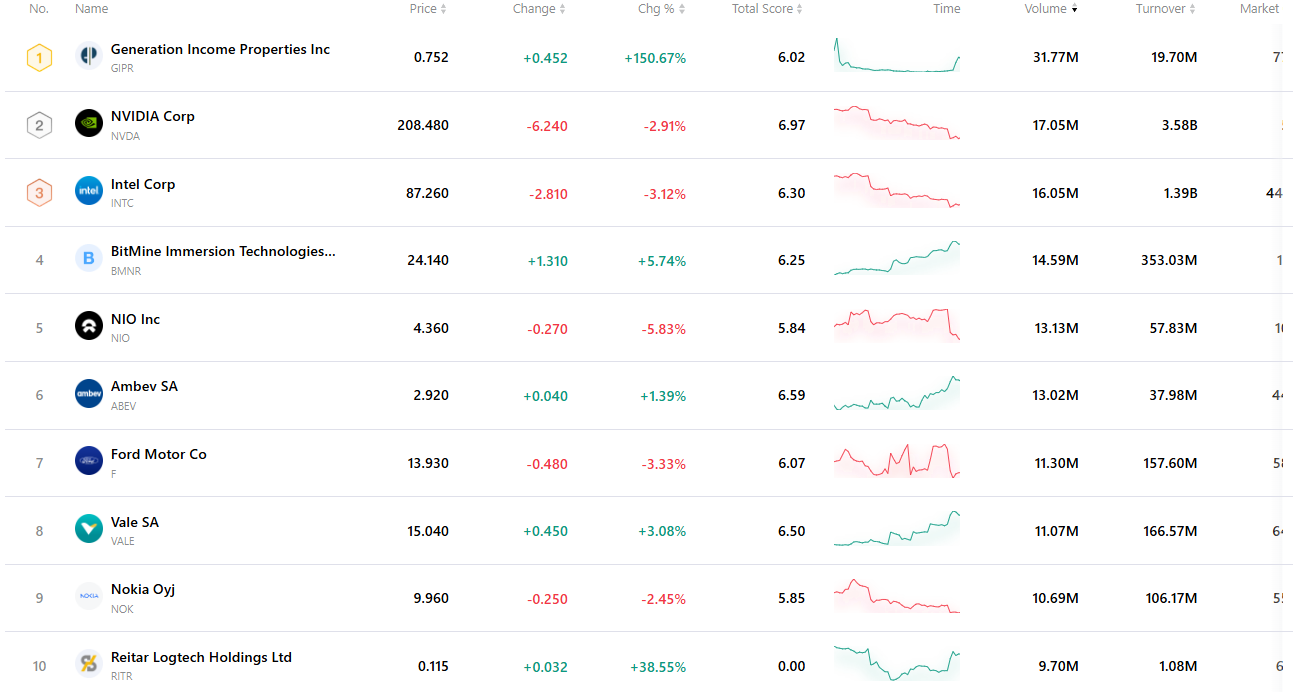
Top 10 Most Active Stocks
The table below lists the ten most actively traded stocks in the market. Supported by massive trading volumes and robust liquidity, these assets have become key benchmarks for tracking global market dynamics.
This content was translated using AI and reviewed for clarity. It is for informational purposes only.
Recommended Articles








Comments (1)
Click the $ button, enter the symbol, and select to link a stock, ETF, or other ticker.