


 Discount


Bitcoin Rebounds Over 10% From Oversold Levels, Poised to Retake $70,000 Mark by Year-End



AI Podcast


Following a severe drop to $55,000 driven by macroeconomic tightening, tech stock corrections, and massive liquidations, Bitcoin has rebounded over 10% to trade at $61,421. The sell-off effectively flushed out excess leverage, while retreating U.S. Treasury yields and potential Federal Reserve policy pauses have improved risk appetite. Sustaining this recovery toward the $70,000 milestone depends on spot buying and ETF net inflows, alongside overcoming key overhead resistance at $66,000 on heavy volume to reattract trend-following capital.

TradingKey - Bitcoin has posted a three-day winning streak after an oversold plunge, rising over 10% cumulatively, with sustained year-end momentum poised to carry it back toward the $70,000 milestone.
On November 23, Bitcoin (BTC) surged over 4% today, trading at $61,421, after experiencing a sharp plunge and retesting lows near $55,000. Over the past three days, Bitcoin has continued to rebound, with cumulative gains exceeding 10%. However, can this price rebound be sustained, and can it climb to the next round-number milestone of $70,000 before entering 2027?
In mid-to-late November 2026, Bitcoin dropped to around $55,000, touching its lowest level since September 2024, with its drawdown widening to 55% from the peak of over $126,000 in October 2025. This was the result of a confluence of multiple factors: macroeconomic interest rate and liquidity tightening, Wall Street's valuation reassessment of tech and AI assets, and cascading liquidations of highly leveraged derivatives.
With long-term U.S. Treasury yields remaining elevated above 5.0%, the U.S. Dollar Index strengthening past 103, and the market staying on high alert regarding sticky inflation and a hawkish Federal Reserve stance, rising global risk-free rates and borrowing costs have directly compressed the valuations and capital absorption capacity of high-volatility, non-yielding assets such as cryptocurrencies.
In mid-to-late November, U.S. and Asia-Pacific equity markets underwent notable corrections as tech and AI-related assets faced the dual tests of profit-taking, concerns over returns on capital expenditures, and rising financing costs. Because institutional capital often manages crypto assets alongside high-beta tech stocks within risk budgeting in cross-asset allocations, weakness in U.S. tech stocks quickly spilled over into the crypto market.
After Bitcoin broke below the key psychological support level of $60,000 on November 20, stop-loss orders and margin calls across the market were triggered en masse. According to CoinGlass data, total 24-hour market liquidations around November 21 surged to between $2.4 billion and $2.67 billion, with long positions accounting for an overwhelming share. Forced liquidations further amplified short-term selling momentum, pushing the price toward $55,000.
Last Friday, U.S. Treasury yields broadly retreated, and cooling expectations for financing costs lowered the opportunity cost of holding non-yielding assets, prompting Bitcoin to halt its decline and rebound near $55,000. In addition, David Kelly, Chief Global Strategist at J.P. Morgan Asset Management, believes the Fed may hit the pause button after completing a rate hike in December, a move that would bolster market risk appetite and provide a liquidity foundation for Bitcoin to stage a stronger rebound.
Moreover, after Bitcoin pulled back sharply from its highs and broke below $60,000 in mid-to-late November, triggering massive derivatives liquidations and panic selling, excessive short-term leverage was largely flushed out. Selling pressure showed signs of interim exhaustion near $55,000, offering bulls an opportunity to counterattack. Notably, Bitcoin's sharp wick down to $55,000 followed by a swift recovery is viewed in technical analysis as a bear trap involving a false breakdown, indicating that a rebound is likely to dominate the near-term outlook.
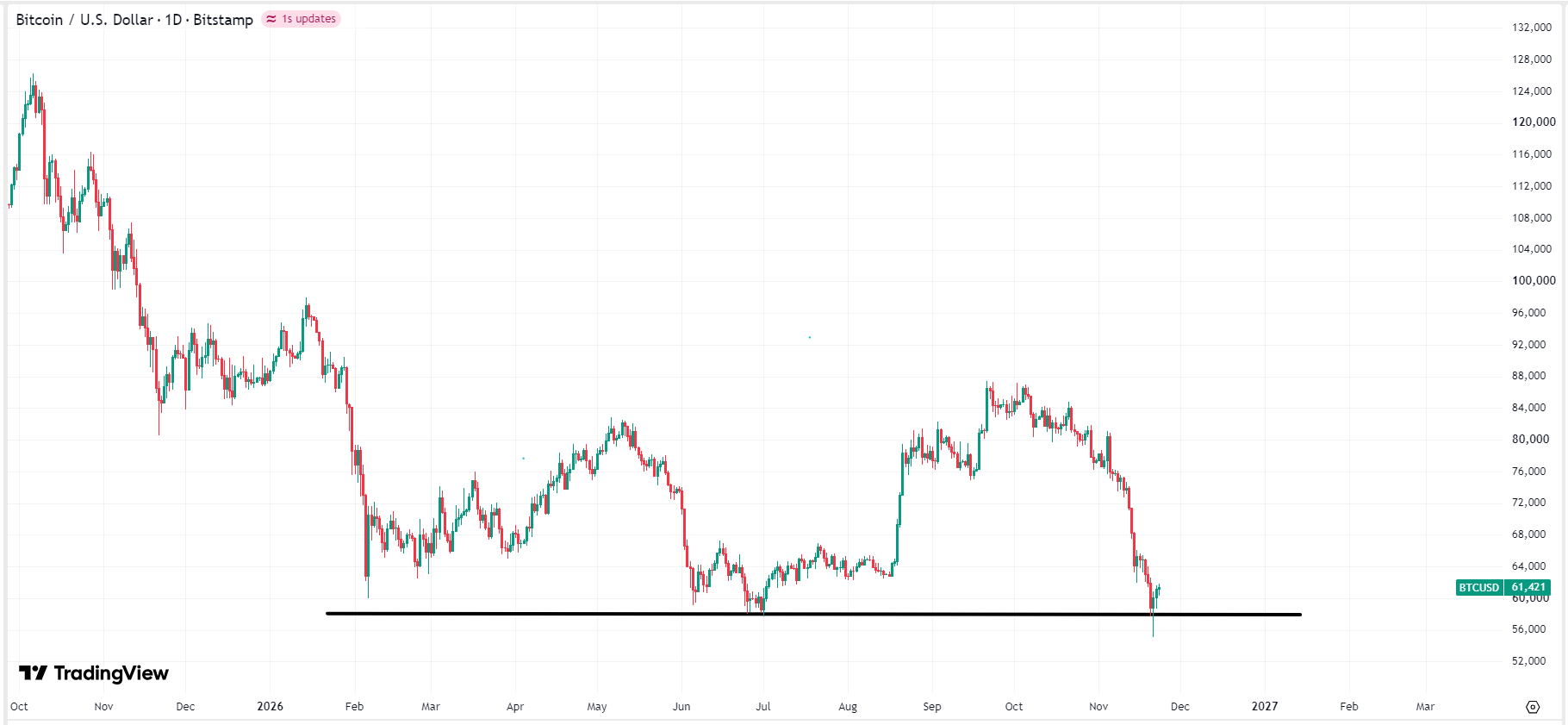
Bitcoin price chart, Source: TradingView
For Bitcoin's rebound following the sharp drop to extend further rather than being just a short-lived short-covering bounce, spot buying and ETF flows must shift from outflows or a wait-and-see stance into net inflows and dip-buying. Furthermore, Bitcoin will confront resistance at $66,000 during the rebound—a pivotal observation level for gauging short-term bullish-bearish momentum. If it can convincingly overcome and hold above this level on heavy volume before year-end, it will attract trend-following capital and short-term momentum buyers back into the market, accelerating a move toward $70,000.
This content was translated using AI and reviewed for clarity. It is for informational purposes only.
Recommended Articles












Comments (0)
Click the $ button, enter the symbol, and select to link a stock, ETF, or other ticker.