


Why the Probability of Success Remains Low for the Western Digital-Kioxia Merger



AI Podcast


On July 21 ET, Western Digital shares surged 12.51% on renewed merger rumors with Kioxia, a combination that would challenge Samsung's market dominance. Despite potential strategic scale, the deal faces significant hurdles. Bain Capital has fully divested, removing merger pressure, while Kioxia thrives independently with soaring profits and plans for US ADRs. Furthermore, SK Hynix retains de facto veto power and strategic competitive alignment against the merger. Valuation discrepancies following Kioxia's explosive market cap growth, complex antitrust spinoff structures, and peak industry cycle dynamics further diminish the probability of a successful consolidation.
TradingKey - On July 21 ET, boosted by rumors that "Western Digital restarted merger talks with Kioxia," Western Digital (WDC) saw its stock price surge 12.51% that day. The two sides had previously initiated merger negotiations, but contacts in 2021 yielded no results, and in-depth talks in October 2023 collapsed because SK Hynix (SKHY) opposed the deal.
The logic behind the merger is easy to understand. According to memory market report data for Q2 2026 published by Counterpoint, once Western Digital (usually counted as SanDisk (SNDK) in the flash memory market) and Kioxia merge, their NAND shipment market share will account for about 25%, not only surpassing SK Hynix (22%) in one move, but also directly matching and challenging Samsung's global dominance.
However, Bain Capital, which was most eager to push through the merger, has exited its position, SK Hynix's veto power remains unlifted, and the valuation gap between the two parties continues to widen. With these three obstacles combined, the probability of a successful merger is becoming increasingly low.
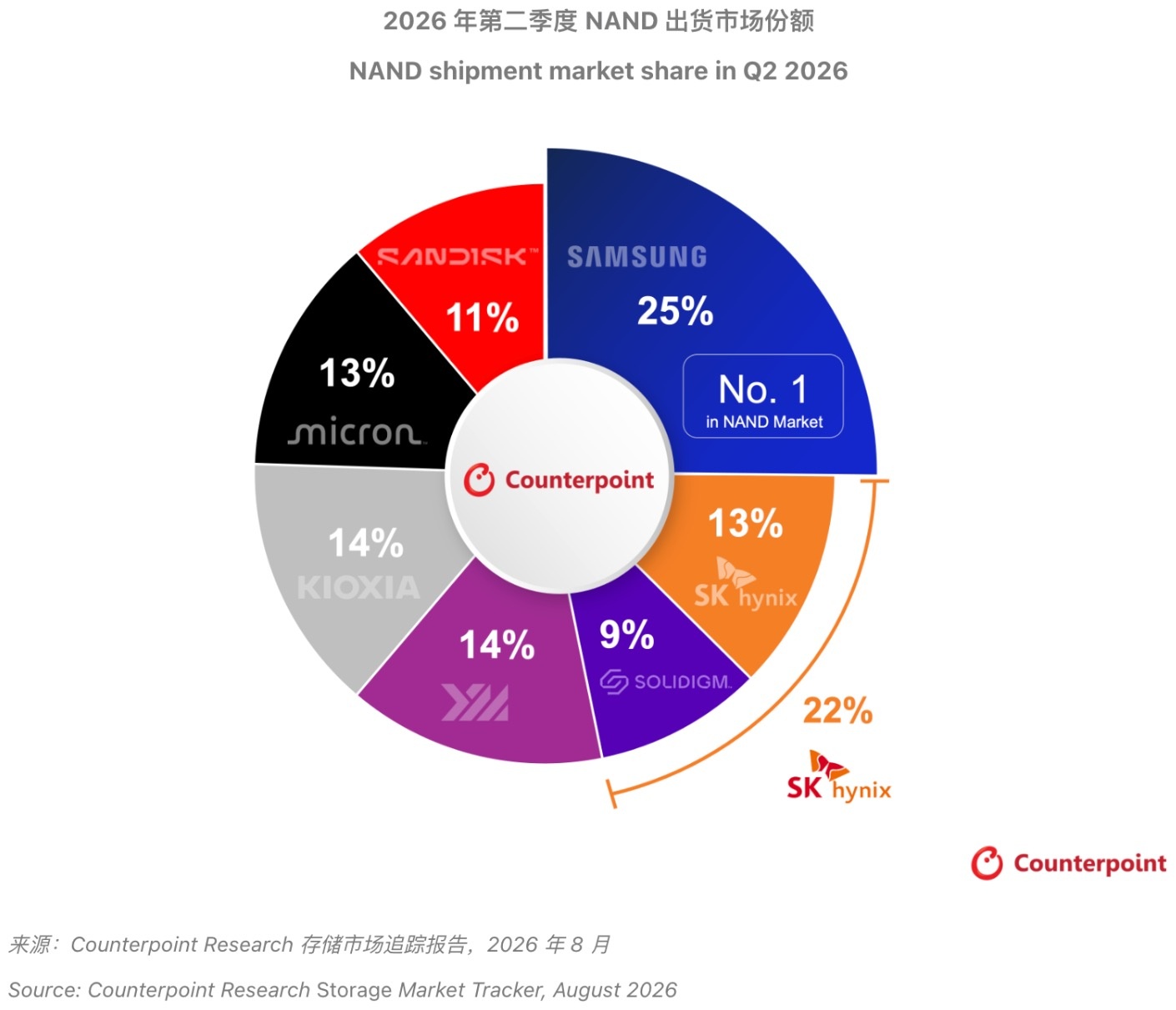
[Source: Counterpoint Research]
Bain Capital Exits as Kioxia No Longer Needs Merger
The essence of the 2023 round of negotiations was Bain Capital seeking an exit strategy for its 2018 acquisition of Kioxia. Whether through "Western Digital spinning off its flash memory business to merge with Kioxia" or the "holding company plus special dividend" plan, the core objective was for Bain Capital to cash out and exit.
However, this core driver has disappeared. By early July 2026, Bain Capital had completed its total divestment, reducing its stake from about 44% to zero and cashing out approximately $17 billion. With the most active seller at the negotiating table having departed, the remaining shareholders lack an urgent motivation to push for a merger.
Kioxia itself has likewise lost the desire for a merger. When Kioxia came to the negotiating table in 2023, it was in the depths of a NAND flash price collapse, suffering quarterly losses of hundreds of billions of yen, making a merger a means of survival. Today's Kioxia is entirely different: for the first fiscal quarter ended June 2026, Kioxia generated revenue of about 1.77 trillion yen (approx. $11.12 billion), up over 400% year-over-year, with net profit exceeding 800 billion yen.
On July 31, Kioxia announced a share buyback plan of up to 800 billion yen while preparing to issue American Depositary Receipts (ADRs) in the US. A company spending heavily on buybacks while planning an independent overseas listing sends a clear signal to the market: the value of independent development outweighs that of being merged.
SK Hynix Veto Power Remains Valid
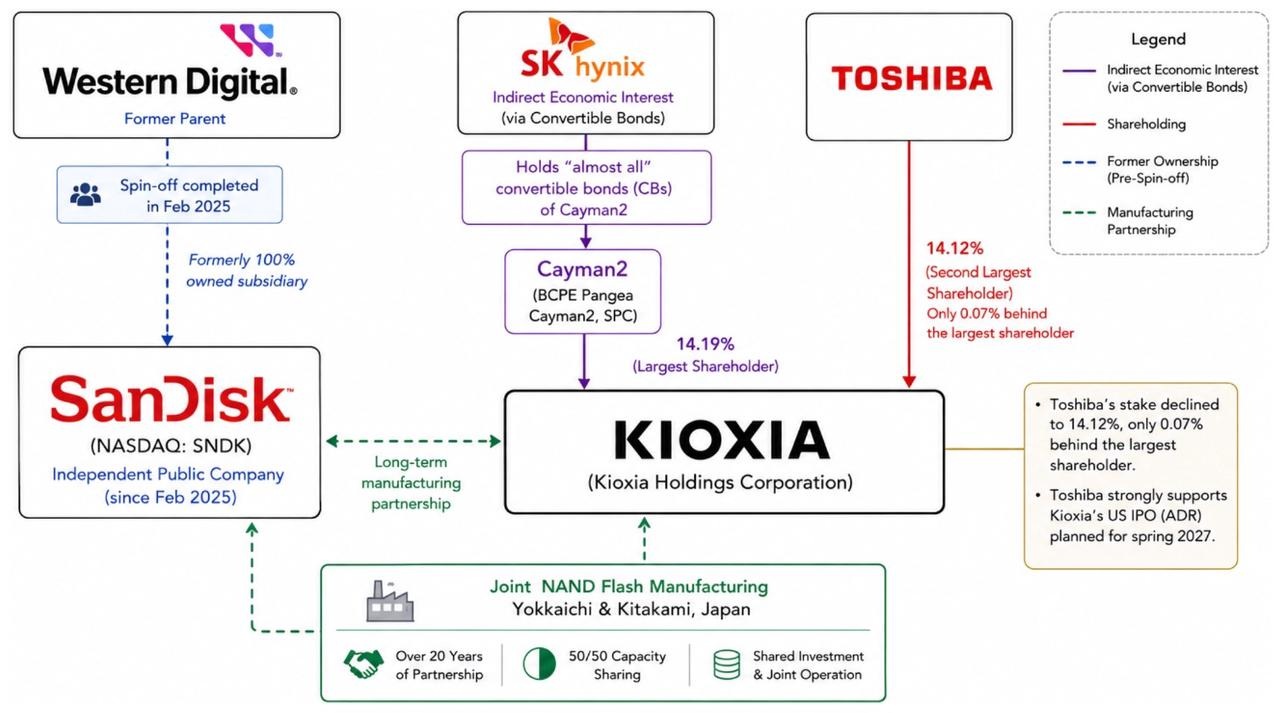
This was the direct reason for the breakdown of negotiations in 2023, which remains unchanged to this day. According to Kioxia's official statement, SK Hynix currently holds bonds convertible into "nearly all" voting rights of BCPE Pangea Cayman2, Kioxia's largest shareholder, giving it de facto consent rights over the merger.
The alignment of interests is clear: once Kioxia and Western Digital's flash memory businesses merge, the new entity's NAND market share will closely rival Samsung's, while SK Hynix would slip from second to third place in the industry. There is no reason to expect it to give its approval.
In addition, on August 3, SK Hynix and SanDisk jointly announced the HBF high-bandwidth flash memory standard, which was officially published by OCP. Supporting 8-layer and 16-layer stacking with a maximum single-chip capacity of 512GB, its read bandwidth upper limit reaches the HBM4 range, creating direct competition with Kioxia's positioning in the enterprise AI storage market.
With SK Hynix holding the triple role of competitor, indirect shareholder, and technology partner simultaneously, the already complex shareholding structure becomes even harder to untangle.
Valuation Gaps, Regulatory Hurdles and Peaking Industry Cycle Impede Merger Consensus
Under the 2023 merger proposal, Western Digital shareholders held 50.1% and Kioxia held 49.9%, a ratio that no longer serves as a basis for negotiations today. Kioxia went public at 1,455 yen per share at the end of 2024, with a total market capitalization equivalent to only about 850 billion yen at the time. Today, Kioxia's market capitalization is around 27 trillion yen, dozens of times higher than during those negotiations.
JPMorgan (JPM) lowered Kioxia's target price from 155,000 yen to 130,000 yen on August 10. With public market pricing already highly volatile, reaching a consensus on a moving target is extremely difficult for both sides.
Valuation is only the first obstacle. Western Digital spun off its flash memory business into an independent company, SanDisk, in February 2025, and it is actually SanDisk, rather than Western Digital itself, that co-owns the joint-venture fabs with Kioxia.
A merger would either mean a direct combination between Kioxia and SanDisk, two pure-play NAND manufacturers, which would inevitably face antitrust scrutiny; or Western Digital buying back SanDisk before merging, which would be equivalent to overturning its previous spinoff decision.
In addition, M&A in the chip industry historically occurs at the bottom of the cycle, whereas the market is currently at the top of the cycle. NAND prices have continued to rise since the fourth quarter of 2025, and AI-driven enterprise SSD demand has caused a supply shortage, which the market expects to persist through 2027.
Kioxia's NAND average selling price doubled quarter-over-quarter in the first quarter of 2026, and its guidance for the second fiscal quarter indicates further increases. In negotiations at the top of the cycle, buyers consider prices too high while sellers are reluctant to sell.
Summary
Rumors of a merger between Western Digital and Kioxia will likely resurface periodically in the future, with each instance potentially driving short-term stock price volatility. However, as long as SK Hynix retains its veto power and Kioxia maintains its commitment to independent development, this merger deal between Western Digital and Kioxia will most likely remain at the rumor stage.
This content was translated using AI and reviewed for clarity. It is for informational purposes only.
Recommended Articles






Comments (0)
Click the $ button, enter the symbol, and select to link a stock, ETF, or other ticker.