


Japanese and South Korean Stocks Diverge: Nikkei 225 Rises Nearly 2%, Kospi Falls 0.48% After 18.8% Third-Quarter Drop



AI Podcast


On September 30, Japanese and South Korean stock markets diverged, as the Nikkei 225 surged 1.94%, while the KOSPI edged down 0.48%. For the quarter ending September 30, South Korean equities suffered a notable 18.8% correction due to the concentrated unwinding of AI trades. This downturn heavily impacted semiconductor leaders Samsung Electronics and SK Hynix, whose valuations dropped to a forward P/E of 4x to 5x. Despite the contraction, these dominant firms represent roughly half of South Korea’s total market capitalization, highlighting localized valuation adjustments amid broader regional divergences.

TradingKey - On September 30, Japanese and South Korean stock markets diverged, with Japanese stocks strengthening significantly while South Korean equities edged lower. The Nikkei 225 Index closed up 1.94% at 66,753.50, while the Korea Composite Stock Price Index (KOSPI) closed down 0.48% at 6,838.05.
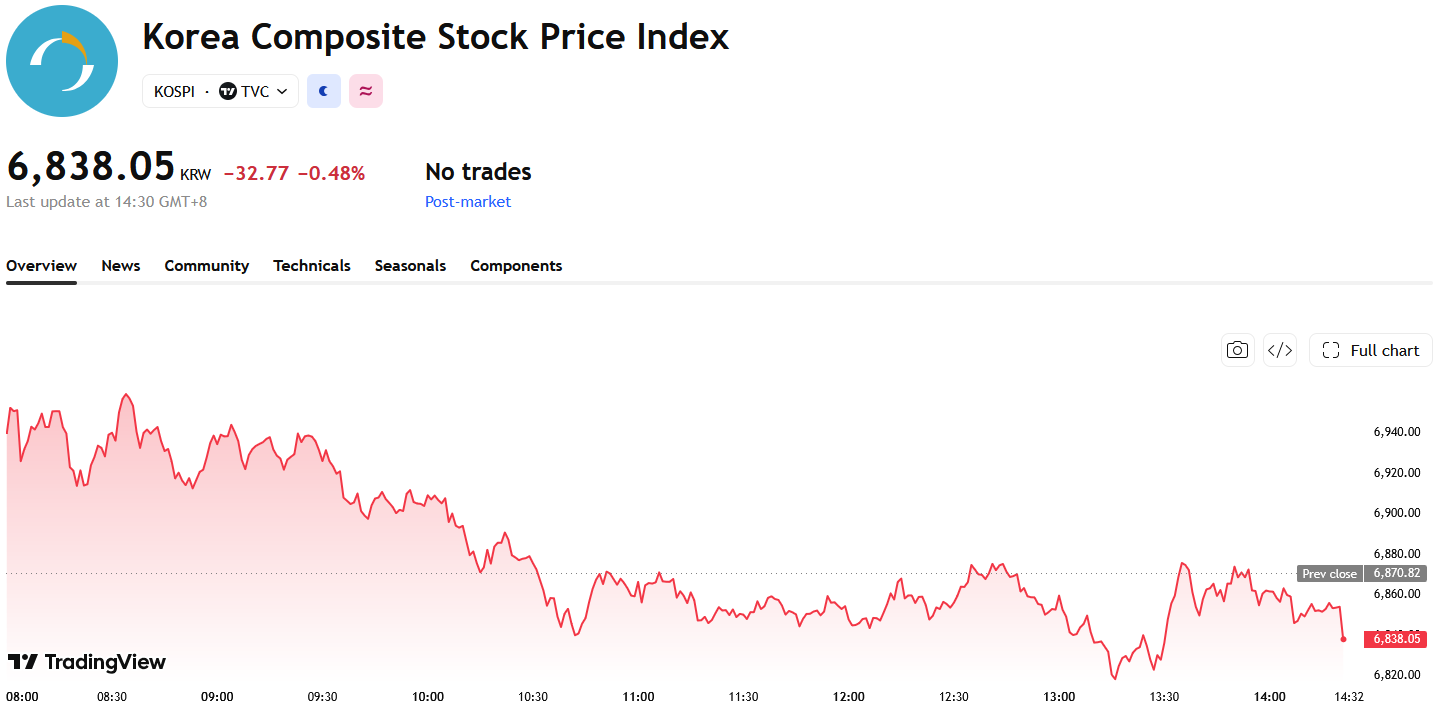
Source: TradingView
South Korean tech stocks ended mixed, with SK Hynix closing up 0.62% at 1.776 million won (approximately $1,312), while Samsung Electronics fell 1.47% to 268,500 won. In the Japanese market, Kioxia closed up 1.20% at 18,095 yen (approximately $115), and SoftBank Group surged 6.55% to 6,430 yen.
In terms of quarterly performance, the South Korean stock market underwent a notable correction. Over the three months ended September 30, the KOSPI accumulated a decline of 18.8%, making it one of the world's worst-performing stock markets in the third quarter. The AI trades, once highly sought-after earlier in the year, faced concentrated unwinding at the start of the quarter, leaving semiconductor leaders such as Samsung Electronics and SK Hynix among the most affected stocks.
Samsung Electronics and SK Hynix were previously viewed as key targets for positioning in the AI supply chain, with their combined market capitalization accounting for roughly half of the total market cap of South Korean equities. Following the stock price adjustments, their forward price-to-earnings ratios have now fallen back to around the 4x to 5x range, reflecting a significant contraction in overall South Korean market valuations compared with earlier levels.
This content was translated using AI and reviewed for clarity. It is for informational purposes only.
Recommended Articles








Comments (0)
Click the $ button, enter the symbol, and select to link a stock, ETF, or other ticker.