


Musk Says AI Traffic Surpassing Humans Is Beyond Doubt, but Burry Shorts Nvidia, Tesla and Other AI Stocks



On August 9, Eastern Time, Elon Musk forecasted that AI bot traffic will surpass human internet activity by May 2026, positioning Starlink as essential infrastructure. Conversely, Michael Burry is aggressively shorting AI-exposed firms, including Nvidia, Oracle, and Micron, citing concerns over opaque financing and unsustainable depreciation practices. Burry warns that current AI demand is driven by circular investment rather than end-user growth, potentially inflating book profits. As the S&P 500 reaches record highs, Burry cautions against a major market correction, highlighting a deep divide between bullish long-term technological projections and bearish structural valuations.
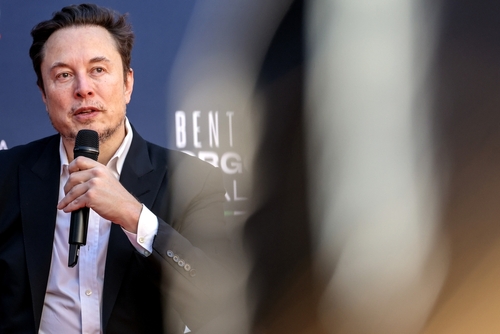
TradingKey - On August 9, Eastern Time, Elon Musk backed a prediction on social media platform X from network infrastructure giant Cloudflare (NET). According to the forecast data, in May 2026, internet traffic generated by AI bots crossed human traffic for the first time, a full 18 months ahead of the original prediction of late 2027.
Cloudflare expects that within five years, bot traffic will reach 1,000 times that of humans, and humans on the internet could be viewed almost as a "rounding error."
Musk wrote on X, "There is zero doubt that internet traffic generated by AI agents will far exceed human usage." He added that the only system capable of supporting the ultra-high-speed bandwidth growth required by AI is Starlink.
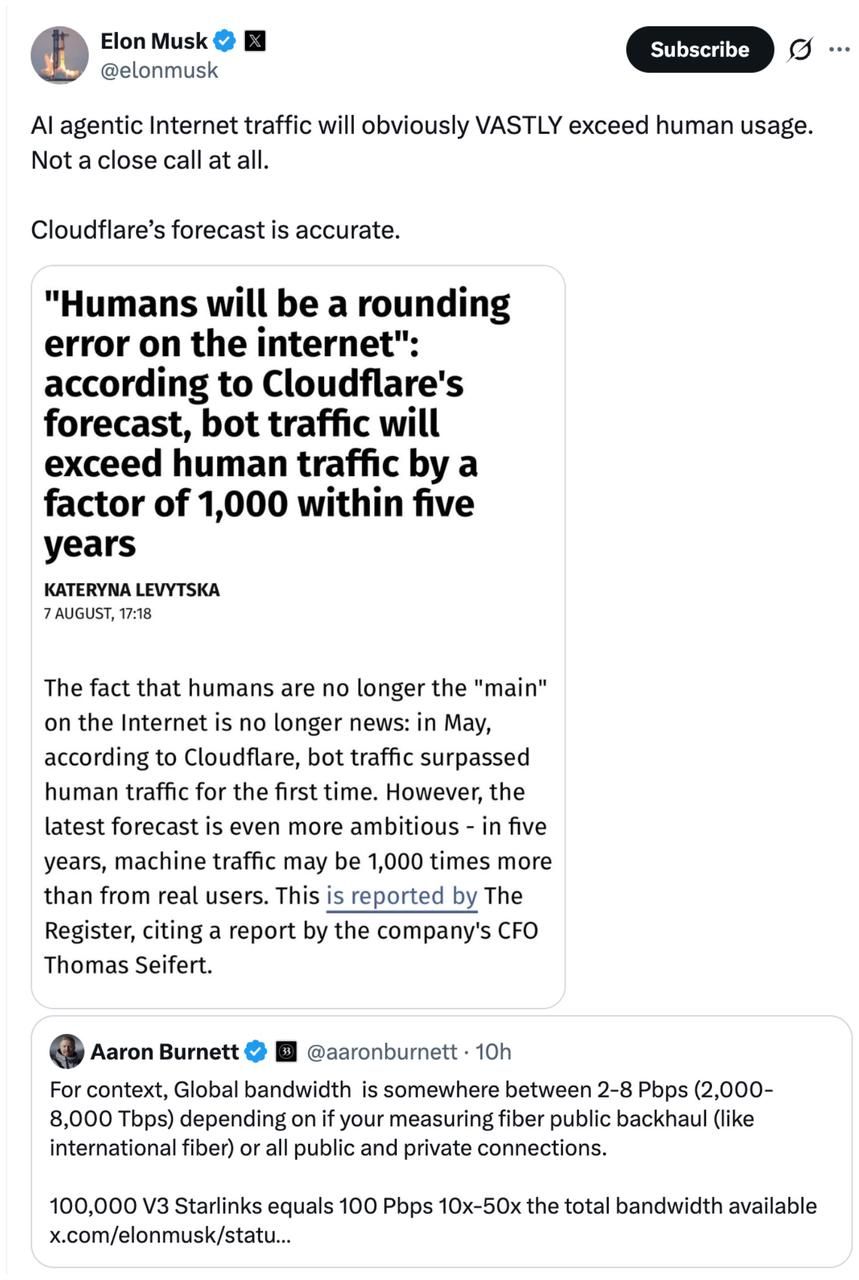
[Source: X]
In contrast to Musk's high-profile optimism is Michael Burry, the "Big Short" investor famous for accurately predicting the 2008 subprime mortgage crisis. Burry is betting with unprecedented force that the AI bubble will burst.
According to Burry's position disclosures on Substack, he maintains short positions in Nvidia (NVDA), Micron Technology (MU), Palantir (PLTR), Tesla (TSLA), Caterpillar (CAT), Applied Materials (AMAT), and the iShares Semiconductor ETF (SOXX). Among these seven short bets, all six except Nvidia are profitable.
Last week, Burry added two new short targets. He shorted Oracle (ORCL) at $144.63 and Nebius Group (NBIS) at $211.77. The latter has surged as much as 244% over the past year. Burry stated that because the implied volatility of Nebius put options exceeded 100% and was overpriced, he chose to short its stock directly.
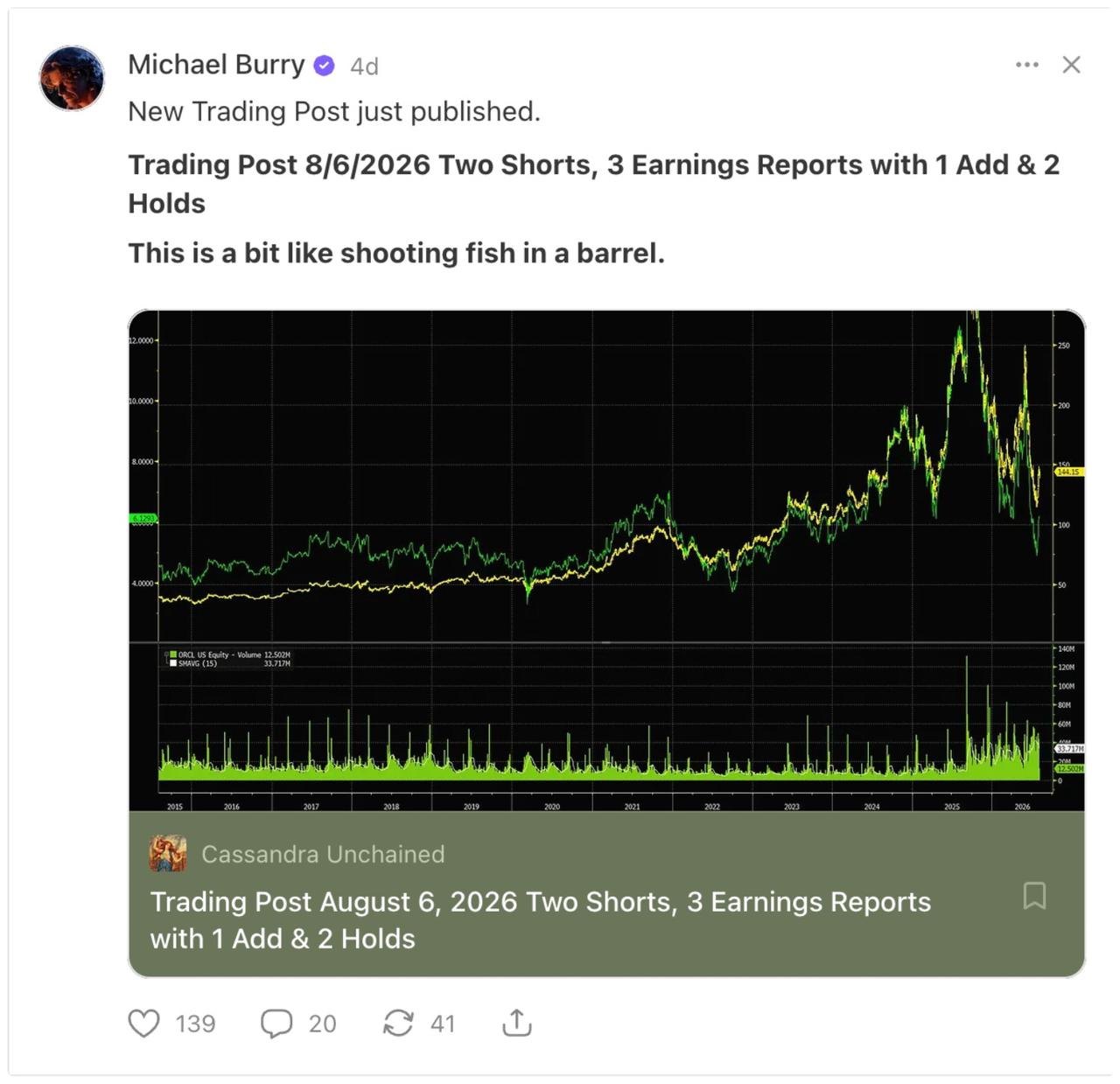
[Source: Substack]
Burry's assessment is that the heavy demand currently seen by AI chip giants is not driven by real end customers, but circularly driven through opaque off-balance-sheet financing arrangements. He warned that many cloud computing and AI infrastructure companies carry massive long-term lease debt, and once the supply-demand cycle reverses, these fixed costs will crush these businesses.
In addition, he pointed out that AI infrastructure companies may be under-provisioning GPU depreciation, making book profits appear higher than actual levels. Taking Oracle as an example, Burry estimates that by 2028, the company's earnings could be overstated by about 26% to 27%.
Burry also warned that after the S&P 500 Index hit a record high, the market may be approaching a "major top" and facing the risk of a sharp correction similar to 1987.
On one side, Musk strongly believes that AI traffic will far exceed human traffic, while on the other, Burry continues to increase his short positions against AI leaders. Musk's "zero doubt" clashes head-on with Burry's short-selling actions, and this bull-bear tug-of-war surrounding the future of AI will take time to decide a winner.
This content was translated using AI and reviewed for clarity. It is for informational purposes only.
Recommended Articles






Comments (0)
Click the $ button, enter the symbol, and select to link a stock, ETF, or other ticker.