


Palantir Surges 15% After Q2 Results Beat Estimates; Full-Year Guidance Raised on Strong AI Demand



AI Podcast


Palantir’s Q2 2026 results exceeded expectations, with revenue rising 93% year-over-year to $1.935 billion and GAAP net income reaching $1.062 billion. Growth was anchored by a 149% surge in U.S. commercial revenue, signaling a successful transition toward enterprise AI. By prioritizing "AI sovereignty," Palantir enables clients to deploy models while retaining data control, effectively differentiating itself from foundation model providers. Following these results, the company increased its full-year revenue guidance by approximately $500 million. Management maintains a bullish outlook, projecting sustained momentum as enterprise demand for operationalizing AI infrastructure continues to accelerate.
TradingKey - AI software company Palantir ( PLTR) once again delivered quarterly results that far exceeded market expectations. After the market closed on Monday Eastern Time, the company released its second-quarter 2026 financial report, with both revenue and earnings beating Wall Street expectations, and raised its full-year revenue forecast by nearly $500 million in one go.
Driven by the strong performance and optimistic outlook, Palantir's share price surged nearly 15% in after-hours trading.
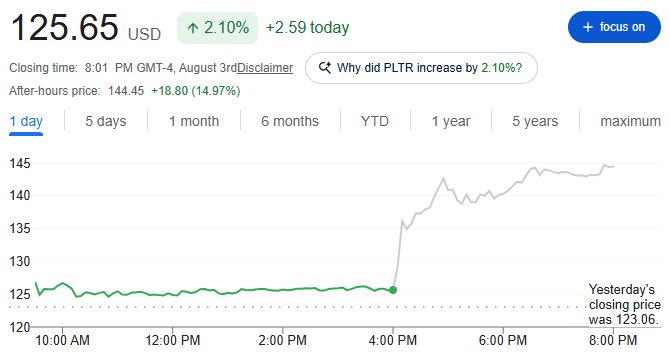
Source: Google Finance
Palantir CEO Alex Karp described this quarter as "beyond imagination" and stated that the company's business is expanding at an unprecedented pace.
Unlike in the past when it relied mainly on government contracts, its US commercial business became the strongest source of growth this quarter, showing that AI products like AIP are accelerating their adoption among large enterprises.
Earnings Beat Estimates as US Commercial Revenue Surges 149%
Palantir's second-quarter revenue reached $1.935 billion, up 93% year-over-year, exceeding analysts' expectations of approximately $1.8 billion; adjusted earnings per share was $0.41, also surpassing market expectations of $0.34 to $0.35.
The company's profitability also improved significantly. GAAP net income for the second quarter reached $1.062 billion, with diluted EPS of $0.41; GAAP operating income was $912 million, representing an operating margin of 47%. Adjusted operating income reached $1.194 billion, with the margin rising to 62%.
Cash flow performance was also strong. Operating cash flow for the quarter was $1.216 billion, and adjusted free cash flow reached $1.220 billion, both equivalent to 63% of revenue, marking the first time quarterly free cash flow has surpassed $1.0 billion.
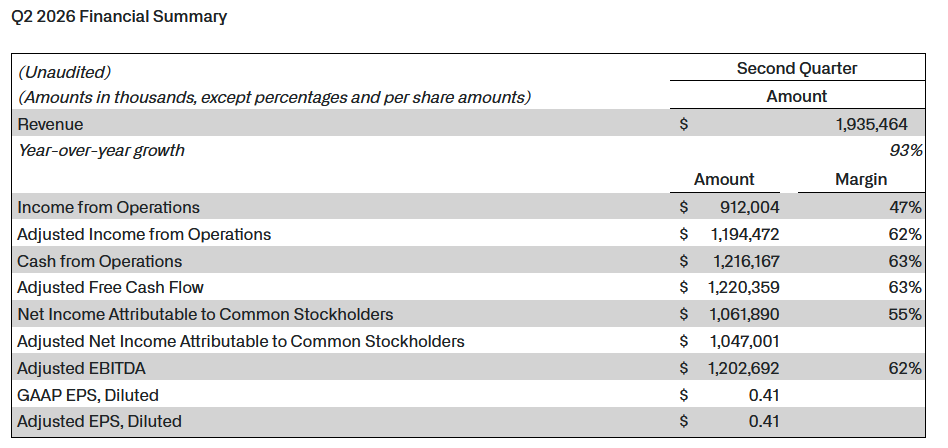
Source: Palantir
By segment, the U.S. commercial market remained the largest growth engine this quarter.
Its U.S. commercial revenue grew 149% year-over-year to $764 million, and rose 28% quarter-over-quarter, well above analysts' prior expectations of approximately $716 million. This indicates that the company is transitioning away from a business structure solely reliant on government and defense clients, gradually becoming a broader enterprise AI software provider.
Contract data further reflects the growth momentum of the commercial business. The total contract value signed by Palantir this quarter reached $3.373 billion, up 49% year-over-year; of this, U.S. commercial contract value hit a record high of $2.132 billion, up 153% year-over-year. As of the end of the quarter, the remaining contract value for U.S. commercial was $6.238 billion, up 124% year-over-year.
Palantir does not directly compete with companies like OpenAI and Anthropic on foundation models. Instead, through platforms like AIP, Foundry, and Apollo, it integrates models into customers' existing data, permissions, and business processes. This positioning enables the company to benefit from enterprise AI deployments while avoiding head-to-head competition with model developers.
The U.S. government business also maintained rapid growth, with second-quarter revenue increasing 90% year-over-year to $809 million. Defense, intelligence, and public safety agencies continued to expand their AI investments, driving ongoing demand for Gotham and related battlefield software. Combined U.S. commercial and government revenue reached $1.573 billion, up 115% year-over-year, now accounting for 81% of the company's total revenue.
Full-Year Revenue Guidance Raised by Nearly $500 Million
Even more closely watched by the market than the single-quarter results was Palantir once again significantly raising its full-year outlook.
The company now expects its 2026 revenue to be between $8.150 billion and $8.158 billion, up from the previous $7.650 billion to $7.662 billion, representing an upward revision of approximately $500 million to the midpoint of its forecast. Based on the new guidance, full-year revenue is expected to grow by approximately 82%.
Its forecast for US commercial revenue was also raised from the previous $3.224 billion to over $3.424 billion, representing an expected year-over-year growth of at least 134%. Management also raised the full-year adjusted operating income guidance to between $4.889 billion and $4.897 billion, and expects adjusted free cash flow to reach $4.5 billion to $4.7 billion.
For the third quarter, the company expects revenue to be between $2.160 billion and $2.164 billion, significantly higher than Wall Street's average estimate of approximately $2.0 billion; adjusted operating income is expected to reach $1.292 billion to $1.296 billion. Karp believes that the current strong growth momentum is likely to last for at least 18 months.
'AI Sovereignty' Becomes Palantir's Core Selling Point
Management attributed this quarter's growth to demand from enterprises and governments for "AI sovereignty"—namely, customers wanting to maintain control over their own data, models, and decision-making processes while using artificial intelligence.
Karp believes that some enterprises directly handing over their internal data and business knowledge to external model providers could turn their own competitive advantages into model training resources.
"What customers really want to protect is their own competitive advantage, rather than turning this value into data for others to train models," Karp said.
What Palantir provides instead is a software architecture capable of deploying and managing models within the customers' own environments, allowing enterprises to retain control over their data, permissions, and AI outputs.
This strategy also addresses market concerns that Palantir might be replaced by foundational model vendors. The company emphasized that improvements in model capabilities do not automatically translate into commercial value; enterprises still need data governance, access controls, systems integration, and operational workflows—which are precisely the strengths Palantir has accumulated over the long term.
Chief Technology Officer Shyam Sankar stated that the pace at which the current market is creating AI capabilities has already outpaced the speed of converting these capabilities into economic value. The role Palantir hopes to play is precisely to connect models with actual business outcomes, rather than generating revenue from model API calls or token consumption.
This content was translated using AI and reviewed for clarity. It is for informational purposes only.
Recommended Articles











Comments (0)
Click the $ button, enter the symbol, and select to link a stock, ETF, or other ticker.