


Marvell Falls Over 30% in Three Trading Days: Why Lumentum Acquisition Sparks Shareholder Concern



AI Podcast


Marvell Technology’s stock has declined approximately 28.5% since announcing its all-stock acquisition of Lumentum, which values Lumentum at roughly $115 billion. The transaction requires Marvell to issue new shares equal to about 49.3% of its original capital, raising market concerns over equity dilution and whether Lumentum's earnings—bolstered by recent price hikes—can justify the valuation. Although management projects over $1 billion in annual cost synergies and first-year EPS accretion, long-term execution risks, integration costs, and a completion timeline extending to the first half of 2028 continue to weigh on investor sentiment and share price stability.
TradingKey - From news of negotiations emerging after hours on October 28 to the official announcement of the acquisition of Lumentum (LITE), Marvell Technology (MRVL)'s stock price has remained under continuous pressure. As of press time, the company was trading at around $180, down roughly 28.5% cumulatively from its October 28 closing price.
This all-stock transaction gives Lumentum a reference enterprise value of approximately $115 billion. While the merger complements Marvell's optical interconnect product lineup, the market is more focused on whether the deal is worthwhile: Marvell needs to give up roughly one-third of the combined company's equity—can the resulting profits cover the equity expansion and compensate for the purchase price and integration risks?
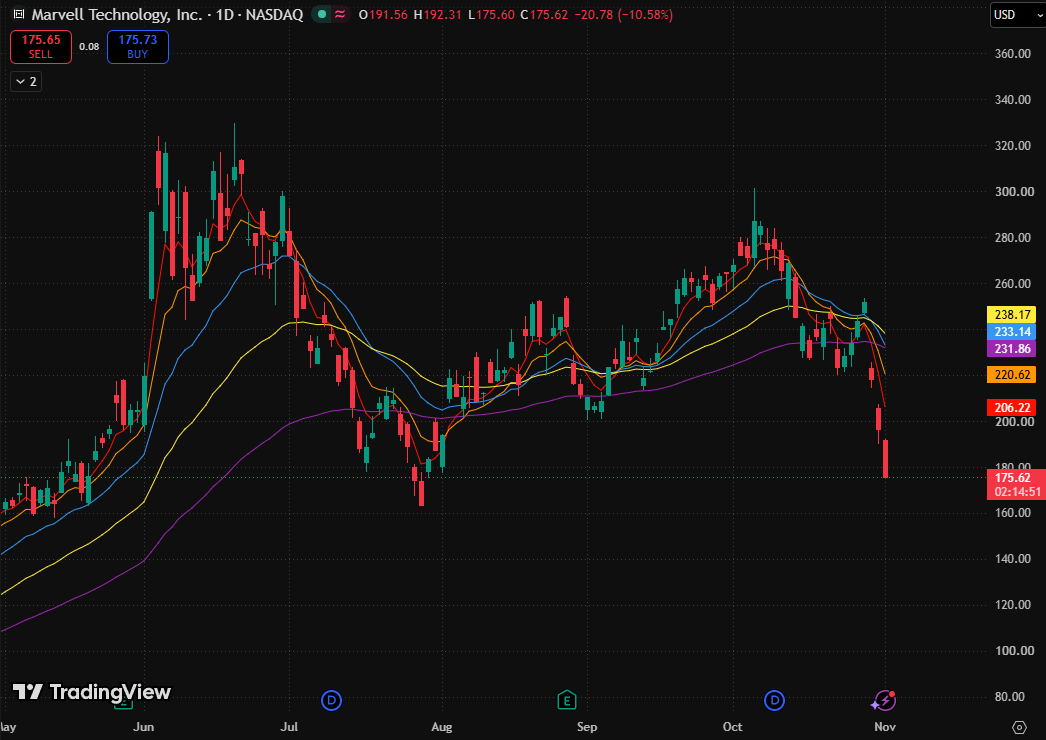
Marvell Technology stock chart, Source: TradingView
Marvell New Shares Approach 50% of Original Capital, Setting High Bar for Earnings Accretion
Under the agreement, upon completion of the transaction, legacy Marvell shareholders will hold approximately 67% of the combined company, while Lumentum shareholders will hold approximately 33%. Based on a simplified calculation from this ratio, Marvell will need to issue new shares equivalent to about 49.3% of its original share count.
This means that, on a like-for-like basis and all else being equal, the profit contributed by Lumentum plus net synergies needs to reach approximately 49.3% of Marvell's original profit to prevent earnings per share from declining. Only above this level will the merger deliver EPS growth.
Marvell expects the transaction to be accretive to adjusted earnings per share in the first year following completion, with the potential to achieve over $1 billion in annual cost synergies. This indicates that management believes the incremental earnings can cover the share capital expansion.
However, investors still need to assess whether this accretion is sufficient to compensate for the equity surrendered. If the incremental profit is only slightly above the dilution threshold, while integration expenses are substantial and earnings volatility increases, the transaction's appeal to legacy shareholders may remain limited. The pullback in the stock price may reflect the market's cautious stance toward the incremental value created by this swap.
Lumentum Surges 148% This Year as Marvell Faces Pressure From Pricey Acquisitions and Long-Term Execution
The controversy surrounding the acquisition price is tied to Lumentum's prior strong performance. Morningstar noted on October 29 that prior to the acquisition rumors, Lumentum's stock had already surged 148% year-to-date, trading about 22% above the firm's valuation. While Morningstar acknowledges the complementarity between its lasers and Marvell's optical interconnect chips, it expressed concern that Marvell might be overpaying.
Morningstar believes that Lumentum's earnings improvement partly stems from product price hikes and supply tightness. If the acquisition pricing extrapolates these currently elevated earnings levels over the long term, it risks overestimating future returns.
Once new capacity eases shortages and product prices retreat, profit growth could slow even if Lumentum's shipments continue to grow. At that point, the number of shares issued by Marvell under the fixed exchange ratio will not decrease, but the earnings contribution it acquires may fall short of expectations, thereby narrowing the scope for EPS accretion.
There is also a time lag before returns are realized. The transaction is expected to close in the first half of 2028, meaning that "accretion in the first full year after completion" corresponds to longer-term earnings. Cost synergies must be realized gradually post-integration, and integration investments during the process will consume cash. Investors will price these factors into current valuations, discounting returns that are further out and carry execution risks.
Declining stock prices in turn diminish the deal's appeal. The agreement stipulates that each Lumentum share will be exchanged for 4.5 Marvell shares. Based on Marvell's current closing price of $180, the implied consideration per share is $810, about 28.5% lower than the reference value of $1,132 at the time of the announcement.
For Lumentum shareholders, the decline in exchange value may weaken their motivation to support the transaction; for Marvell shareholders, the lower dollar consideration does not automatically reduce the number of shares issued. Both sides, therefore, need greater confidence that combined growth will outperform operating independently. The transaction remains subject to approval by shareholders of both companies and regulatory clearances, and a persistently weak stock price could make securing support more challenging.
The pressure this acquisition exerts on Marvell's stock price centers on the tension between a large equity exchange and earnings that have yet to materialize. While product complementarity provides a business rationale, supporting the acquisition price will still require the company to generate sufficient EPS and cash flow growth through customer expansion, product integration, and cost savings.
This content was translated using AI and reviewed for clarity. It is for informational purposes only.
Recommended Articles










Comments (0)
Click the $ button, enter the symbol, and select to link a stock, ETF, or other ticker.