


Nvidia’s OpenAI and SK Group Deals Fuel $750B ‘Circular Financing’ Debate,Why are Investors Concerned?



AI Podcast


Nvidia faces market scrutiny over a "circular financing" model, where its strategic investments and guarantees to AI partners—such as SK Group, OpenAI, and CoreWeave—facilitate the purchase of its own GPU chips. Critics argue this financial engineering masks underlying demand by creating a closed capital loop, potentially distorting market signals. While management defends these deals as necessary ecosystem development, investors remain cautious. The sustainability of this model hinges on AI revenue growth outpacing debt expansion. Failure to meet demand expectations could amplify systemic risks, as reflected in recent volatility and rising credit default swap spreads.
TradingKey - Nvidia ( NVDA) is advancing a new round of AI infrastructure deals with a total size that could exceed $750 billion, including a cooperation agreement of over $500 billion with South Korea's SK Group, as well as talks with OpenAI on lease guarantees of up to $250 billion. However, the market is concerned that this 'circular financing' model may be distorting the real demand in the AI industry.
What Is Revolving Financing?
In traditional finance, revolving financing refers to a loan business where a bank and an enterprise sign a one-time credit agreement, allowing the borrower to repeatedly draw down, repay tranche by tranche, and reuse the funds within specified terms and credit limits.
However, in the current AI investment boom, the market uses this term to describe a business model of Nvidia: AI companies invested in or partially owned by Nvidia are often also major customers of its GPU chips. Capital flows from Nvidia to the customers, who then in turn purchase Nvidia chips, thereby channeling the funds back to Nvidia.
Nvidia's recently advanced transactions are as follows:
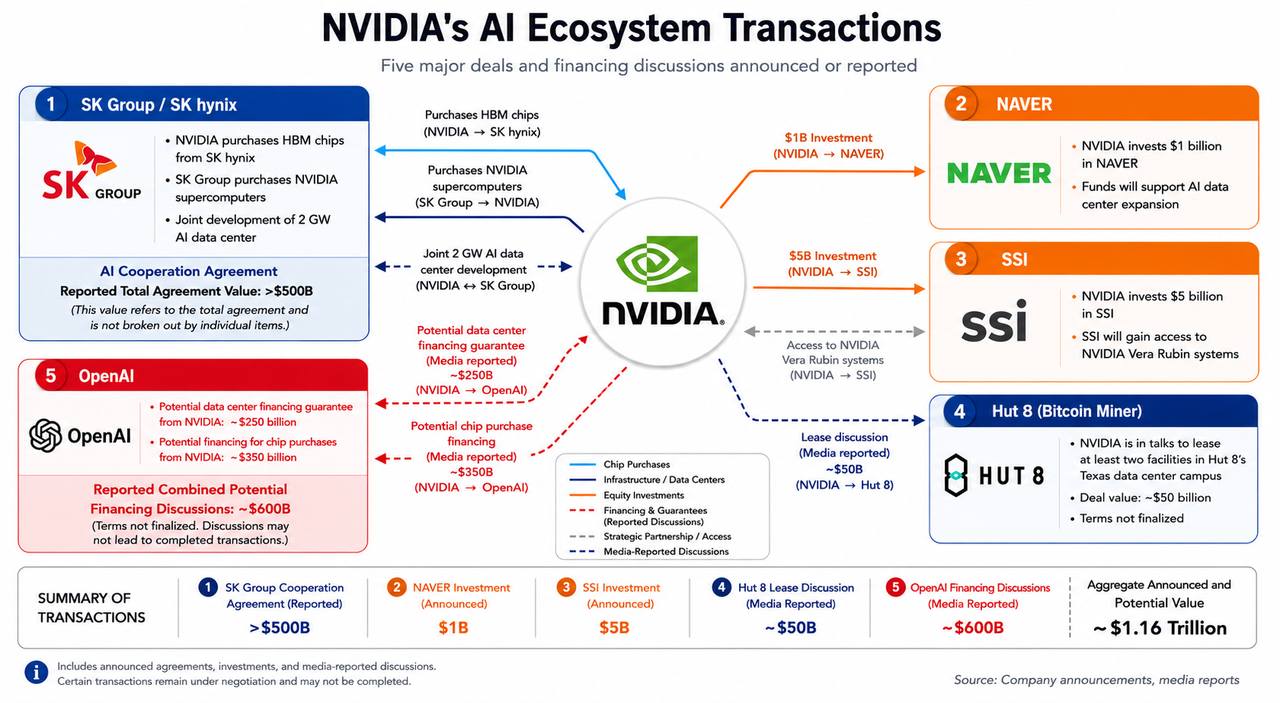
Nvidia's cooperation agreement with SK Group, valued at over $500 billion, has been officially announced, covering chip procurement, supercomputer delivery, and the co-construction of a 2 GW data center.
Nvidia is advancing two negotiations with OpenAI simultaneously: it plans to provide approximately $250 billion in guarantees for OpenAI's data center leases, while also discussing a financing arrangement of approximately $350 billion for chip procurement; currently, none of the terms have been finalized.
Nvidia is in talks with Bitcoin miner Hut 8, planning to invest approximately $50 billion in a 1.2 GW data center park project in Texas and lease part of its facilities.
Nvidia has invested $1 billion in South Korea's Naver to expand AI data centers and $5 billion in AI company SSI, with both investments having been confirmed.
In addition, Nvidia has previously invested in CoreWeave ( CRWV ), IREN ( IREN ), Nebius ( NBIS) and other data center operators, as well as Marvell ( MRVL) and other chip companies.
Is Nvidia’s ‘Circular Financing’ Financial Engineering?
Nvidia's 'circular financing' can be viewed as a form of 'Financial Engineering'.
Because the core of financial engineering is solving financial problems through innovative methods, and Nvidia is doing exactly this—providing funds to customers through financial means such as guarantees and investments, and then having those customers use the money to purchase its own chips, forming a closed capital loop. This is a classic model of utilizing financial tools (rather than technological breakthroughs) to drive business growth.
Therefore, the core concern of skeptics is that Nvidia's practice of tying customers with funding to drive chip sales could distort business decisions, create perverse incentives, and amplify industry losses if AI demand fails to meet expectations. Well-known short-seller Michael Burry has been expressing concern over these risks for several months.
Nvidia CEO Jensen Huang responded that the company's investments account for only a small fraction of customers' total financing and are expected to generate actual returns.
Gary Tan, portfolio manager at Allspring Global Investments, said: "Nvidia's investments and partnerships have reinforced market confidence in the long-term AI buildout, but concerns over circular financing have not dissipated, and capital is increasingly being used to cultivate future AI customers and deploy infrastructure."
The core of the disagreement between the two sides lies in differing expectations regarding the sustainability of AI demand. Until that demand materializes, this debate is unlikely to subside.
Why Is the Market Suddenly Panicking?
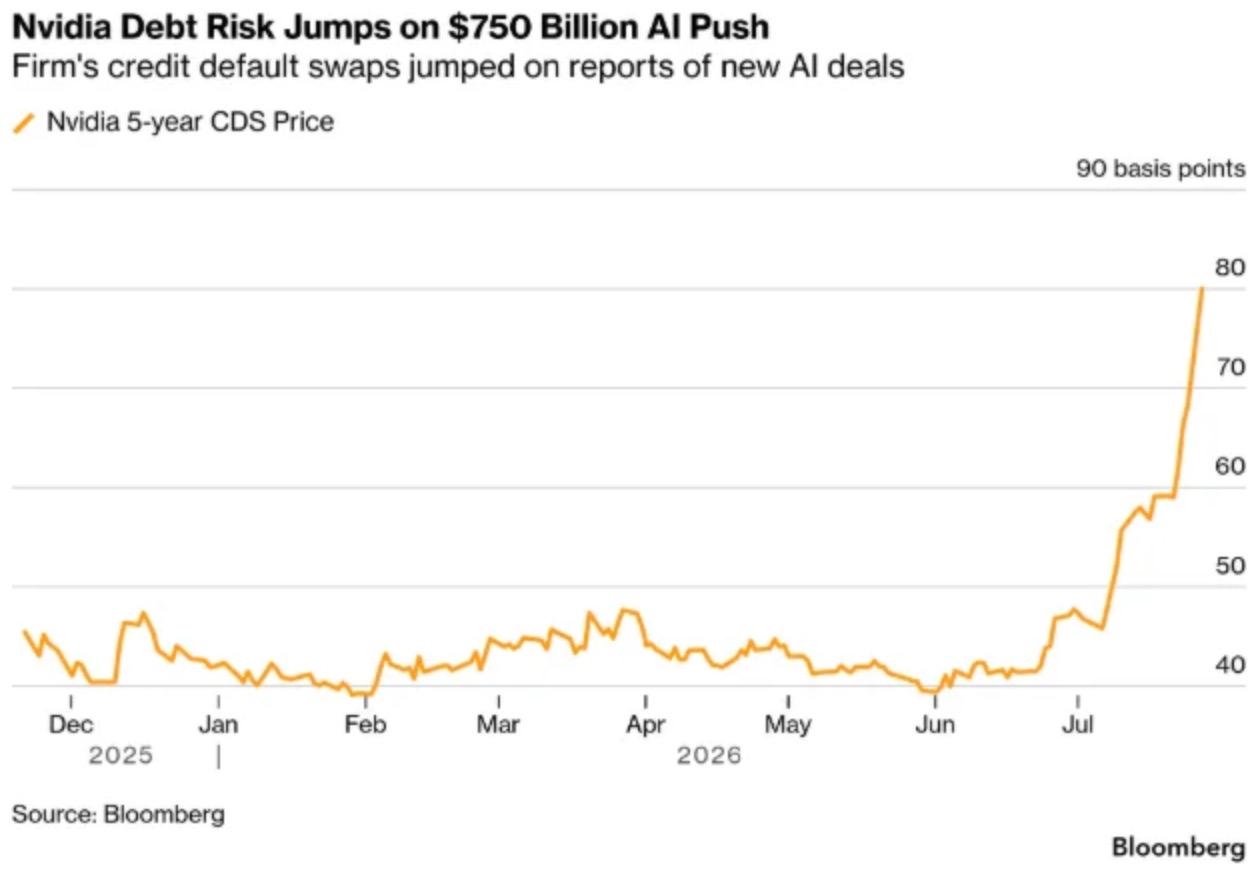
On July 27 Eastern Time, Nvidia's stock plummeted 5%, and its market capitalization was surpassed by Apple ( AAPL ). The company's five-year credit default swap (CDS) surged by as much as 14 basis points to 82 basis points on the day, marking its largest intraday increase on record.
[Source: Wallstreetcn, Bloomberg]
CoreWeave is the most typical case in this model: Nvidia made a strategic investment in CoreWeave, which in turn purchased a large volume of Nvidia chips to build data centers, carrying $24.9 billion in debt, and the upstream supplier that spawned this debt is none other than Nvidia.
Analysts believe that the core condition for this model to hold is that the growth rate of AI business revenue continuously outpaces the rate of debt expansion. Once earnings growth fails to keep pace with debt expansion, risks will be unleashed in a concentrated manner.
Jensen Huang firmly denied the allegations of 'circular financing,' emphasizing that they are 'simply ridiculous.' However, as Nvidia becomes deeply embedded in the upstream and downstream of the AI ecosystem, its multiple roles as a chip seller, equity investor, and financing guarantor are increasingly intertwined. Market concerns about the vulnerability of this model under a demand-slowdown scenario have yet to dissipate.
This content was translated using AI and reviewed for clarity. It is for informational purposes only.
Recommended Articles






Comments (0)
Click the $ button, enter the symbol, and select to link a stock, ETF, or other ticker.