


Micron Shares Fall 30% From June High: Is the AI Memory Supercycle Over?



AI Podcast


Micron Technology stock has corrected roughly 30% from its June peak despite robust fundamentals, as elevated market expectations and intensifying competition weigh on sentiment. While HBM demand and financial results remain strong, investors are concerned about potential supply-demand imbalances, increased capital expenditures, and the entry of new competitors like CXMT. The stock’s technical indicators, including a breach of the 50-day moving average and sustained downward momentum, suggest that selling pressure persists. Future stability depends on the company maintaining margins amidst capacity expansion and the sustainability of AI-driven capital spending by major cloud providers.

TradingKey - After experiencing a significant rally for nearly a year, Micron Technology ( MU )'s stock price has recently entered a high-level correction phase.
As of July 28, Micron's stock price closed at $820, falling back about 30% from its historic high set in late June.
Notably, Micron's latest earnings report did not reflect a significant cooling in AI demand. On the contrary, the company's HBM products continued to ramp up, its data center business maintained rapid growth, and both its financial results and future guidance exceeded market expectations.
What has truly made investors cautious is that the stock price had already priced in the high growth expectations brought by AI. As competition intensifies and capital expenditures continue to climb, the market has begun to re-evaluate Micron's profitability and valuation levels over the next few years.
Why Micron Stock Is Pulling Back From Record Highs
Over the past year, rapid growth in demand for HBM, DDR5, and data center SSDs from AI servers has driven the company's revenue, margins, and stock price upward in tandem. With market expectations already highly optimistic, even if fundamentals remain strong, the stock price is susceptible to a pullback as capital locks in profits.
Meanwhile, the listing of ChangXin Memory Technologies (CXMT) has further amplified competitive concerns. As the world's fourth-largest DRAM manufacturer, CXMT may accelerate technology R&D and capacity expansion after securing more financing. Although it remains difficult for CXMT to replace Micron Technology in the high-end HBM market in the short term, an increase in the supply of conventional DRAM could weaken the industry's long-term pricing power.
In addition, the listing of SK Hynix ADRs in the US market has also led to a diversion of funds.
In the past, Micron Technology was the primary choice for US investors allocating to major memory chip companies. Today, investors can more easily buy SK Hynix, which holds a leading position in the HBM market, thereby impacting Micron's historical scarcity premium.
Now, the market is starting to focus on the returns on AI capital expenditures by tech giants. If cloud service providers cannot translate data center investments into sufficient revenue, the growth rate of server and AI chip procurement may slow down in the future. As a highly sensitive stock in the AI infrastructure supply chain, Micron Technology is particularly vulnerable to such shifts in expectations.
Why Strong Earnings Failed to Stop Micron’s Stock Drop?
From a fundamental perspective, Micron's latest financial results remain strong. In the third quarter of fiscal 2026, the company's revenue reached $41.46 billion, GAAP net income was $28.24 billion, and the overall gross margin rose to 84.6%. Micron expects fourth-quarter revenue to be approximately $50 billion, with a gross margin of around 86%.
The company also stated that HBM4 has already shipped in volume to major customer platforms, and HBM4E is scheduled for mass production in 2027. This indicates that demand for high-bandwidth memory from AI servers remains robust.
However, stock prices trade on future expectations rather than already-reported results. Micron's current near-record-high gross margin is largely driven by tight memory supply and rising product prices. Investors worry that as Micron, SK Hynix, Samsung, and ChangXin Memory Technologies expand capacity, the future supply-demand dynamic may gradually loosen.
Micron plans to increase its investment in the U.S. to more than $250 billion by 2035, with a long-term goal of producing approximately 40% of its DRAM in the U.S. While this helps strengthen the domestic supply chain, it also means higher capital expenditures and depreciation pressures. If memory prices fall when the new capacity comes online, Micron's profitability could suffer a dual impact.
Therefore, the decline in Micron's stock price is not due to poor current performance, but rather because the market is starting to question how long such strong pricing, margins, and growth rates can be sustained.
When Might Micron’s Stock Stabilize?
Source: TradingView
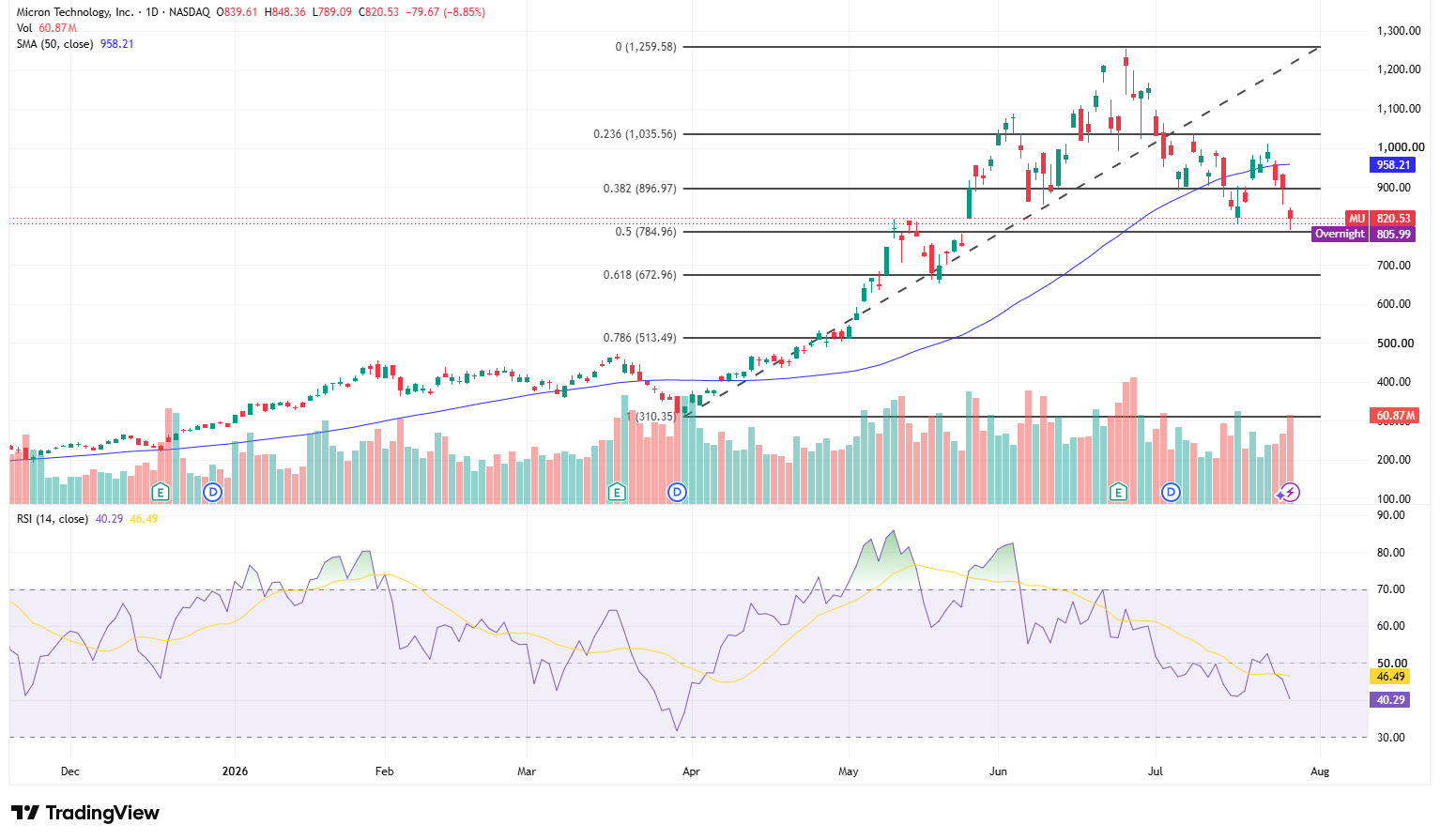
Looking at the daily chart, Micron's stock price continued to rise after touching a temporary low of $310 at the end of March, reaching an all-time high at the end of June. However, after peaking, the stock price consecutively formed lower highs and lower lows. Recently, it not only broke below the previous upward trendline but also lost its 50-day moving average of 958.21, indicating that the medium-to-short-term trend has shifted from an uptrend to a correction.
As of July 28, Micron's stock price plunged 8.85% to close at $820.53, touching an intraday low of $789.09, with volume rising to 60.87 million shares. The drop on heavy volume indicates a significant increase in market selling pressure. Meanwhile, the stock price has fallen below the 38.2% Fibonacci retracement level of $896.97, suggesting that the previous support around 900 has failed and short-term bears still hold the upper hand.
However, it is not yet possible to confirm that the stock price has stabilized. The RSI has dropped to 40.29, below its signal line of 46.49 and also below the 50 neutral threshold, reflecting that downward momentum is still ongoing. Since the RSI has not yet entered the oversold territory below 30, nor has it formed a clear bullish divergence, this suggests that selling pressure may not have been fully released.
Going forward, if the stock price can hold $785 and exhibit shrinking volume, long lower shadows, or a bullish engulfing pattern during the pullback, while the RSI stops making new lows, Micron may first consolidate and form a bottom between $785 and $850. In the short term, a move back above $850 would suggest that selling pressure has eased, and only a further recovery of $896.97 would initially confirm a temporary stabilization.
This content was translated using AI and reviewed for clarity. It is for informational purposes only.
Recommended Articles











Comments (0)
Click the $ button, enter the symbol, and select to link a stock, ETF, or other ticker.