


Nvidia Stock Price Forecast: Drops Below $190 to 7-Month Low, Could Plunge Over 10% Further



AI Podcast


On November 5 ET, Nvidia shares tumbled 9.26% to close at $181.60, marking a nearly seven-month low and a 25% drop from its record high. This valuation contraction stems from multiple headwinds, including tech giants' CapEx ROI concerns, customer credit risks, surging supply chain costs, and macroeconomic shifts. Technically, the stock is in a bearish setup following a head-and-shoulders breakdown. While support between $175.00 and $180.00 could halt near-term downward momentum, a decisive break below $175 risks triggering a further 10% to 12% decline toward the $160.00–$165.00 range.
TradingKey - Nvidia shares break down and plunge to a nearly seven-month low, with over 10% further downside on watch.
On November 5 ET, Nvidia (NVDA) shares continued to weaken after the open and ultimately tumbled 9.26%, decisively breaking below the $190 mark to close at $181.60. This price not only marks its lowest level since April 2026, but also represents a drop of more than 25% from its record high of $243.37.
Nvidia's stock has drifted steadily lower since reaching its peak on October 5, 2026. This nearly month-long valuation contraction was not driven by a single event, but rather by the confluence of multiple headwinds: doubts over tech giants' CapEx return on investment, customer credit risk exposures, surging supply chain costs, macroeconomic and political shifts, and technical breakdowns in market positioning.
In early October, as NVDA's share price approached $240 with its forward P/E at elevated levels, the stock retreated amid risk-off market sentiment. After breaking below $210 and the 50-day moving average, the technical chart confirmed a breakdown from a massive head-and-shoulders top. Market makers were forced into hedging-related selling in the congested $190–$200 zone, triggering a seven-day losing streak and a heavy-volume plunge.
In mid-October, CoreWeave, a computing power leasing giant heavily reliant on Nvidia GPUs, saw its shares plunge over 15%, alerting the market that a portion of AI chip demand was backed by highly leveraged debt. In fact, market reports revealed that Nvidia had committed to an astonishing volume of data center-related guarantees and obligations, sparking institutional concerns over circular financing risks between Nvidia and its customers.
In late October, as tech giants reported earnings, Alphabet and Amazon (AMZN) saw their free cash flow come under significant pressure due to soaring AI data center CapEx. Subsequently, Wall Street began questioning the sustainability of hyperscalers' massive procurement of Nvidia's Blackwell / Rubin chips. Meanwhile, Japan's Kioxia issued a warning over softening NAND flash demand, and rising global memory chip prices directly compressed gross margins for server assembly.
On November 3, 2026, U.S. midterm election results confirmed that Democrats retook the House of Representatives and secured control of the Senate. Markets grew concerned that the new Congress would tighten energy consumption limits on hyperscale data centers, impose green carbon taxes, and hold antitrust hearings—directly driving up the marginal operating costs of building AI infrastructure and accelerating the slide in Nvidia's stock.
From a technical chart and market positioning perspective, Nvidia is currently in a bearish setup following a breakdown from a major swing head-and-shoulders top as it seeks support at its annual moving average. If NVDA can attract strong spot buying support between $175.00 and $180.00, the downward momentum will be halted in the short term, giving the stock an opportunity to build a range-bound base and stage a recovery.
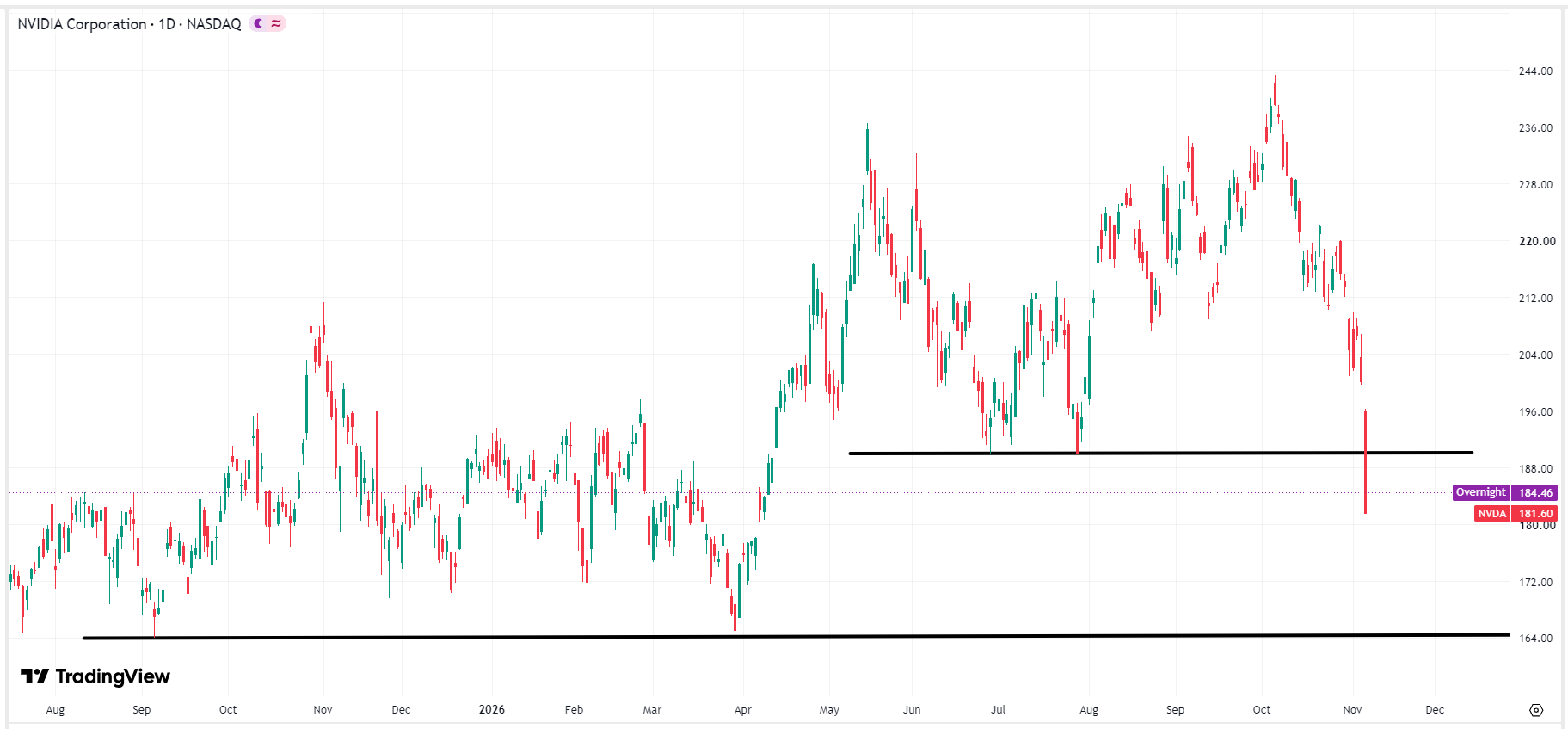 Nvidia stock chart, Source: TradingView
However, if post-election panic across U.S. tech stocks intensifies further, causing NVDA to break decisively below $175, the technical outlook will confirm a swing 1:1 measured move to the downside, and the stock will face a secondary leg down of roughly 10%–12%, targeting $160.00–$165.00.
This content was translated using AI and reviewed for clarity. It is for informational purposes only.
Recommended Articles










Comments (0)
Click the $ button, enter the symbol, and select to link a stock, ETF, or other ticker.