


Micron, SanDisk, AMD, Nvidia Jump Pre-Market but July Chip Stocks Set for Worst Month Since 2002



AI Podcast


Before the market open on July 31 EST, the semiconductor sector saw a sharp technical rebound, led by Micron, SanDisk, and Nvidia, driven by end-of-month fund inflows and improved AI demand outlooks. Microsoft’s robust infrastructure spending and sustained tight supply for memory chips have alleviated growth concerns. Despite this, the sector remains on track for its worst monthly performance since 2002, with significant corrections in memory stocks. Investors are now closely monitoring upcoming tech capital expenditure and memory pricing to determine if this dip-buying marks a recovery or if further volatility persists amid ongoing valuation reassessments.
TradingKey - Before the market open on July 31 EST, the US semiconductor sector staged a sharp rebound, with Micron Technology ( MU ), SanDisk ( SNDK ), SK Hynix ADR ( SKH Y), Nvidia ( NVDA ), AMD ( AMD) and Intel ( INTC) rallying across the board. However, despite the technical recovery in chip stocks driven by end-of-month fund inflows, the overall semiconductor sector is still on track to record its worst monthly performance since 2002 in July, indicating that market sentiment toward the AI supply chain has not yet fully recovered.
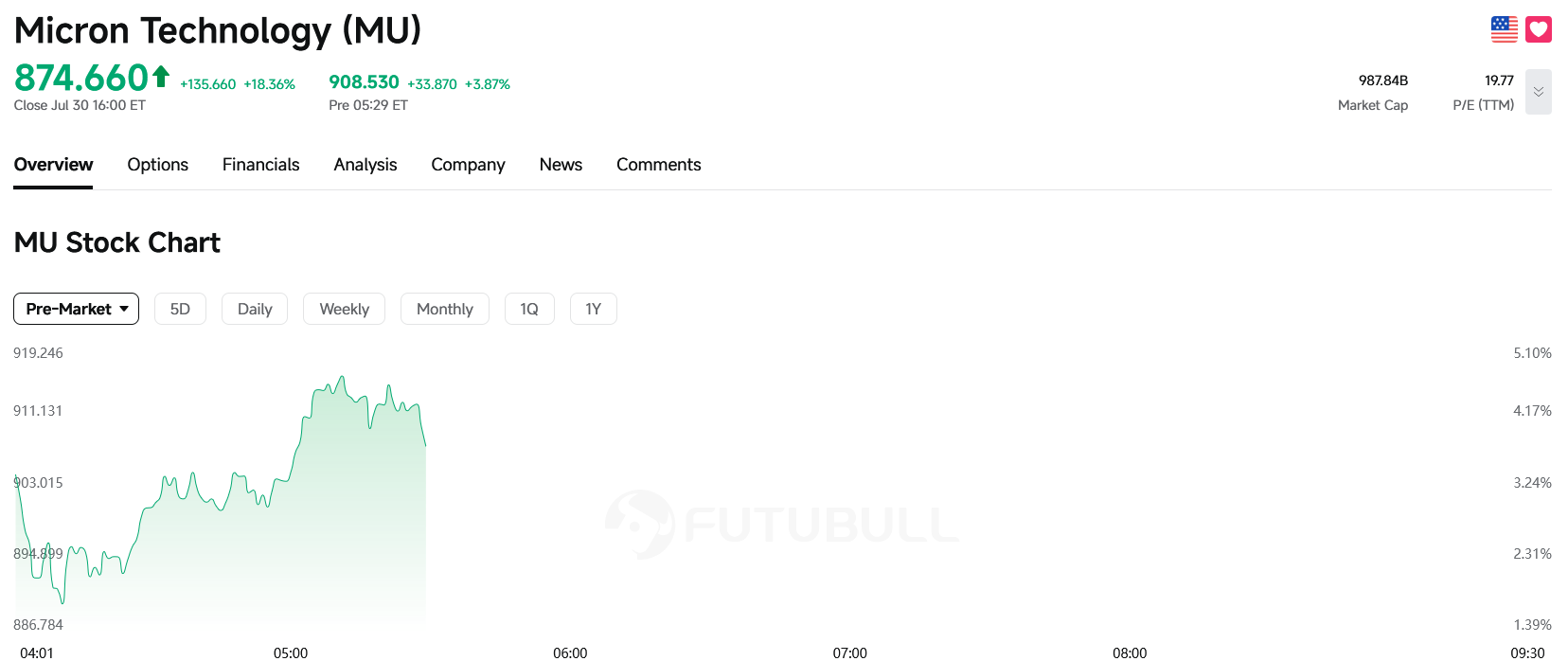
Micron's pre-market stock price chart, Source: FUTUBULL
In pre-market trading, the memory chip sector led the market, with Micron up over 4%, SanDisk up over 5%, SK Hynix ADR up over 7%, Nvidia up about 2%, AMD up over 4%, and Intel up over 6%. Market analysis suggests that after a continuous correction this month, many investors chose to reposition at the end of the month in AI and memory chip leaders whose valuations have dropped significantly, driving a notable rebound in the sector.
The catalyst for this rebound mainly came from improved expectations for AI demand. Microsoft's latest earnings report again raised its AI infrastructure investment plans, further easing market concerns that cloud computing giants might cut capital expenditure. Meanwhile, Samsung Electronics expects that the tight supply-demand situation for memory chips could last until 2028, and Japan's Kioxia expects NAND flash prices to continue rising in the second fiscal quarter, further strengthening market expectations for sustained strength in HBM, DRAM, and NAND prices. Investors believe that as long as global cloud service providers continue to expand AI data center construction, the profitability cycle of the memory chip industry is still expected to persist.
However, looking at the overall monthly performance, the semiconductor sector has yet to truly break free from its correction. The Philadelphia Semiconductor Index's cumulative decline in July is expected to approach 20%, on track to post its worst single-month performance since 2002. The memory sector's decline was particularly pronounced, with Micron's cumulative drop this month once approaching 30% and SanDisk's cumulative decline exceeding 40%, both marking their largest monthly corrections in recent years. In contrast, Nvidia's performance remained relatively resilient thanks to its leading position in AI GPUs, with its monthly decline being significantly smaller than that of most chip stocks. The market believes this round of correction was mainly driven by profit-taking, intensifying competition in China's memory industry, and investors reassessing AI hardware valuations, rather than a significant deterioration in AI demand.
Analysts pointed out that if US stocks can sustain their pre-market gains tonight, the monthly candlestick of chip stocks is expected to leave a long lower shadow, indicating that funds buying on dips are increasing. But in the short term, the market will remain focused on the capital expenditure plans of tech giants such as Amazon, as well as the price trends of HBM and NAND, to determine whether the semiconductor sector can end this round of correction and kickstart a new AI rally.
This content was translated using AI and reviewed for clarity. It is for informational purposes only.
Recommended Articles









Comments (0)
Click the $ button, enter the symbol, and select to link a stock, ETF, or other ticker.