


SpaceX Supply Chain De-China Push Analyzed Amid Defense Compliance, Stock Impact



AI Podcast


SpaceX’s strategic move to divest Chinese personnel and equipment aims to ensure U.S. defense compliance, securing its position for exclusive military contracts. While this strengthens the company’s long-term competitive moat and valuation foundation, the resulting surge in capital expenditures for supply chain reconfiguration is expected to pressure operating and gross margins. Consequently, these increased costs, combined with recent market volatility, may hinder a near-term stock price recovery. Investors should anticipate continued range-bound trading as the company navigates this costly transition and prioritizes defense-qualified operations over short-term profitability.
TradingKey - SpaceX's demand that its supply chain remove Chinese employees or equipment will help it secure defense orders, but it will increase operating costs, which is unfavorable for a short-term rebound in its stock price.
On July 30, according to a Nikkei Asia report, Elon Musk's space exploration company SpaceX ( SPCX) has requested its global supply chain to "de-China" by not hiring Chinese employees and not using equipment from Chinese companies to meet U.S. defense compliance requirements. As of press time, SpaceX was up 0.34% in pre-market trading, temporarily trading at $112.93.
It is reported that U.S. defense compliance requires that key military supply chains must not contain raw materials, electronic components, and manufacturing equipment from countries such as China and Russia. If the supply chain involves Chinese employees or Chinese-funded manufacturing equipment, it will face extremely high compliance penalties and could even be stripped of its defense supplier qualification. Yesterday, SpaceX just announced that it had won a $1.6 billion "Falcon 9" rocket launch contract from the U.S. Space Force.
SpaceX's pursuit of a fully compliant, defense-qualified supply chain ensures it has no worries when bidding for exclusive military satellites and launch contracts from the U.S. military and intelligence agencies, greatly consolidating the foundation of its high valuation. However, SpaceX's requirement to divest Chinese personnel, equipment, and other resources may require expanding non-Chinese production lines in other countries to meet this demand. The increased capital expenditures during the initial stage of factory construction and the capacity ramp-up phase may depress its operating and gross profit margins, which is unfavorable for a rebound in its stock price.
Since surging to a high on June 16, SpaceX's stock price has continued to decline, falling to a low of $107.01 on July 28, a 52% drop from its peak of $225.64. This week, SpaceX's stock price has been trading between $107 and $120, and is expected to continue its narrow range-bound trend.
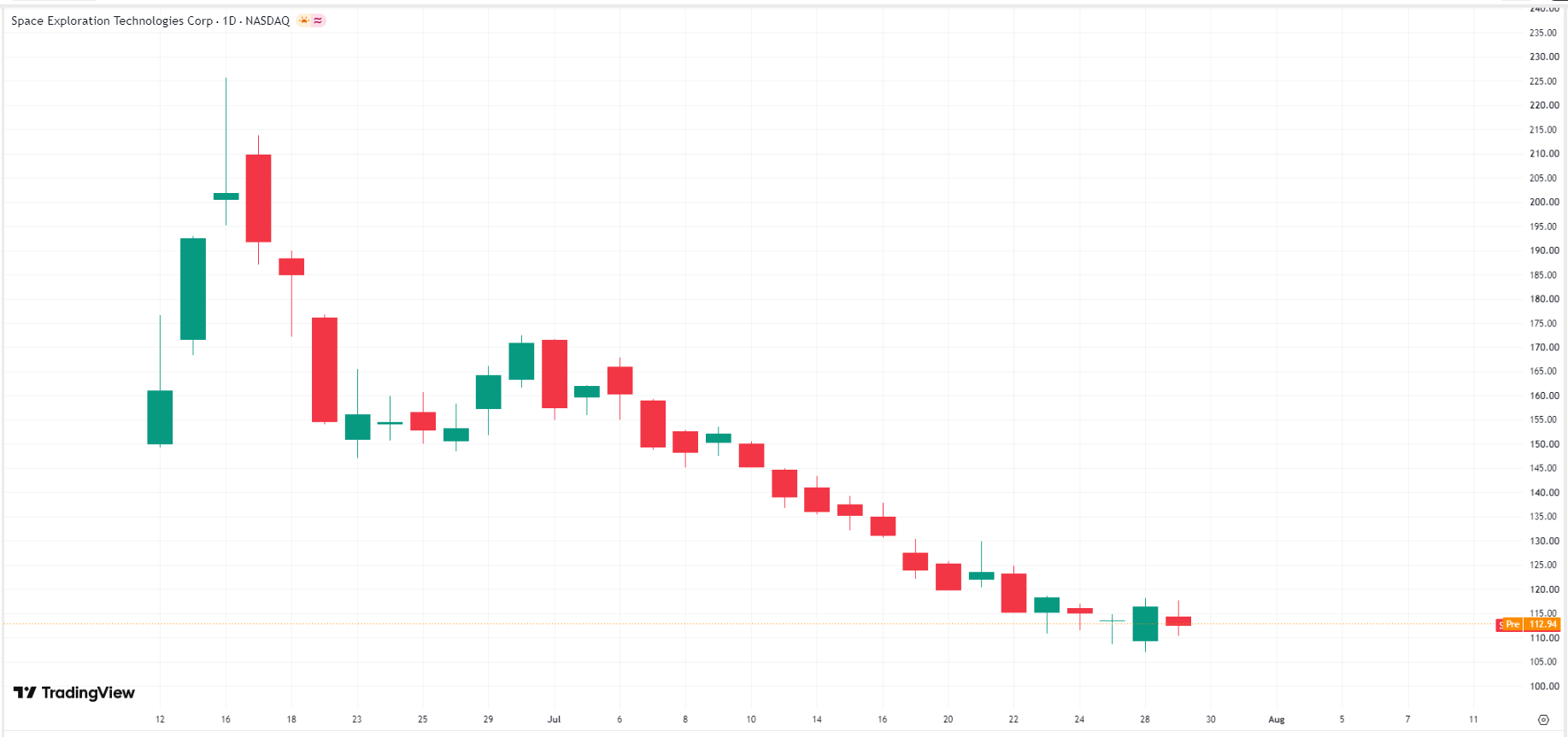 SpaceX stock price chart, Source: TradingView
This content was translated using AI and reviewed for clarity. It is for informational purposes only.
Recommended Articles






Comments (0)
Click the $ button, enter the symbol, and select to link a stock, ETF, or other ticker.