


Why Is Micron Technology Stock Still Undervalued? Memory Chip Price Hikes, HBM Demand and Cyclical Risks



AI Podcast


Micron Technology is experiencing record profitability driven by surging AI-related demand for HBM, DRAM, and NAND memory, with fiscal Q3 revenue exceeding fourfold year-over-year to $41.5 billion and gross margins reaching 84.6%. Despite stellar earnings, Micron’s forward P/E ratio remains at 6x, as the market prices in potential cyclical capacity expansions and lower-than-expected price increases from competitors. Long-term customer supply agreements through 2030 enhance earnings stability, mitigating traditional cyclical volatility. Technically, the stock is consolidating near support following a recent pullback, with the $940–$960 range acting as key resistance for a medium-term trend reversal.

TradingKey - Micron Technology (MU) is one of the strongest-performing semiconductor stocks in this wave of AI investment. As AI hyperscale data centers heavily procure high-bandwidth memory (HBM), DRAM, and NAND flash, global memory chip supply remains tight, sending product prices and Micron Technology's profitability soaring in tandem.
However, compared with its rapidly growing revenue and profits, Micron's forward P/E ratio remains in the single digits.
Over the past year, Micron's stock price has gained nearly 690% cumulatively, and has also risen about 214% since 2026. However, after reaching an interim peak in June, Micron's stock price has pulled back by nearly 30%.
Why Micron Technology Stock Is Cheap: Market Is Pricing In an Early Cycle Peak
Micron Technology primarily produces DRAM and NAND flash memory, with DRAM used for high-speed data processing and NAND mainly responsible for long-term data storage. Although the applications for both product types differ, the industry as a whole exhibits distinct cyclicality.
Memory chips are largely standardized products. When market demand exceeds supply, chipmakers gain stronger pricing power, driving rapid growth in revenue, gross margins, and cash flow; however, when new capacity comes online en masse or demand declines, prices can drop quickly, leading to a sharp contraction in corporate profits.
Micron is currently in a strong upswing of the cycle. According to disclosed data, for the third fiscal quarter ended May 28, 2026, Micron's revenue increased more than fourfold year-over-year to $41.5 billion, with its gross margin rising to 84.6% and operating cash flow reaching $25.4 billion. Data center revenue exceeded $25 billion, serving as the core driver of performance growth.
Management expects fourth fiscal quarter revenue to be approximately $50 billion, with a gross margin of around 86%, figures that reflect remaining robust demand for memory chips driven by artificial intelligence infrastructure.
However, Micron's stock price has not received a valuation commensurate with its earnings growth. Based on market earnings forecasts, the company's trailing P/E ratio is around 20x, but its forward P/E ratio is only 6x.
Such a pronounced valuation gap indicates that investors believe Micron's current high profitability is difficult to sustain over the long term. The higher memory chip prices go, the stronger the motivation for Samsung, SK Hynix, Micron, and other manufacturers to expand capacity. The market is pricing in increased supply, price cuts, and margin contraction in advance, rather than focusing solely on Micron's current stellar earnings report.
What Headwinds and Growth Drivers Does Micron Stock Face?
Recent operating data disclosed by Samsung and SK Hynix provides an important reference for Micron investors.
Market data shows that both DRAM and NAND prices rose significantly in the second quarter, with some institutions estimating that Samsung and SK Hynix saw double-digit or even higher quarter-on-quarter increases in DRAM and NAND ASPs.
While these figures appear robust, they still fell short of some analysts' forecasts. Goldman Sachs analysts had previously projected that SK Hynix's DRAM selling prices could rise by 39%, before adjusting their next-quarter price growth expectation to around 19%. Morningstar analysts had expected a 48% price increase for Samsung's DRAM, which also failed to materialize in the actual results.
Lower-than-expected pricing from Samsung and SK Hynix implies that Micron's average DRAM selling price for the next quarter may also miss Wall Street's most optimistic projections.
In addition, SK Hynix's lower-than-expected HBM4 shipments raised market concerns over a slowdown in AI memory demand growth. Although management stated it would ramp up HBM4 production in the second half of the year, short-term shipment fluctuations could still weigh on market sentiment.
However, a moderation in price increases does not necessarily signal a significant drop in AI demand. Long-term supply agreements also temper spot price gains. Micron has signed 16 strategic customer agreements, with most contracts covering the period from 2026 through the end of 2030 and requiring customers to purchase specified volumes over several years.
Therefore, Micron's peak profits may fall short of the most aggressive forecasts, but its earnings stability is expected to be higher than in previous memory cycles. If long-term agreements can significantly reduce revenue and cash flow volatility, MU stock could also command a higher valuation than traditional memory chip makers.
However, Chinese memory chip makers entering the high-end DRAM or HBM market poses a potential risk. If new entrants achieve breakthroughs in product performance, yield rates, and production volume, global memory chip supply could increase, undermining the pricing power of Micron, Samsung, and SK Hynix.
Micron Technology Stock Price Forecast: Can MU Stock Still Rise?
From a fundamental perspective, conditions remain favorable for further upside in Micron Technology's stock price. AI data centers continue to procure HBM, DRAM, and NAND, while major new capacity additions are unlikely to be released in concentrated volumes until 2028 to 2029.
If investment in AI infrastructure continues to grow, the supply shortage in memory chips could last longer than the market expects, and Micron's revenue, margins, and cash flow are expected to remain elevated.
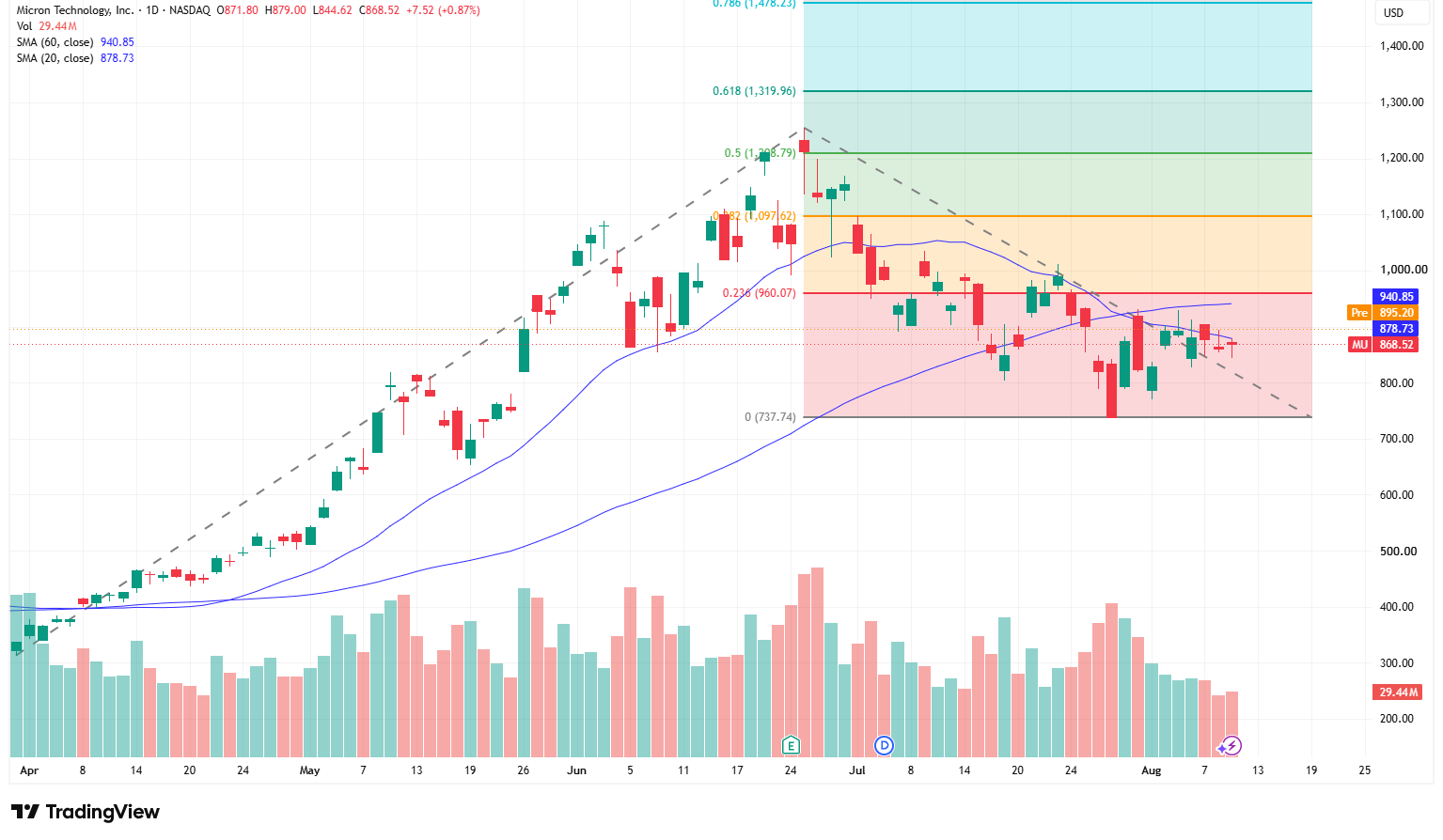
Source: TradingView
From a technical perspective, Micron Technology's daily chart previously showed a rapid rally from around $330 in April to an intermediate peak of around $1,230 in late June, followed by a noticeable pullback. During the correction, the share price consistently formed lower highs and lower lows, visibly weakening the short-term uptrend.
In late July, the share price touched a low near $737.74, leaving a prominent lower shadow accompanied by expanded volume on that day, indicating strong buying support at lower levels. Since then, the stock has gradually entered a consolidation and bottom-building phase.
As of August 11, Micron closed at $868.52, remaining below its 20-day moving average of $878.73 and its 60-day moving average of $940.85. Meanwhile, the 20-day moving average has crossed below the 60-day moving average, keeping moving average alignments bearish. Therefore, it can only be inferred at present that downside momentum has weakened, but a medium-term trend reversal cannot yet be confirmed.
The $940-$960 range forms a key technical resistance zone at present. Among them, $940.85 corresponds to the 60-day moving average, and $960.07 corresponds to the 23.6% Fibonacci retracement level. If the share price breaks through $960 on heavy volume and holds above it, it would signal a substantive repair of the recent downtrend structure, opening the door to challenge $1,000 and $1,097.62 successively. Conversely, if the stock faces resistance and retreats in the $940-$960 zone, the current rally should still be viewed as a technical rebound within a downtrend.
To the downside, $844-$850 constitutes the nearest short-term support, while $820-$800 serves as an important line of defense for the current bottoming range. If the share price can hold above $800, the stock may still gradually build a bottom through sideways consolidation. If it breaks below $800 on heavy volume, caution is warranted regarding a retest of $780 and $737.74.
This content was translated using AI and reviewed for clarity. It is for informational purposes only.
Recommended Articles











Comments (0)
Click the $ button, enter the symbol, and select to link a stock, ETF, or other ticker.