


Cisco Beat Revenue at 18% Growth and $9.3B AI Orders — So Why Did the Stock Plunge 9% to $112?



AI Podcast


Cisco reported strong fiscal fourth-quarter results for 2026, beating revenue and guidance estimates driven by surging AI infrastructure demand. However, the stock fell 9% to $112.81 due to margin compression, with adjusted gross margins dropping to 66.3% as hardware-heavy AI products scale. Management projects fiscal 2027 revenue between $72.2 billion and $73.4 billion, while guiding margins to 65%–66%. Technically, the stock is testing critical support at $111.70, with an RSI of 38 indicating persistent selling pressure. Investors are weighing aggressive AI growth against lower hardware profitability, looking to security and software expansion for margin stabilization.
TradingKey - Cisco Systems (CSCO) reported impressive results for its fiscal fourth quarter of 2026 on August 13. The stock decreased by 9% to $112.81. According to reports, investors punished the company for margin compression. Even with the margin compression ($17.25 billion, +18% YoY, beat consensus) and sharp profitability deterioration (from 68.4% to 66.3%), Cisco still saw strong growth in bookings ($9.3 billion of hyperscaler orders, above $9 billion goal) from its AI networking business and booked $7.5 billion of AI infrastructure revenue for FY2027.
Cisco also projected strong top-line guidance of $72.2-73.4 billion for its fiscal 2027 year. For traders, the support level to watch is $111.70, as RSI is at 38 which is stubbornly at the extreme selling range, with no clear signs of overselling. From an investing standpoint, the new outlook is: “Will Cisco be profitable?”
The Results: Beat on Revenue, Orders, and Guidance — But Margins Compressed
The story around the company's AI offerings was also compelling. The company has a client agreement to provide $4 billion of hyperscaler AI infrastructure for Q4 and brings the total to $9.3 billion for the fiscal year of 2026 as compared to its prior goal of $9 billion, reflecting almost a 4.7 times jump from the $2 billion total booked for the fiscal year of 2025. Cisco is predicting revenue recognition of approximately $7.5 billion for the fiscal year of 2027, creating excellent runway and visibility for potential future growth.
While the outlook is positive for the future growth and runway, they also shared metrics for reduced gross margin, which expectations weren't for. Adjusted gross margin for the year was reported at 66.3%, as compared to the previous year at 68.4% - a noteworthy decrease.
For the fiscal year 2027, adjusted gross margin was expected to fall within the range of 65% - 66%, which was lower than what was shared previously. It was announced the stock would take a hit due to the operational beat because of AI infrastructure requiring a significant amount of hardware, yet margin revenue is lower for AI infrastructure than software as a service.
Fiscal 2027 Guidance: Revenue Acceleration to $72.8B at Midpoint
Cisco’s revenue for fiscal year 2027 is expected to be in the range of $72.2 billion - $73.4 billion, representing material growth from the pre-earning call consensus range of $68.7-$69.1 billion. Adjusted EPS is expected to be $5.05 - $5.11. For the first quarter of fiscal year 2027, the guidance range is for revenue to be in the range of $18.0-$18.2 billion and adjusted EPS is expected to be in the range of $1.32-$1.34.
At the midpoint, full-year guidance is for $72.8 billion in revenue. While the last fiscal year 2026 revenue was $63.3 billion, Cisco’s guidance for fiscal year 2027 represents an estimated 15% growth. Historically speaking, Cisco has been viewed as a mature and low-growth company. With the estimated growth given, coupled with the expected positive impact of AI and enterprise networking upgrades, this represents a solid growth outlook.
The Margin Debate Is Now the Stock's Central Issue
The concern for the stock has been with the margins. Although, there are strong fundamentals for Cisco in other aspects including confirmed demand for AI networking, multi-year cycles, management confidence as demonstrated by guidance above consensus, and proven actual spending of $9.3 billion with a guidance of $7.5 billion for fiscal year 2027. What Cisco lacks is proven evidence for aggressive AI spending and profitability.
Hardware, even rapid growth hardware, typically translates to lower margins compared to software and subscription-based services. Cisco has a clear choice, capture the AI spending opportunity at the expense of margins or retain higher margins on traditional business. Management has chosen to capture the AI spending opportunity. While this is a strategic choice, investors should expect a new margin range of 65-66% compared to the former 68%+ range.
Networking Remains Exceptionally Strong, But Security Growth Is Key Forward Metric
Cisco's networking revenue was up a staggering 28% at $9.79 Billion due in large part to the company's ongoing upgrades to their AI Data Centers, enterprise campus networking, and wireless networking. The acceleration in growth has likely contributed to large increases in networking product orders up 40% from last year. This current cycle stands among the strongest in decades for Cisco’s networking business. Should the company’s Hyperscale AI customers slow spending, enterprise networking should be able to sustain growth on its own.=
Security order growth was also positive, with double-digit order growth for Cisco security portfolio in Q4 and over 1,500 new customers purchasing new security products. Firewall orders grew over 30% year over year. Even with continued migration to software and services, security and software growth as a percentage could slow gross margin erosion or even progress toward improvement.
Cisco Technical Breakdown: $111.70 Critical Support, $114.81 EMA Resistance
On the 4 hour chart, Cisco has seen a sharp bearish reversal after failing to break the trend line at $124.54. The stock has now fallen to $112.81, erasing the recovery and landing CSCO in the critical support zone.
The area of interest is stated to be $111.70 - $112.80 and is composed of a convergence of horizontal support with a rising trendline from the July low. This area could attract dip buyers, but the short term structure is clearly down. Cisco has fallen beyond the 50 EMA around $117.40 and the 100 EMA at $114.81, forming both resistance levels on a rebound.
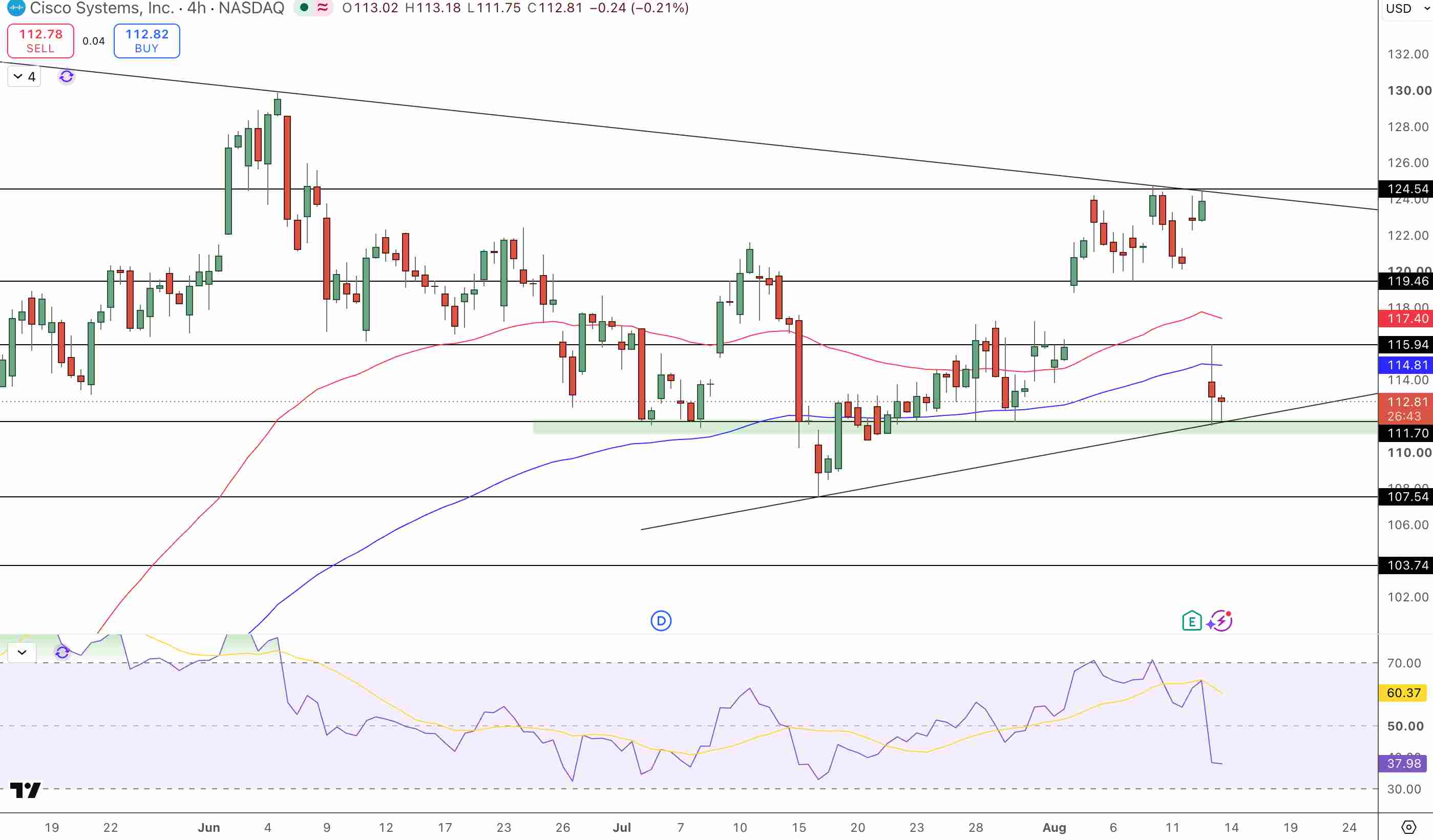
Cisco Beat Price Chart - Source: Tradingview
The structure is also confirmed by momentum. The RSI has fallen to around 38 from recent levels around 60-70. While this is extremely bearish, RSI has not reached an oversold status yet (30), therefore break of $111.70 could see selling continue. A rebound would first need to reclaim $114.81 - $115.94 then $117.40 to be considered a recovery.
Key Levels (Aug 14, Post-Earnings Selloff)
- Immediate resistance: $114.81 (50 EMA, must clear)
- Secondary resistance: $115.94, $117.40 (100 EMA)
- Extended resistance: $119.46 (recovery target if EMAs break)
- Critical support: $111.70 (confluent horizontal + rising trendline)
- Deeper support: $107.54, $103.74
- Current price: $112.81 (testing support)
- RSI: 38 (strong selling, not yet oversold)
Why Did the Stock Fall 9% Despite Beating Earnings?
Cisco stock jumped 60 percent in 2026 ahead of the earnings announcement. Investors expected strong AI-Networking cycles. When Cisco confirmed the story as well as a harder-to-maintain revenue line (margin compression from hardware sales), the market saw it a validation of the story and not a new positive surprising upside. So, the movement of stock prices depends on the result relative to the expected result, not the absolute result.
The Bull Case: Margin Stabilization + Security Growth Could Re-Rate Stock Higher
UBS reportedly boosted its price target to $138 from $132 post sell-off, seeing the stock price drop as an opportunity. Citi Group maintained its $139 target, Evercore ISI, and others are bullish, with a price target at $150. The conservative view of management could allow for upside on both margins and fiscal 2027 growth. Cisco appears to have met the target on AI order, and the $9.3 billion orders provide good revenue visibility for fiscal 2027. If the margin pressure from hardware improves and the security/software segments accelerate, gross margins could stabilize around 65-66 percent.
Bottom Line (Aug 14, Post-Earnings)
Cisco closed Q4 and FY 2025, with Revenue of $17.25 billion, an increase of 18 percent, AI orders of $9.3 billion, FY 2027 EPS of $1.22, and guidance for FY 2027 in the range of $72.2 - $73.4 billion, which is well above current analysts’ estimates. The AI-Networking thesis has been confirmed. The marginal compression to 66.3 percent from 68.4 percent is a concern as it signals a shift to a hardware driven mix and probably some negative margin compression. This was reflected in the price, as stock dropped 9 percent to $112.81.
CSCO is currently testing critical support at $111.70 due to a confluent horizontal + rising trendline. However, RSI at 38 indicates slight selling, not oversold. Should $111.70 break, support will move to $107.54 and potentially $103.74. To regain, CSCO will need to break past the 50-EMA at $114.81 and the 100-EMA at $117.40.
For tactical traders, $111.70 is the major support level. A break could take CSCO down to $107. A hold on this level will attract dip buying. For investors, the margin debate is of importance now. Keep an eye out for confirmation on FY2027 gross margin guidance and the security/software growth acceleration for the next quarter. The stock will need to stabilize margin more than it needs to grow revenue in order to get re-rated. This is analysis, not investment advice.
Recommended Articles











Comments (1)
Click the $ button, enter the symbol, and select to link a stock, ETF, or other ticker.