


SpaceX Reportedly Plans to Launch Starlink Retail Mobile Service, Directly Challenging Verizon, AT&T and T-Mobile



AI Podcast


On June 25, Eastern Time, SpaceX disclosed plans to launch direct retail mobile services, signaling a shift from a satellite connectivity provider to a direct competitor against Verizon, AT&T, and T-Mobile. Supported by nearly $20 billion in spectrum acquisitions, this strategy aims to capture the broader mobile market. Despite Starlink’s high profitability and 10.3 million subscribers, SpaceX faces significant net losses and intense competition. While building a terrestrial network remains challenging given spectrum constraints, this move serves as a strategic bargaining chip against major carriers to leverage long-term revenue growth and improve its financial profile.
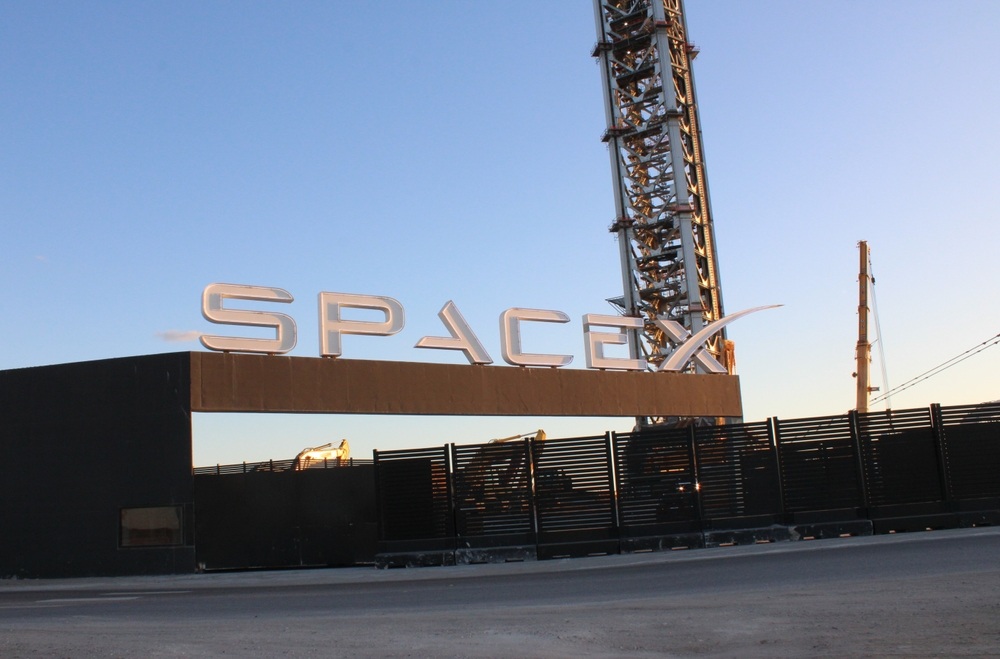
T radingKey - On June 25, Eastern Time, S paceX ( S PCX) dropped another bombshell on the market just days after completing the largest I PO in history. According to the Financial Times, citing four people familiar with the matter, S paceX President and C hief Operating Officer Gwynne S hotwell stated during the I PO roadshow that the company is considering launching S tarlink retail mobile services for US consumers and may build its own terrestrial mobile network covering the US.
I f implemented, this would mean S paceX is no longer satisfied with being a supplementary provider of satellite coverage for telecom operators. I nstead, it will directly sell mobile communication contracts to individual users, competing head-on with Verizon Communications ( V Z ), A T&T ( T) and T -Mobile, the three major giants. P reviously, its primary model was to allow telecom carriers like A T&T and T -Mobile to connect to its satellites to supplement rural network coverage and take a cut of the customer revenue.
S paceX has long laid the groundwork for this. L ast S eptember, S paceX announced the purchase of A WS-4 and H -block wireless spectrum licenses from E choS tar for approximately $17 billion. T he two parties revised the agreement in November, with S paceX adding about $2.6 billion to purchase A WS-3 spectrum, bringing the total transaction value to approximately $19.6 billion. T his massive deal was officially approved by the F ederal C ommunications C omission (F CC) in May of this year.
T he wording in the bond offering prospectus also hints at a broader vision: while S tarlink's mobile service currently appeals most to "the unconnected in remote areas," the company's ambition clearly goes beyond this. U ltimately, it aims to become "the preferred provider of connectivity experiences," regardless of whether users live in cities, suburbs, or rural areas.
S tarlink currently operates in more than 150 countries worldwide, with subscription users surpassing 10.3 million as of March this year. F or the full year of 2025, revenue was $18.67 billion, and in the first quarter of 2026, revenue reached $4.69 billion with an E BI T DA margin of 63%. A lthough the S tarlink business is highly lucrative and serves as S paceX's sole "cash cow," S paceX as a whole still posted a net loss of approximately $4.9 billion in 2025 and a net loss of $4.28 billion in the first quarter of 2026.
T his may also explain why S paceX is eager to find new revenue pillars. T he retail mobile service market is far larger than satellite broadband. O nce established, it will not only bring significant recurring revenue to the company but also create leverage against existing partners at the negotiating table.
A s D avid B arden, a partner at NewS treet R esearch, pointed out, S paceX holds only 65 M Hz of spectrum resources, whereas the three major US carriers collectively hold about 1,020 M Hz, making it "extremely difficult" to build its own wireless network in a globally saturated telecom market. H owever, looking at it from another angle, playing the card of "building its own retail network" as a bargaining chip with mobile operators is an exceptionally powerful opening move.
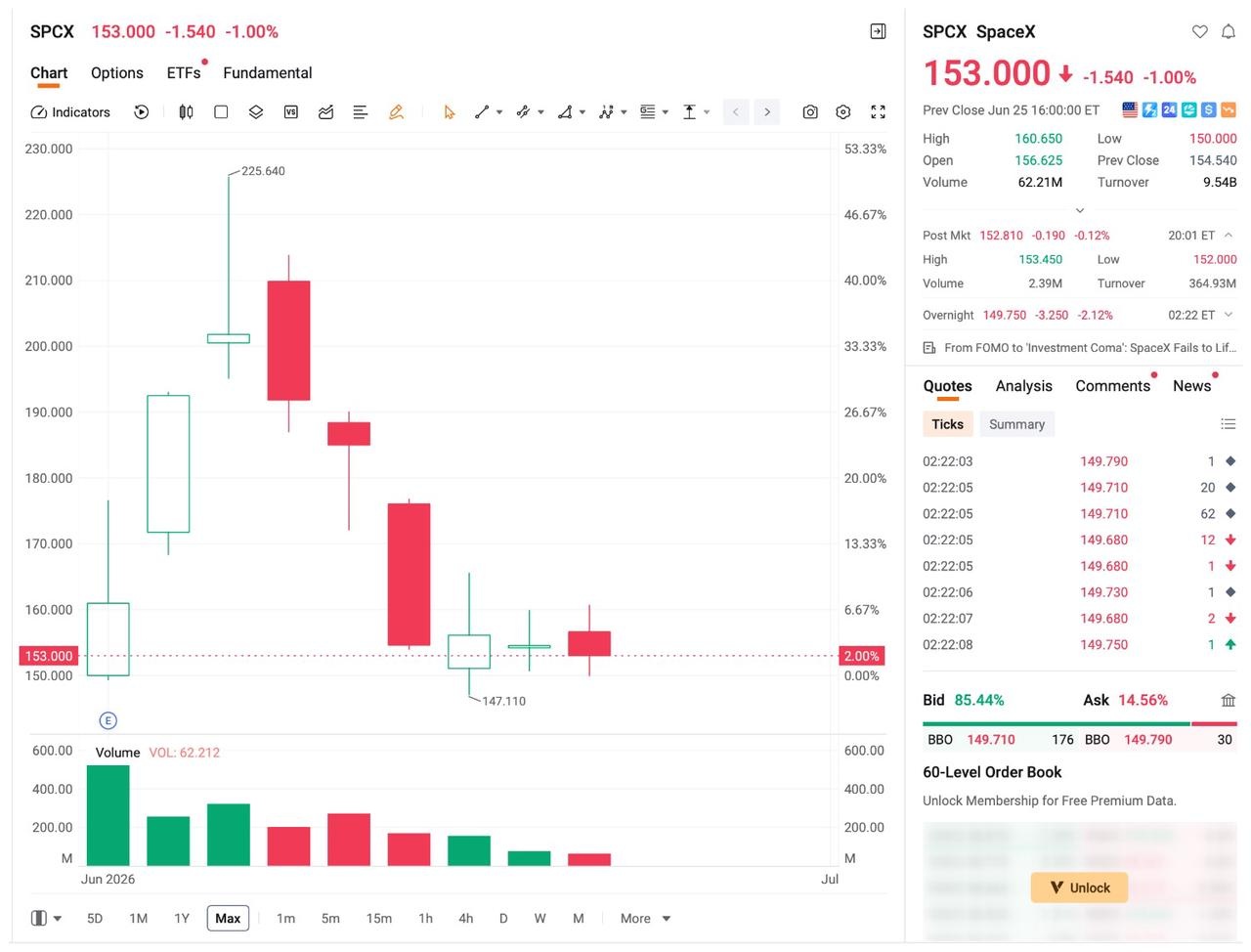
S paceX debuted on the Nasdaq on June 12 at an I PO price of $135, raising $75 billion. T he stock opened at $150 on its first trading day. A s of the close on June 26, the share price fell to $153, down approximately 32% from the high of $225 touched last week.
[S ource: F utu]
This content was translated using AI and reviewed for clarity. It is for informational purposes only.
Recommended Articles








Comments (0)
Click the $ button, enter the symbol, and select to link a stock, ETF, or other ticker.