


SanDisk Surges Over 13% as 80% Gross Margin Target Stuns Wall Street: What Was Said at Investor Day?



AI Podcast


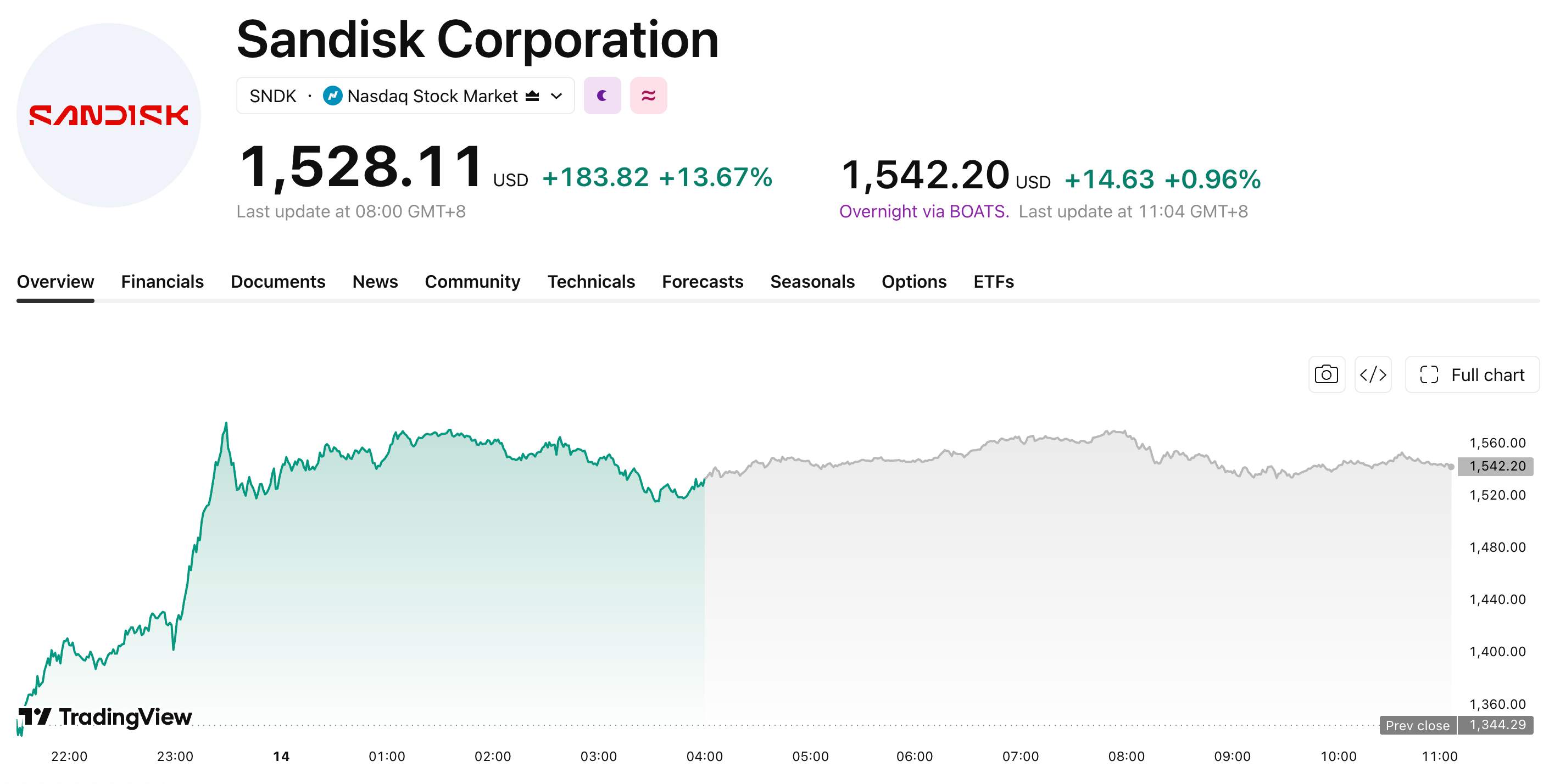
On August 13 ET, SanDisk hosted its 2026 Investor Day, driving its stock up 13.67% as long-term financial targets and a $94 billion New Business Model agreement exceeded expectations. The company projects mid-to-high double-digit revenue growth and an 80% non-GAAP gross margin through fiscal 2030, supported by fixed-price long-term contracts. Management plans proactive capacity adjustments and committed to returning 100% of excess free cash flow to shareholders. While Goldman Sachs maintains a "Buy" rating with a $2,200 price target, risks remain regarding whether fixed pricing could constrain profits during an industry upcycle.

TradingKey - On August 13 ET, SanDisk (SNDK) hosted its 2026 Investor Day in New York, sending its stock price soaring over 17% intraday and closing up 13.67%, with total market capitalization rising to $227.688 billion. What signals did this event release to make the market so excited?
[Source: TradingView]
$94 Billion NBM Long-Term Agreement Supports 80% Gross Margin Target
SanDisk's long-term financial model was hailed by analysts as far exceeding expectations. The company expects revenue to maintain mid-to-high double-digit growth, non-GAAP gross margin to reach around 80%, operating margin around 75%, free cash flow margin around 50%, and capital expenditures to account for only about 5% of revenue for fiscal years 2028 to 2030.
Gross margins in the chip industry mostly range between 50% and 60%, while 80% is close to the level of software companies. By comparison, Nvidia (NVDA)'s latest gross margin is around 73%, Microsoft's (MSFT) around 69%, and Salesforce's (CRM) around 76%. SanDisk's target is already comparable to those of some software companies.
The core mechanism supporting this target is the "New Business Model" (NBM) agreements—long-term supply contracts signed with major customers to lock in pricing and volume. According to disclosures from the company's Investor Day presentation and IR materials, eight customers have signed on so far, including three U.S. hyperscale cloud providers.
The total contract value is approximately $94 billion, with remaining performance obligations of about $91 billion. The agreements have a weighted average duration of four years, utilizing fixed pricing in the near term and price collars for the longer term.
These agreements cover about 50% of bit shipments in fiscal year 2027, with the proportion rising to about two-thirds in fiscal year 2028. The company stated that even calculated at the contract floor price, gross margin can be maintained at 80%.
However, the market's concern regarding the price-lock model is that while it serves as protection during a downcycle, it acts as a constraint during an upcycle. If NAND prices continue to rise after 2027, SanDisk supplying at contracted prices would mean ceding a portion of excess profits to customers.
Goldman Sachs (GS) analyst James Schneider released a research report after Investor Day, reiterating a "Buy" rating. Based on normalized earnings per share of $110, representing a 20x P/E ratio, he maintained a 12-month price target of $2,200, which offers about 44% upside from the current price of $1,528.
Goldman Sachs believes that SanDisk's long-term financial targets significantly exceed investor expectations, but also points out that whether long-term customer agreements can truly smooth industry cycle fluctuations still requires time to verify. Whether trading upside elasticity for downside protection is worthwhile ultimately depends on the future direction of the NAND cycle.
Capacity Adjustments and AI Demand Support Both Supply and Demand Sides
In his opening remarks, SanDisk CEO David Goeckeler addressed market concerns regarding low bit shipment growth in 2027. Management stated that the volume of bits available for sale will be adjusted based on profitability. Each NAND technology node transition can deliver an approximate 54% increase in bit density, and the company plans to proactively reduce wafer starts during transition periods to maintain a balance between supply and demand.
According to August data from TrendForce, NAND bit output growth in Q3 2026 narrowed to 2.3% quarter-over-quarter, the lowest level in nearly five quarters, aligning with SanDisk's capacity adjustments. Limited incremental supply helps maintain pricing power.
On the demand side, growth revolves around AI inference. SanDisk believes AI inference is reshaping storage architecture and projects that the total addressable market for flash memory in enterprise data centers will reach 1.2 ZB by 2030.
100% Excess Cash Returned to Shareholders
Capital return was one of the most closely watched topics at this Investor Day. SanDisk clarified its capital allocation priorities: invest in the business first, maintain a healthy balance sheet, and then return 100% of excess free cash flow to shareholders via buybacks or dividends. The company currently has approximately $15.5 billion remaining under its buyback authorization.
In comparison with peers, over the past 12 months, Samsung Electronics' combined buybacks and dividends accounted for approximately 50% to 60% of free cash flow, while Micron Technology repurchased about $4.5 billion over the past four quarters, representing roughly 55% of its free cash flow over the same period. SanDisk's committed 100% clearly far exceeds both companies. Goldman Sachs analyst James Schneider commented that this level of return is "far ahead of peer announcements to date."
The message conveyed throughout Investor Day was clear: SanDisk is attempting to leverage long-term contracts to transform memory chips from a cyclical commodity into a predictable cash flow model. The 13.67% single-day gain reflected initial market approval.
This content was translated using AI and reviewed for clarity. It is for informational purposes only.
Recommended Articles








Comments (0)
Click the $ button, enter the symbol, and select to link a stock, ETF, or other ticker.