


Intel Stock Forecast: $20 Billion Offering, AI Growth and Foundry Risks



AI Podcast


Intel shares rose following a completed $20 billion stock offering funding its turnaround and capital expenditures. While second-quarter revenue grew 25% year-over-year to $16.1 billion and margins improved, Wall Street remains divided over equity dilution and valuation multiples. Major challenges persist, including heavy losses in the foundry business, CPU market share losses to AMD, and high capital spending requirements. Although AI-driven demand and potential re-entry into the memory market offer growth catalysts, Intel must successfully attract external foundry customers and execute its manufacturing strategy to ensure long-term recovery.
TradingKey - Intel (NASDAQ: INTC) rose by 4.41% on August 13 after a 3.3% increase on Wednesday, settling at $100.95. The move came as investors continued to digest the chipmaker’s newly completed $20 billion stock offering.
The move marks a significant reversal from a stock that's up more than 150% this year. Intel, though, is far from its June levels and still has a big issue to address: is AI-based demand strong enough to warrant the massive capital investment that the company is throwing at its turnaround?
The $20 Billion Offering Is Now Complete
The company had originally planned to sell $15 billion in shares, but the institutional demand amounted to $100 billion, so it expanded the offering to 210.5 million shares valued at $95 apiece.
The new shares represent about 4.2% of Intel's pre-offering sharecount of approximately 5.04 billion. The gross proceeds match the company's total capital expenditure guidance for 2026, which was increased by 21% from previous year to over $20 billion.
Investors so far seem to have been viewing the offering as a means to help Intel's turnaround, rather than as evidence of financial stress. Shares also closed well above the $95 offer price.
Wall Street Is Split Over Dilution and Long-Term Potential
But analysts have mixed views on Intel's next steps.
Bank of America maintained an "outperform" rating on the stock, but reduced its price estimate from $160 to $145, citing dilution due to the offering and lower valuation multiples for chip stocks that focus on AI.
Both UBS analyst Timothy Arcuri and J.P. Morgan's Harlan Sur have $112 and $85 targets, respectively, and both have Sell ratings, indicating significant downside risk from current levels.
Seven of 32 analysts covered are Buys, 23 Hold and 2 are Sells. The average price expectation is about $118.93, implying a potential upside of about 18% from Wednesday's closing price.
Citi's Atif Malik has been more bullish, boosting his price target to $130 from $95 earlier in the cycle.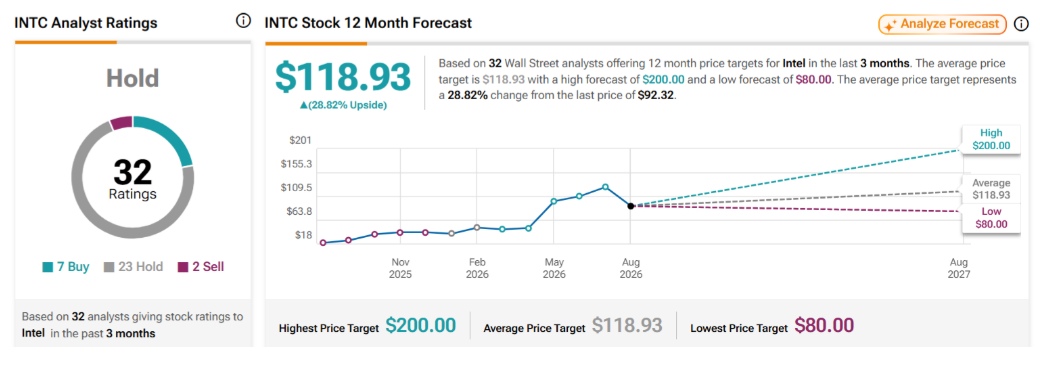
Image Source: tipranks
Intel’s Operating Numbers Are Finally Improving
The stock’s rally is not based on the offering alone. Intel's core business has also seen some positive signs of improvement.
Second-quarter revenue rose by 25% year over year to $16.1 billion, the company's best performance since 2011. GAAP gross margin was up to 40.4% from 27.5%, and operating margin was positive at 11.1% versus a loss of 24.7% last year.
Cash flow from operations also increased more than tripled to $7 billion.
Server chip prices have also seen an improvement. During the quarter, the average selling price stood at about $1,200, an increase of 43% from the same period a year ago. Growing demand for AI workloads is returning to CPUs in addition to GPUs, particularly in agentic AI applications.
Foundry Is Still the Expensive Part of the Story
One of the largest hurdles in the turnaround is Intel's foundry business.
Foundry revenue grew 31% to $5.8 billion in the quarter, but the unit still posted an operating loss of approximately $2.1 billion. There is also a lack of external revenue from customers outside Intel.
The company has invested a further €5 billion in Ireland to increase production capacity. The larger question is if Intel will attract enough outside customers to make the foundry viable in competition with TSMC.
Intel is working to bolster that claim by a number of high-profile partnerships. These include Nvidia's $5 billion investment to co-develop custom x86 CPUs, involvement with Elon Musk's Terafab project and nearly 10% U.S. government equity stake with an estimated $8.9 billion investment.
Intel May Be Eyeing a Return to Memory
One area that investors are keeping an eye on is the prospect of Intel getting into the memory market again.
CEO Lip-Bu Tan has hinted that Intel could eventually move back into memory after leaving the market years ago. One of his personal projects is the description of new memory architectures, including possible designs to combine memory with CPUs in a stack.
The idea was enough to send Intel shares more than 4.5% higher in one session.
It is interesting that the global memory market is tight at the moment. Omdia data indicated that the PC market fell 3.6% year-over-year in the second quarter, stemming from the shortage of memory and rising prices.
Memory is a critical component of the AI and computing supply chain, and Intel is currently dependent on suppliers including Micron and SK Hynix, so the return to the space could give the company greater control.
While the new revenues are welcome, the financial success is no guarantee that Intel has solved all its problems.
Losing Ground in CPUs Even While Winning the Narrative
The latest data from the Mercury Research is further evidence of Intel losing CPU market share to AMD. The PC market is also under cyclical pressure, and the company is investing heavily in new technology and manufacturing.
Macroeconomic and geopolitical risks are contributing to the uncertainty. On-going technology trade bans and potential disturbances in the Strait of Hormuz may further complicate the recovery of Intel.
It leaves Intel with little room when it comes to execution blunders as it attempts to reconstruct its manufacturing operation, protect its CPU market share and carry out a much bigger capital spending initiative.
Analyst Targets and What to Watch Next
Technically, Intel's rally is nearing a resistance level at the 38.2% Fibonacci retracement level from its June high. The 200 day EMA is also a significant support level.
If a rejection occurs at current resistance, then it could push shares back to the moving average and trigger a further decline. But a hold higher would maintain the overall bullish trend and give the chance for a further run toward the June tops.
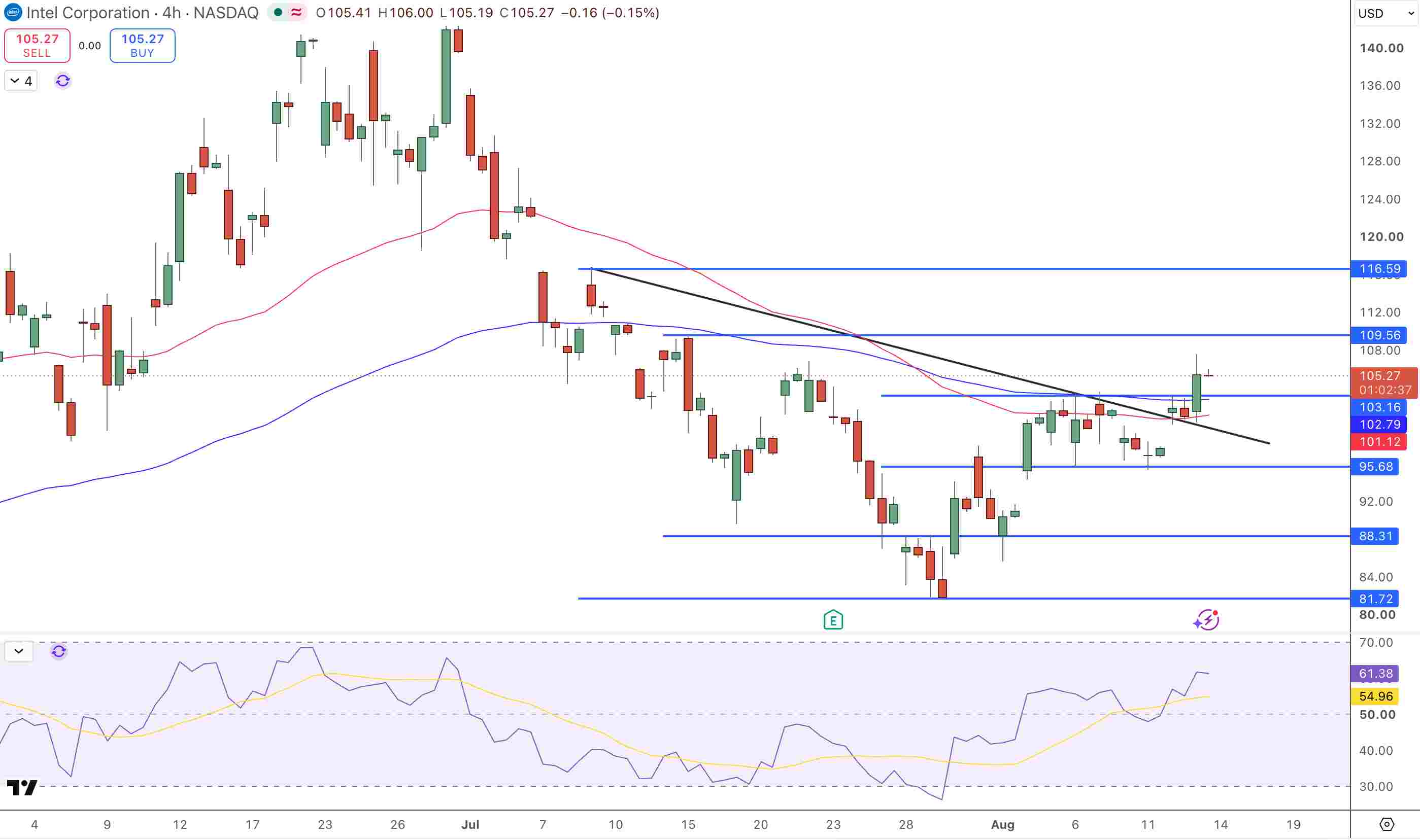
Intel Stock Price Chart - Source: Tradingview
Volume around the stock offering was approximately 42% higher than the average level, suggesting increased investor interest in Intel’s future moves.
Other catalysts are expected to be third-quarter guidance for $15.8 billion to $16.8 billion in revenue and non-GAAP EPS of $0.38. Investors will also be waiting for further clues on the return of Intel to the memory industry and the emergence of sufficiently important outside customers for the company's foundry.
Until now, Intel's turnaround narrative is gaining traction, but it has yet to demonstrate that its improving performance can match the scale of the challenge of rebuilding the company's semiconductor dominance.
FAQs
Is Intel stock a good investment?
Intel’s improving revenue, margins and AI-related opportunities support the bullish case, but heavy capital spending, dilution and foundry losses remain major risks.
What is the Intel stock forecast?
Analyst targets remain divided, with the average target near $119. Continued revenue growth, foundry progress and AI demand will be key to Intel’s next move.
The Bottom Line
Intel’s turnaround is gaining momentum as revenue growth, margins and server chip pricing improve. The $20 billion stock offering gives the company additional funding for its expensive AI and foundry ambitions, but also creates dilution for shareholders. A possible return to the memory market adds another potential growth avenue as shortages persist. Still, Intel must prove it can win external foundry customers while defending its CPU market share and delivering stronger results.
Recommended Articles







Comments (0)
Click the $ button, enter the symbol, and select to link a stock, ETF, or other ticker.