


Dell Stock Forecast: Why Is DELL Falling Despite a $51.3B Backlog and 88% Revenue Growth?



AI Podcast


Dell Technologies (DELL) has retreated to the $398.94 level, approaching the 4H EMA50 support at $390.97. This pullback occurs despite strong financial results: Q1 FY2027 revenue surged 88% YoY to $43.8 billion, with a record $51.3 billion order backlog and raised FY2027 guidance to $165-$169 billion, including $60 billion for AI servers. The backlog signifies robust demand, though conversion speed is crucial. New government contracts and a $2 billion deal in India diversify revenue sources. Technically, the stock appears to be consolidating, with the EMA50 as a key support level to defend, targeting $430.50 and $445.
TradingKey - As Dell Technologies (NYSE: DELL) fell below $430 in Friday's session, it now approaches the 4H EMA50 support level of $390.97. The stock is trading at $398.94, which is still above this level and in a pullback from recent price action within a declining blue channel established after the $465 peak.
This decline comes as the company is delivering strong financial results: Q1 FY2027 revenue came in at $43.8 billion (+88% YoY), order backlog expanded to a new all-time high of $51.3 billion, and FY2027 full-year guidance was raised to $165 billion to $169 billion (with AI servers now expected to be ~$60B). We've added the $9.7B in new government contracts and the $2B, multi-year deal with Gorilla Technology in India since publishing our latest note on May 30.
Why the $51.3B Order Backlog Points to Revenue Conversion Speed
The record order backlog of $51.3B is significant, but it's crucial to understand that the real measure of the strength here is how fast the company can actually start recognizing revenue from it. With guidance of $165 to $169B for FY2027 and an order backlog of $51.3B booked, that suggests roughly three month's of Dell's annualized revenue has been committed in the pipeline, assuming Dell doesn't receive any new orders and the business runs as expected.
The supply chain for AI servers, assembling GPUs, high-bandwidth memory, networking equipment, and liquid cooling systems all in a single rack, before shipping them out, is a lot more complex than just selling computers and storage, so we see Dell's backlog as both proof of the demand, while at the same time, it could act as a bottleneck in the revenue cycle that slows down how quickly those bookings can start generating actual revenue for the company.
With Dell turning 88% YoY revenue growth in Q1 FY2027 it is clear that Dell is turning bookings into real, billable, shipped revenue far faster than it turned over even prior-year numbers that were already very impressive. Management's raising FY2027 guidance to $165B to $169B (with $60B of that attributable solely to AI servers) signals they see enough of the order backlog translating onto a reasonably predictable schedule that they can put a number on it for the year-end run rate.
What is the risk of a backlog story like this playing out? It is the risk that was embedded into every conversation on TSMC's commentary on its CoWoS backlog that they've sold out to capacity constraints (at least for now) or Marvell's comments on its design win pipeline.
A backlog reflects bookings that were made months to maybe years ago, and if those bookings were to slow, they would not be reflected in the actual revenue reported on for several quarters, but it would be a leading indicator that the market should be reacting on. The $9.7B in government contracts diversifies Dell's exposure to that risk as government spending on IT modernization is typically funded differently than the hyperscaler capex for AI, and has less to do with the return-on-investment of AI.
A backlog that is more heavily-weighted to the demands from hyperscalers for their AI and the spending on modernization from the government is a higher quality order backlog than one that is just heavily-weighted to a few hyperscalers with high spending for AI.
Liquid Cooling and $2B Gorilla Technology Deal: Two Very Different Growth Drivers
The liquid cooling technology that was part of what Dell Technologies unveiled at Dell Technologies World addresses an issue that is becoming a bottleneck as the industry looks to build out more and more AI datacenters: power and heat dissipation. As AI training clusters squeeze more GPUs into a rack that consumes more power, the cooling requirements become physically greater than simple air cooling. Liquid cooling is becoming more like an operational necessity at the high-end AI deployments and more of a nice-to-have premium feature at the lower-end ones.
Dell's ability to bundle those solutions into a single server/storage/liquid cooling solution is a meaningful benefit versus the alternative that involves the datacenter having to source their cooling solutions separately, integrate them to the servers and racks, and manage that entire supply chain process themselves.
The $2B Gorilla Technology deal is an entirely different growth driver from that liquid cooling infrastructure expansion and instead represents an expansion into a new geography. India is a less mature hyperscaler market at this point for their AI infrastructure buildouts but has far more potential long-term growth on that trajectory due to the population and the trajectory of the digital economy. This $2B deal is diversifying Dell's growth and revenue profile away from US hyperscaler AI demand cycles in the same way as the government contracts are, instead focusing on a specific geographic market with high long-term potential. Both deals represent evidence that Dell's growth from its AI infrastructure expansion is getting broader at the expense of narrowing the demand profile.
DELL Technical Setup: EMA50 at $398.94, $430.50 and $445 Potential Targets
On the 4H chart, DELL has tested the EMA50 support level at $390.97 after pulling back in a descending blue channel from the $465 highs. The near-term resistance sits at $407 to $430 as the intersection of the descending blue trendline and the red dynamic resistance line. The RSI between 54 to 57 is neutral without a clear divergence, while the volume in the pullback has abated somewhat from the highs, which could be a pause rather than distribution. The broader EMA200 support level is now at $339.66, well below where DELL is trading at the time of writing, which supports that the overall uptrend has not yet shifted direction in spite of the current correction.
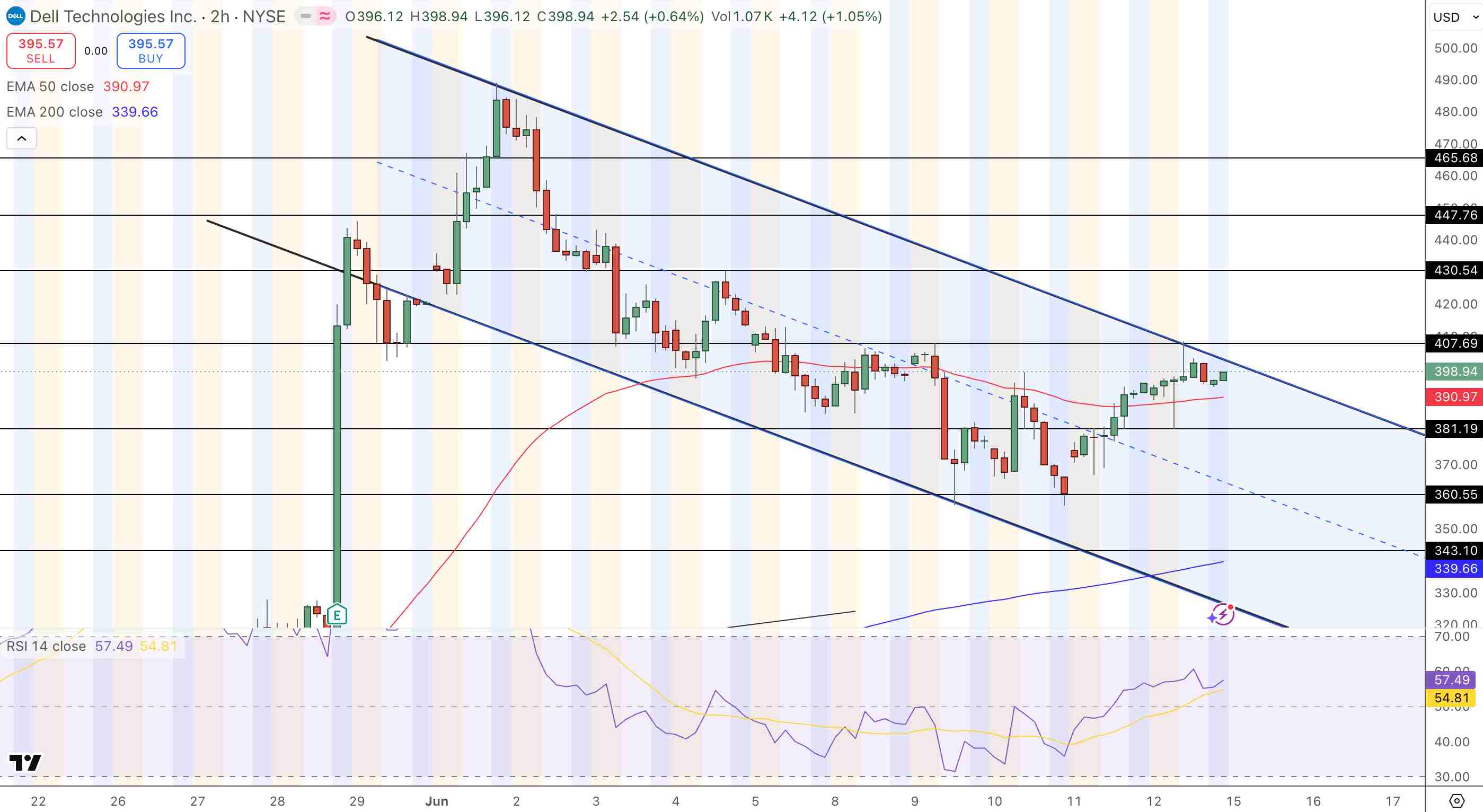
A clear move up through $407.70 will target a move to the EMA50 extension at $430.50, after which the move would likely target near the $445 level from the initial bullish breakout on the prior breakout level. A move below EMA50 on a closing basis would open the path to target a measured decline from $381 down to $360.
- Long above $407.70, descending trendline cleared
- Target 1: $430.50, EMA50 bounce extension
- Target 2: $445, prior breakout level
- Stop Loss: Daily close below $390.90, EMA50 support fails
Bottom Line
Dell (DELL) has fallen back to $398.94 from the $430s after making new highs, despite the stock's fundamentals being stronger, given the new $51.3B record backlog, +88% YoY revenue to $43.8B in Q1 FY27, FY27 guidance increased to $165 to $169B, and a more diversified customer and geography mix via $9.7B in new government contracts, and the new multi-year, $2B deal with Gorilla Technology India, among others.
The 4H RSI is in the 54 to 57 area, with the volume profile for the correction being lighter than the preceding rally. This looks like consolidation, not distribution, and we see the 4H EMA50 at $390.97 as the level to defend, to target $430.50 and $445. Conversely, if $390.97 gets broken, we see $381 and $360 as support.
The June 16 to 17 FOMC meeting of the warsh is the big near-term event for all the AI infrastructure stocks, including Dell.
Recommended Articles









Comments (0)
Click the $ button, enter the symbol, and select to link a stock, ETF, or other ticker.