


Rocket Lab Stock Forecast: Why June 22 Could Matter More Than the SpaceX IPO



AI Podcast


Rocket Lab (RKLB) experienced a modest 10% decline, a capital rotation response to SpaceX's IPO announcement, not a fundamental judgment. This drop was the smallest among peers, indicating RKLB's relative strength. The company reported strong Q1 2026 results with $344.1 million revenue and a $2.2 billion backlog. Furthermore, RKLB's inclusion in the Nasdaq-100 on June 22 will drive passive buying. Neutron missions are priced significantly higher at $50-55 million, a key driver for future revaluation, with the first flight expected in Q4 2026. Technically, the stock holds at a trendline and EMA200 confluence, with oversold indicators suggesting a potential rebound.
TradingKey - RKLB was one of the lesser of the major space companies to decline, dropping nearly 10% on June 11 when news broke that SpaceX is set to launch an IPO that will value the privately held rocket-maker at $1.78 trillion. The nearly 10% fall was the smallest drop in the space group, compared with 24% at Virgin Galactic (SPCE), 15% at Intuitive Machines (LUNR), 14% at Redwire (RDW), etc. RKLB is now trading at $102.79 as of its 4H chart, which shows it defending confluence of an ascending black trendline at the $104.94 mark with the EMA200, after a correction from $154.14 highs. It’s trading with a neutral-oversold relative strength index reading of 41.54 with a small positive divergence.
My June 5 story discussed the $1.1 billion backlog and Neutron roadmap then at $117.40. Since then, Q1 2026 results came in a lot better than expected at $344.1 million in revenue and a new high of $2.2 billion in backlog, and the Nasdaq announced on Saturday that RKLB will be added to the Nasdaq-100 Index on June 22, 10 days from today.
Why the nearly 10% Drop Is Capital Rotation, Not a Verdict on Rocket Lab
Why the nearly 10% drop is capital rotation, not a judgment on Rocket Lab. There is a very simple reason for RKLB’s drop today. For months now, RKLB has been the only space investment you can invest in through a public market account if you want to access any slice of the private market for SpaceX shares. Any public market investor who would like to gain exposure to the broader commercial space economy without investing in SpaceX’s private shares simply buys RKLB stock to do so.
When SpaceX launches a public stock offering, that removes the only constraint on investors gaining exposure to the commercial space economy. Many investors who bought Rocket Lab specifically because they wanted space exposure through a proxy now want to rotate that capital directly into space sector stocks. That’s portfolio dynamics and has nothing to do with fundamentals. Nothing fundamentally changed at Rocket Lab today, including its backlog of $2.2 billion, its Neutron contracts, or government programs.
The relative performance of each of the stocks I mentioned above supports this interpretation. If the drop today were a judgment of Rocket Lab’s competitiveness now that it has a rival in the public space that has been private for all of the investors, we’d expect to see the smaller cap stocks hold their ground and RKLB decline by far more than it did, because it’s the most direct rival to the most recent public space offering.
Instead, we saw RKLB fall the least in the entire group by a wide margin as the market clearly differentiated Rocket Lab as the highest-quality name in the group.
Q1 2026: $344.1M Revenue, $2.2B Backlog, and Why Neutron Pricing Changes the Multiple
In late May, Rocket Lab announced its Q1 2026 results, boasting its highest-ever revenue and backlog totals: $344.1 million and $2.2 billion, respectively. Revenue is now two-thirds accounted for by the Space Systems segment, which includes the Photon platform, spacecraft manufacturing, and satellite component production. This represents a fundamental shift to a higher-margin and more predictable revenue profile, away from a heavy focus on launch services.
A third of its current backlog ($792 million) is slated to convert to revenue within 12 months. This backlog includes government programs that are entirely independent of the SpaceX dynamic, such as the SDA (Space Development Agency) satellite contracts; $190 million contracts with Anduril for the HASTE hypersonic program; and the Raytheon partnership for the Golden Dome. However, what matters most for the long-term valuation is that even with its not-yet-launched rocket, Neutron, companies have already signed five contracts for dedicated Neutron missions at a rate of $50 to $55 million per mission, six to six-and-a-half times higher than a standard Electron mission price point, at about $8.4 million per mission, according to Rocket Lab.
This represents a fundamental re-rating of the economics of launch services. And once that rate of Neutron flights becomes a reality, even at the low-end of its expected annual cadence, that revenue per mission will transform the unit economics of the launch service entirely. Neutron will fly for the first time in Q4 2026, a launch that will determine whether that pricing structure converts to completed and billable flight services. It is a key short-term catalyst on Rocket Lab’s roadmap for the remainder of the year.
June 22 Nasdaq-100 Addition: 10 Days of Buying Pressure
On Wednesday, Nasdaq added Rocket Lab (RKLB) as an index constituent for the Nasdaq-100 (NDX), effective on June 22, 10 trading days away. Shares of RKLB rallied more than 8% before market open, only to reverse all of these losses later in the day as capital rotated toward potential initial public offerings of SpaceX assets. These two events are mutually exclusive, but overlapping in this case. Rocket Lab’s membership in the Nasdaq-100 Index has little to do with today’s price action, and the date of June 22 cannot move. Because every ETF tracking the Nasdaq-100 Index (including the massive QQQ ETF and the dozens of related ETNs) must own its component stocks in order to track the performance of the Index itself, RKLB will be bought on behalf of each one of those funds ahead of June 22. This will create a predictable window of passive price-insensitive index buying over the next 10 days.
RKLB is trading with an RSI of 41.54, while an oversold RSI reading is also supported here with positive divergence and confluence at the daily trendline and EMA200. The intersection of an oversold setup, an event set for the next 10 days, and better fundamental expectations is a time-limited setup. The only potential obstacles are if that SpaceX-related equity rotation extends beyond 10 trading days, or if the Nasdaq-100 and other Nasdaq indices fall precipitously over the next few weeks before Warsh’s June 16-17 FOMC meeting. However, the buying that must happen on June 22 is a scheduled event, not a sentiment event.
RKLB Technicals: Trendline and EMA200 Confluence at $102.79; $115.90 and $122.50 Targets
On the 4-hour time frame, RKLB is trading at $102.79 while upholding the ascending black trendline (which has now aligned itself with EMA200 on the 4-hour time frame at $104.94) and after correcting down from its recent 4-hour peak of $154.14. Recent red candles exhibit long lower wicks, confirming participation at this confluence from buyers. The 4-hour RSI (41.54) is in neutral oversold territory while showing early positive divergence, suggesting sellers are getting exhausted. RKLB is still trading below the 4-hour EMA50 (at $115.93). The descending red trendline connecting the recent price highs is most likely to prevent short-term breakouts in the $115-122 range unless breached by the price itself.
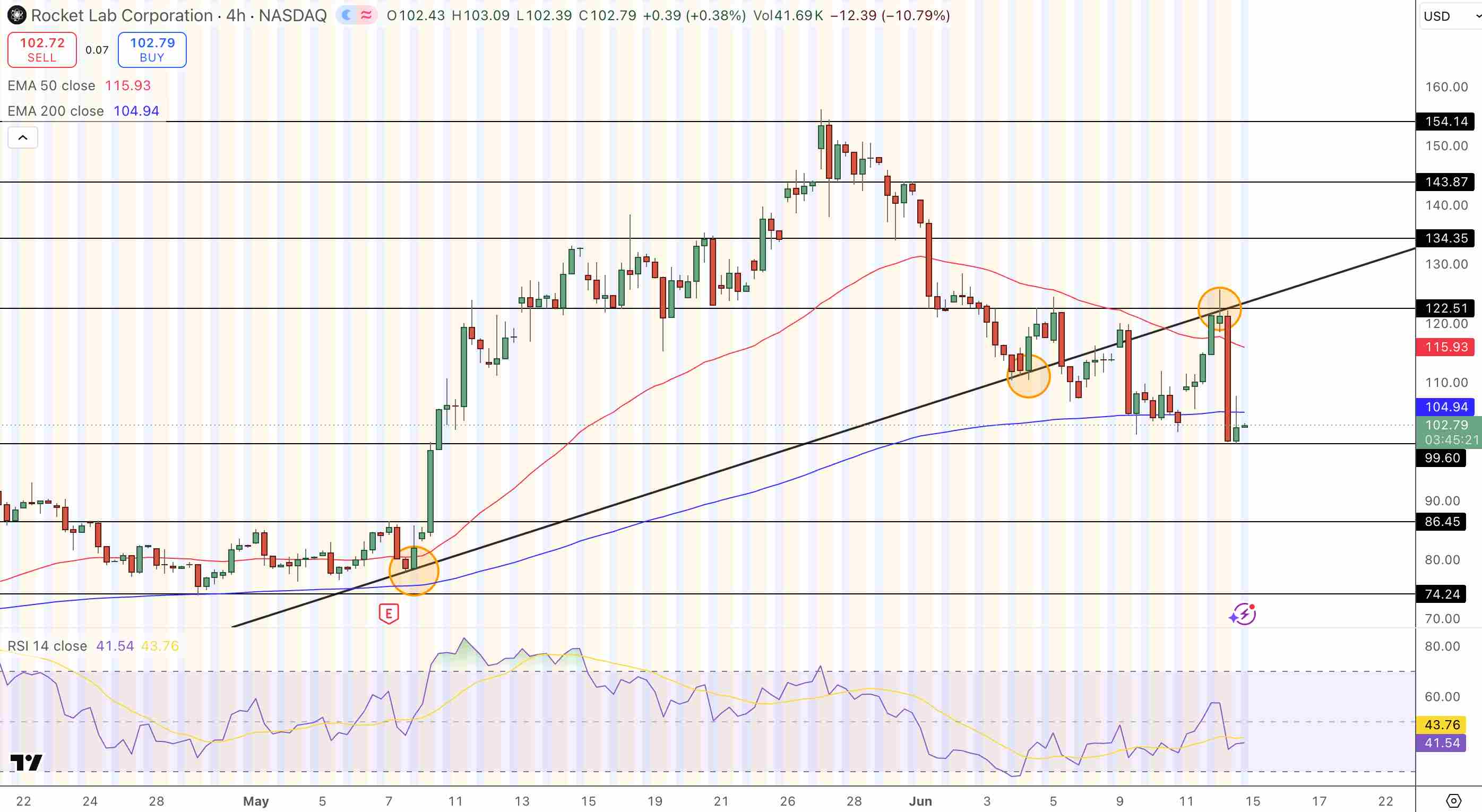
The level map from the original chart reads as follows: a break above the $105 level (50 EMA zone) will maintain a bullish outlook leading through June 22 (Nasdaq-100 event); a break below $94 will likely result in additional downside towards the $80 area, in which case, the short-term technical outlook will need to be revised and reassessed.
Trade Parameters
- Entry Trigger: Execute a long position above $115.90 once the 50 EMA and the descending trendline are decisively breached.
- Primary Target: $122.50, based on the projected upward extension of the current trendline.
- Primary Support Level: $94, representing a critical juncture roughly 11% lower than current pricing.
- Stop Loss Condition: A daily closing price below $99.60 (where the trendline/EMA200 confluence fails).
The Bottom Line
Rocket Lab’s nearly 10% drop on the day of the SpaceX IPO was by far the tamest of its big peers, indicating rotation of funds rather than a revaluation of the company. We reported last quarter with Q1 2026 sales of $344.1M and a $2.2B backlog, the biggest ever. In addition, the firm will be added to the Nasdaq-100 on June 22, which means it will benefit from 10 calendar days of mechanical buys for index funds.
Rocket is now offering Neutron missions for $50M to $55M, rather than the $8.4M it charges for Electron. That is the catalyst for the higher revaluation over time. The company expects first Neutron flight in Q4 2026.
The stock has held the confluence of trendline plus the 200-day exponential moving average at $102.79, the relative strength index reading is 41.54, and there is positive divergence on the indicator. If it closes above $115.90, RKLB could aim for $122.50 next. The next level to watch for support is $94, 11% lower. The stock has a technical setup that has oversold conditions coupled with a specific date for a catalyst.
Recommended Articles






Comments (0)
Click the $ button, enter the symbol, and select to link a stock, ETF, or other ticker.