


D-Wave Quantum Stock Forecast: Can the AT&T Deal Justify QBTS' $7 Billion Valuation?



AI Podcast


D-Wave Quantum is transitioning from a startup to a commercial enterprise, underscored by its expanded AT&T partnership and strategic acquisition of Quantum Circuits. While Q1 revenue was modest, record bookings of $33.4 million highlight growing demand. With $588.4 million in cash and potential U.S. government funding, the firm maintains significant operational runway despite current net losses. Market focus now shifts to the August 6 earnings report, where investors will monitor the conversion of bookings into revenue. Technically, the stock exhibits bullish momentum, though success remains contingent on demonstrating realized commercial viability rather than mere potential.
TradingKey - After announcing an expansion to its partnership with AT&T earlier this week, D-Wave Quantum (NASDAQ: QBTS) is facing a crucial quarter for the stock.
This is significant because this particular relationship reinforces the business case that has been built around D-Wave as a quantum computing company. As the stock climbed higher on July 27 following the announcement, the company was scheduled to report second-quarter results on Aug. 6, and that’s where the real question lies for the stock: Can we see evidence of more demand for enterprise solutions leading to better financial performance?
The stock last traded at around $19.50 on July 28, which suggests the market valued the company at approximately $7.2 billion based on its quarterly revenue so far. That implies an expectation from investors that D-Wave is poised to become one of the first publicly traded quantum computing companies to grow into a viable business. Earnings season is going to give us a much clearer answer.
Why the AT&T Deal Is Significant
The renewed agreement with AT&T is among the biggest commercial milestones for D-Wave to date because it shows how quantum computing can be applied to solve actual problems.
AT&T will apply D-Wave’s quantum annealing technology to solve a variety of network management issues, including routing, employee scheduling, outages and traffic control. In a trial, the telco reduced the time required for one network planning problem from nearly an hour to under 15 seconds.
The collaboration is part of AT&T’s broader push into artificial intelligence. The company said that its AI-driven network agents cut customer downtime by more than 12 million hours in 2025, and now the telco is investigating whether quantum computing can further enhance automation and efficiency.
Whereas gate-based quantum computers aim to tackle general-purpose computing tasks, D-Wave is focused on optimisation issues using quantum annealing, including logistics, production, planning and resource distribution. The company has been able to commercialise quantum computing ahead of its peers by applying the technology to practical problems across several verticals.
While the deal was not broken down financially, it provides yet another data point that major corporations are starting to move from research to real-world operations in quantum computing.
Strong Bookings Indicate Growing Interest
Revenue remains relatively low, but bookings are indicating a sharp uptick in demand.
First-quarter revenue came in at $2.9 million, primarily declining from a year ago due to a $12.6 million one-off quantum computer sale in the prior quarter.
However, bookings were at a record $33.4 million, up 1,994% year over year. That included a $20 million system purchase by Florida Atlantic University, along with a $10 million two-year Quantum Computing as a Service agreement with a Fortune 100 company.
Those deals indicate demand continues to build among large businesses, even though the timing of revenue recognitions may delay the accounting impact. Earnings will show whether Q2 revenue starts to convert bookings into recognisable income, offering further confirmation that the company’s go-to-market strategy is working.
Financial Position Supports Continued Growth
D-Wave remains in investment mode, focused on building its products and attracting customers rather than turning a profit.
Net loss came in at $18.4 million in the first quarter as operating expenses increased following management’s decision to invest in research, engineering and commercial activity after acquiring Quantum Circuits.
The company closed the quarter with $588.4 million in cash and investments, which gives it significant runway to develop new products and expand without having to raise additional capital anytime soon.
Acquisition of Quantum Circuits Expands Market Opportunity
D-Wave had historically specialised in quantum annealing, so the acquisition of Quantum Circuits brings significant expansion to its technology portfolio.
The company will now be able to use superconducting gate-based quantum computing, opening the door to more commercial and academic applications.
The company’s management team sees the combination of the two technologies as a means to create a more powerful competitive advantage, which should help D-Wave grow across enterprise, government and scientific markets.
Meanwhile, D-Wave’s Advantage2 platform continues to be widely used. Year-over-year usage grew by 314%, as clients submitted more than 200 million problems through its hardware and cloud services.
The integration is another area of uncertainty for D-Wave as management attempts to seamlessly integrate two different types of quantum computing technology while containing R&D spending.
Government Support Adds Another Catalyst
In addition to commercial demand, D-Wave is also receiving backing from the US government. Earlier this year, D-Wave signed a letter of intent to secure up to $100 million in funding under the US CHIPS and Science Act, which seeks to enhance the US competitive position in advanced computing technologies like quantum computing in North America.
While the company does have plans to issue more shares, which will dilute existing shareholders, government backing will increase the company’s financial security and allow it to ramp up research into next-generation quantum computers.
D-Wave Quantum Price Prediction is Technical Analysis Shows a Strong Buy Signal
Technically speaking, D-Wave has flashed one of its strongest buy signals in recent weeks. The stock recently broke out of a descending channel that has been providing resistance. The breakout has seen the stock move above both the upper boundary of the channel and the 50-period EMA at $18.46, indicating a resurgence in buying pressure after bouncing off $16.12. The next key resistance level is at $19.50, followed by the 200-period EMA at $21.01. A move above this level may allow the stock to reach $24.18. The momentum indicators paint a similar picture.
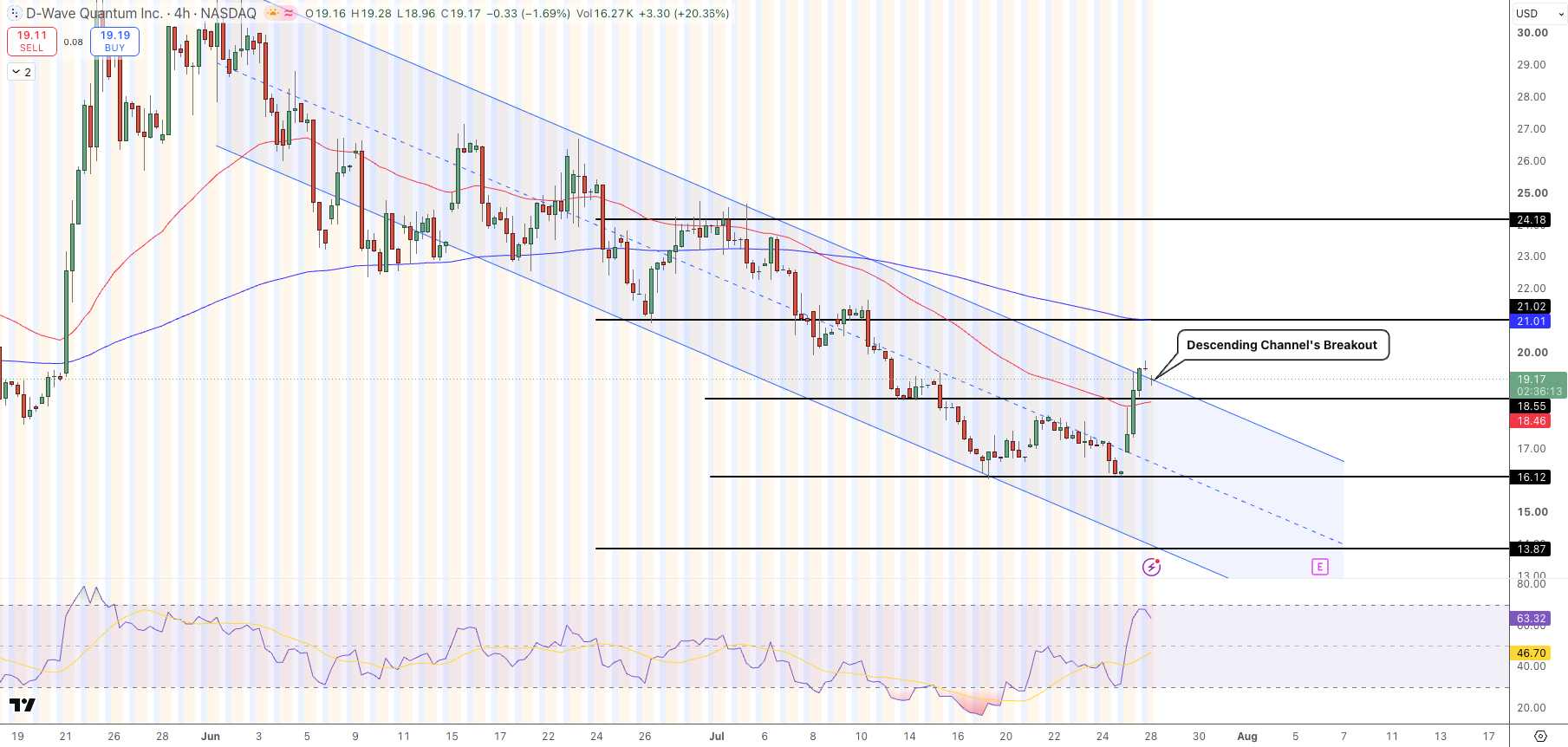
D-Wave Quantum Stock Price Chart - Source: Tradingview
The RSI has risen to 63, indicating bullish momentum, though it is not yet overbought. The previous channel high at $18.55 will likely be the initial support level. Should the stock hold above $18.55, the bullish breakout is still intact. However, if the price falls below $18.55, D-Wave could once again target $16.12.
Key Levels
- Q2 Earnings Date: August 6, 2026
- Market Cap: approximately $7.2 billion
- Q1 Revenue: $2.9 million
- Record Bookings: $33.4 million
- Cash & Marketable Securities: $588.4 million
- RSI: approximately 63
- Support: $18.55, $16.12, $13.87
- Resistance: $21.01, $24.18
Conclusion
D-Wave Quantum is currently at a transition stage, where it is shifting from being a startup to a commercial quantum computing company. The expanded AT&T deal, high bookings and the Quantum Circuits acquisition enhance D-Wave’s growth prospects in the long term by extending customer reach and adding to its product offerings. But there is also some risk since the shares have already surged in anticipation of the company becoming commercially viable. In other words, the market is no longer just pricing in the potential of quantum computing. It is pricing in the realization.
Therefore, in the upcoming August 6 Q2 earnings report, investors will be looking to see if record bookings are translating into actual revenue, whether corporate clients are ramping up usage, and whether the company can prove that it is making real progress towards becoming a profitable enterprise with a solid balance sheet.
Frequently Asked Questions
When is D-Wave’s earnings report due?
D-Wave will release its second quarter 2026 earnings results before market opens on August 6, 2026.
How important is the AT&T partnership?
The partnership is important as it shows quantum computing is being used to solve real-world problems. AT&T is using D-Wave’s system to improve its network routing, scheduling and traffic management.
Why are bookings an important metric?
Bookings are seen as an early indicator of future revenue because it typically takes time for quantum solutions to be implemented and booked.
What are the important technical levels?
Support is at $18.55 and $16.12. Resistance is at $21.01 and $24.18.
Recommended Articles








Comments (0)
Click the $ button, enter the symbol, and select to link a stock, ETF, or other ticker.