


Sandisk Stock Forecast: Can AI Storage Demand Justify SNDK's Premium Valuation Ahead of Earnings?



AI Podcast


Sandisk faces a pivotal August 5 earnings report following a successful fiscal Q3, where disciplined NAND pricing and strong enterprise SSD demand drove significant margin expansion. While AI infrastructure spending remains a primary growth catalyst, market focus has shifted to the sustainability of these margins through fiscal 2027. Despite robust cash flows and strategic R&D, investor sentiment is tempered by high valuations and potential hyperscale spending volatility. Technically, the stock remains in a downward channel; upcoming earnings and the August 13 Investor Day will be critical in determining whether the firm can justify its current market premium.
TradingKey - Sandisk (NASDAQ: SNDK) kicks off a pivotal week as the flash memory maker prepares to announce its fiscal fourth-quarter earnings on August 5. Having emerged as one of the semiconductor industry’s biggest winners from the AI infrastructure buildout, the company now needs to demonstrate that the rapid earnings growth it has enjoyed can keep pace with sky-high expectations.
The stock has traded erratically in July as traders have taken profits in multiple AI plays. The fundamental bull thesis revolves around long-term enterprise storage demand, but the markets are fixated on what the company expects its fiscal 2027 full-year outlook to look like, specifically whether NAND pricing, hyperscale capex, and enterprise SSD sales will be able to sustain margin expansion.
Following the earnings announcement on August 5, Sandisk is scheduled to host its annual Investor Day on August 13, where it is expected to outline additional specifics about its AI storage strategy and its future product pipeline.
Fiscal Q3 Results Show Robust Recovery in the NAND Market
The results Sandisk reported for fiscal Q3 highlight how significantly the NAND market has bounced back. Revenue came in at $5.95 billion and adjusted earnings per share hit $23.41, marking one of the most impressive turnarounds in the memory business.
Unlike prior cycles where NAND revenues recovered primarily because of shipment growth, this turnaround was supported by much better pricing. Average selling price per gigabyte jumped while the number of units shipped remained fairly flat, showing that the industry has been disciplined in controlling supply.
The increase in ASP drove an outsized improvement in gross margin, too. But now, the big question facing investors is whether margins will stay at these elevated levels if NAND ASPs start to decline. Even a small dip in ASP could significantly impact earnings since Sandisk is operating out of a much higher base.
AI Is Fueling Enterprise Storage Demand
AI has become a major catalyst for storage demand within the semiconductor industry. Large language models require a significant amount of high-capacity storage for data collection and model training, inference, and long-term archiving.
To capitalize on the trend, Sandisk has focused on the enterprise SSD segment where it sells to hyperscale cloud providers and other large enterprise customers. In comparison, consumer flash drives are low-margin businesses.
That focus has paid off. During the prior quarter, data center revenue increased 645% year over year thanks to both higher ASPs and volume growth. Management said that revenue has continued to grow sequentially as hyperscalers ramped up their AI infrastructure buildouts.
Enterprise SSDs have the added benefit of higher margins, longer customer lifecycles, and more predictable order patterns compared to consumer SSDs, reducing the inherent cyclicality of the memory business.
Sandisk has also been able to gain visibility on revenues through long-term customer contracts. Customer prepayments increased materially, indicating that several large customers have committed capital ahead of time to purchase future storage.
That said, there is still the risk of customer concentration, with a few key clients accounting for a significant portion of the company’s quarterly revenue. A cutback in hyperscale spending or a delay in purchase orders could dent future revenues.
Next-Gen NAND Products Should Drive Future Growth
Sandisk is already working on newer NAND technologies to maintain its competitive position and drive long-term revenue growth.
It recently began sampling its BiCS10 1Tb TLC 3D NAND product which provides greater storage capacity, faster performance, and lower power consumption. Those attributes are especially relevant for hyperscale data centers that need massive amounts of storage without skyrocketing energy costs.
Sandisk also benefits from its joint venture with Kioxia which allows both companies to share development expenses and accelerate the creation of new NAND chips. While the relationship makes sense, the success of the project is still subject to execution issues and capacity constraints.
NAND inventories rose slightly during the past quarter as the company planned for customer demand and the launch of new products. But management will be watching inventories carefully going forward for any indication that enterprise demand is slowing.
Strong Balance Sheet
Sandisk’s earnings recovery has been good for the balance sheet. Operating cash flow was significantly higher in the first nine months of FY26. That allowed the company to reduce debt while keeping up investment in R&D. Management thinks that current liquidity is enough to finance capex, working capital, and R&D for the next year.
For investors, though, the big question is no longer whether another quarter will be good. It’s whether the AI-driven demand will keep profits high enough to justify today’s valuation in FY27.
Sandisk Technical Analysis
Technically, Sandisk is still in a downward channel after pulling back toward the $1,125 support zone. The lower highs and lower lows are telling us that the bears are still in charge.
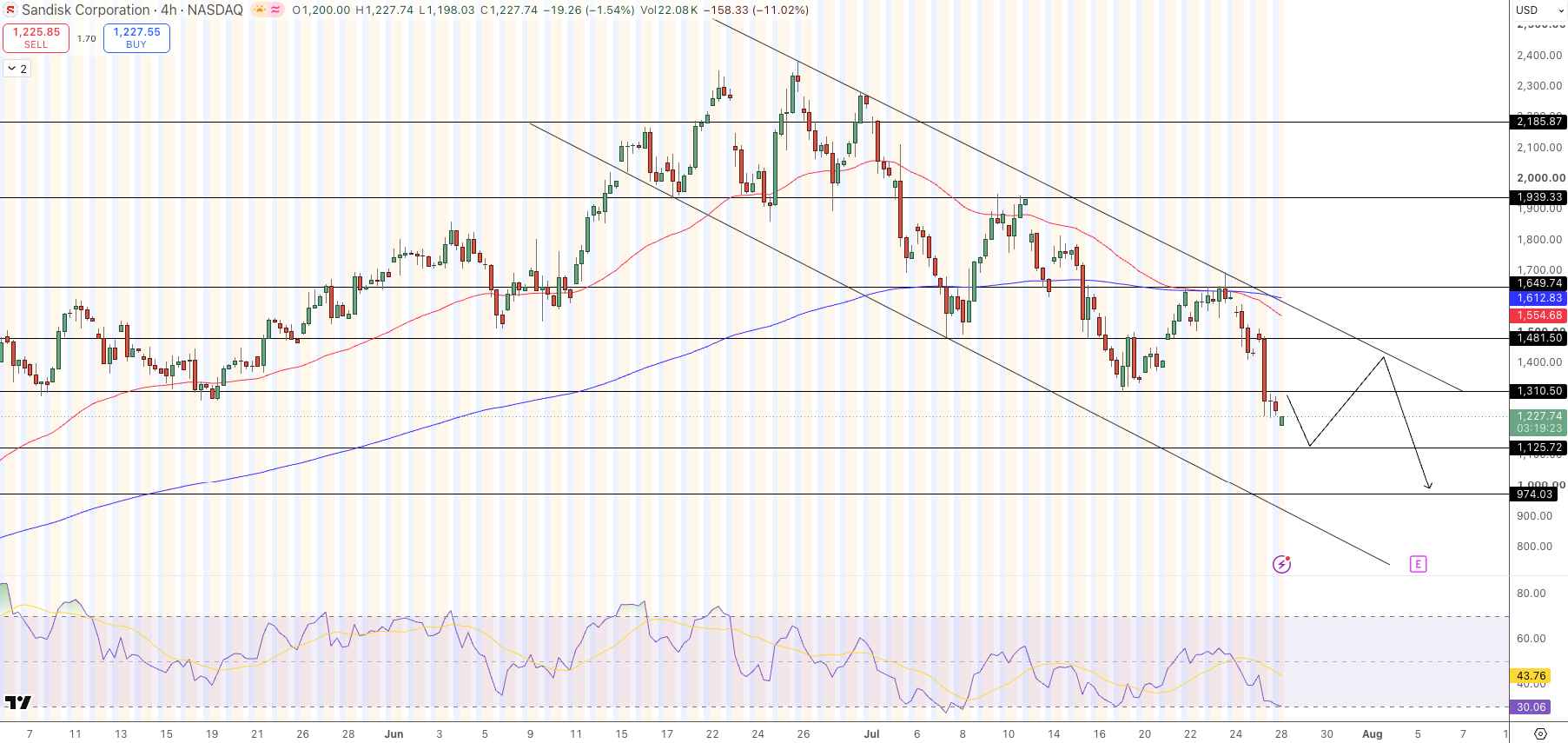
Sandisk Stock Price Chart - Source: Tradingview
The stock is still under the $1,310 resistance, and the 50-period EMA ($1,555) is under the 200-period EMA ($1,613). The RSI is hovering around 30, but even if it triggers a short-term bounce, that isn’t usually enough to change the trend.
A move above $1,310 would put Sandisk back in the bullish camp and open up $1,482, then $1,555, and $1,613. But falling below $1,125 could drag the stock down to $974.
Key Levels
- Next earnings date: August 5, 2026
- Investor day: August 13, 2026
- Q4 revenue guidance: ~$8B
- Adjusted EPS guidance: ~$31.50
- RSI: ~30 (oversold)
- Support: $1,125, $974
- Resistance: $1,310, $1,482, $1,555, $1,613
Bottom line
Sandisk is one of the most obvious beneficiaries of the AI infrastructure spending. Enterprise SSD sales and disciplined NAND pricing have given the company better margins, better cash flow, and closer ties to the hyperscalers. But the good news has been priced in, and the market is now waiting for proof that the AI-driven demand will stay strong enough to keep those margins high through FY27.
That makes the earnings call on August 5 and the Investor Day on August 13 two very important events. Continued strength in enterprise SSD demand and supply discipline, along with upbeat guidance, would cement Sandisk’s status as a top AI play. But if we see signs of weaker NAND pricing or a slowdown in hyperscale spending, the stock could drop as the market re-evaluates the future of one of the fastest-growing stocks in the semiconductor industry.
FAQs
When will Sandisk report earnings?
Sandisk will report fiscal Q4 and full-year 2026 earnings on August 5, 2026, and Investor Day on August 13.
Why is AI important for Sandisk?
AI workloads need fast, reliable storage, which means more demand for enterprise SSDs and advanced NAND flash for hyperscale data centers.
Why has Sandisk stock pulled back?
The pullback is due to profit-taking and high expectations before earnings, not weakness in the business.
What are the key technical levels?
Resistance: $1,310, $1,482, $1,555, $1,613. Support: $1,125, $974.
Recommended Articles








Comments (0)
Click the $ button, enter the symbol, and select to link a stock, ETF, or other ticker.