


Nvidia Vera Rubin Ramp-Up Triggers Global Memory Shortage, SanDisk Nears $2,000 Mark. Mizuho Sees $2,200



AI Podcast


Storage stocks rallied as SanDisk neared $2,000, driven by an intensifying global storage supply crisis. NVIDIA's new AI accelerator launch, coupled with cloud providers securing future capacity, points to deepening DRAM and NAND shortages from H2 2026, expected to worsen through 2027. Storage prices are projected to remain strong for two to three years, with manufacturers confident in contract price increases. AI is the primary driver of this imbalance, with demand growth outpacing sluggish supply expansion until 2028. Despite IPO market activity, Goldman Sachs views 2026 issuance as not signaling an end to the bull market.
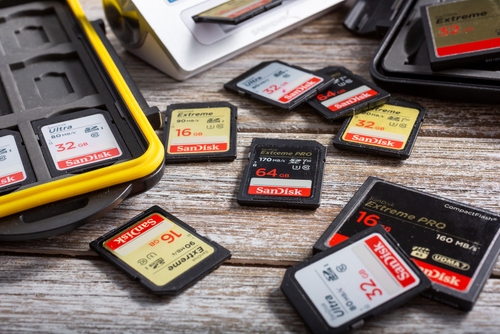
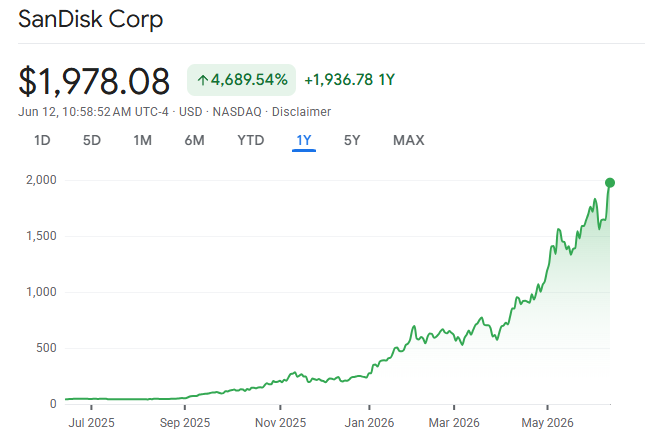
TradingKey - On June 12, storage stocks led the gains, with SanDisk ( SNDK) share price is approaching the $2,000 mark, hitting an intraday high of $1,996.77 today. Notably, the NAND flash semiconductor supplier has seen its shares surge approximately 50 times year-to-date.
As of press time, within the storage sector, Seagate Technology ( STX) rose 5.25%, Western Digital ( WDC) gained 4.77%, and SanDisk rose 3.43%.
On the news front, as NVIDIA's ( NVDA) next-generation AI accelerator, Vera Rubin, enters its ramp-up phase, the global storage market is facing a deepening supply crisis.
Supply chain sources revealed that major cloud service providers have already locked in all long-term agreement capacity for 2027 and are pre-positioning for 2028 supply. The pressure of storage shortages is expected to intensify continuously starting from the second half of 2026.
This supply pattern is propagating throughout the entire industry chain. Shortages in the DRAM and NAND markets are expected to expand further from the second half of 2026, with widespread industry expectations that the shortage in 2027 will exceed that of 2026. For investors, storage prices are expected to remain strong over the next two to three years, and the market remains optimistic about the upside potential for manufacturers' contract prices.
Industry sources pointed out that the structure of long-term agreements varies by supplier; while only a few require down payments, the majority involve customers first committing to expected purchase volumes, which suppliers then use to adjust expansion schedules, with final prices confirmed only before actual shipment. This arrangement indicates that storage manufacturers remain fully confident in the upside potential for contract prices over the next two to three years.
Furthermore, Mizuho recently raised its price target for SanDisk from $1,825 to $2,200. The firm noted that artificial intelligence remains the core driver of the current supply-demand imbalance in the storage market, and that rising industry demand through 2027 and 2028 is expected to further exacerbate the supply crunch.
The firm stated that in the NAND flash market, enterprise solid-state drives (eSSD) have become the core driver of demand growth. It expects global NAND demand to grow by 18% year-over-year in both fiscal years 2026 and 2027. However, growth on the supply side is sluggish, with wafer starts projected to decline by 5% year-over-year in 2026 and grow slightly by 3% in 2027; significant new industry capacity is not expected to come online until 2028.
Notably, today marks the first day of SpaceX's listing. The market is concerned that the IPO will absorb existing investor allocations, thereby exerting valuation pressure on AI supply chain leaders such as Micron and SanDisk.
Goldman Sachs, meanwhile, judges that the record volume of U.S. equity issuance in 2026 will not end the current bull market. The firm stated that while IPO activity is heating up, it has not reached extreme levels. Approximately 100 IPO deals are expected in 2026, close to the average of the past 25 years. In contrast, the number of IPOs exceeded 250 in 2021 and approached 400 in 1999 during the dot-com bubble.
Relative to the total equity market, the scale of new supply remains limited. Goldman Sachs estimates that the total volume of corporate equity issuance in 2026 will be approximately $700 billion, representing only about 1% of the total market capitalization of the Russell 3000 Index, largely consistent with the average level from 2015 to 2019.
This content was translated using AI and reviewed for clarity. It is for informational purposes only.
Recommended Articles








Comments (0)
Click the $ button, enter the symbol, and select to link a stock, ETF, or other ticker.