


Micron Stock Price Forecast: Shares Down More Than 30%, Will the Decline Continue?



AI Podcast


As of July 29 Eastern Time, Micron Technology shares have corrected over 30% from their June peak. This pullback stems from profit-taking following a 300% year-to-date gain, executive share sales, and concerns regarding future industry competition. Despite the price decline, Micron’s fundamentals remain robust, with record revenue and strong AI-driven demand for HBM and DRAM through 2027. While short-term technicals suggest further downside pressure with support at $750, long-term valuation remains supported by secular AI growth. Investors should monitor semiconductor sector volatility, supply-demand dynamics, and potential export policy shifts as key risks to the outlook.

TradingKey - As of July 29 Eastern Time, Micron Technology ( MU )'s stock price has experienced a cumulative correction of more than 30% from the all-time high set at the end of June. Although the company's previously released third-quarter results for fiscal 2026 and its fourth-quarter guidance both hit record highs, the market did not continue to chase the stock higher, opting instead to take profits. Against the backdrop of still-robust demand for AI memory, why does Micron's stock price continue to pull back? Can it still rise in the future?
Why Are Micron Shares Falling?
Micron's recent stock price adjustment is not due to a sudden deterioration of fundamentals, but rather the result of a combination of high valuation, market sentiment, and expectations of industry competition.
First, profit-taking is a major reason for this correction. Driven by the AI wave, Micron once became one of the strongest-performing semiconductor stocks in 2026, with its stock price achieving a cumulative maximum gain of over 300% this year. With rapid valuation expansion, some capital chose to lock in profits after the company announced record financial results, forming a classic 'sell-the-news' pattern.
Meanwhile, the recent share sale plan disclosed by the company's CEO, Sanjay Mehrotra, has also affected market sentiment to some extent. According to filings disclosed by the U.S. Securities and Exchange Commission (SEC), Mehrotra sold a portion of Micron stock based on a pre-established 10b5-1 trading plan. This type of divestment is a common asset management arrangement for executives of U.S. listed companies and does not necessarily mean that management is bearish on the company's prospects. However, because the sale occurred after a significant rise in the stock price, it still triggered concerns among some investors regarding current valuation levels, further intensifying the pressure to realize short-term profits.
In addition, the market has begun to worry about intensifying future competition in the AI memory industry. The recent sharp correction in the stock price of South Korea's SK Hynix, along with the technological progress of Chinese memory manufacturers, has raised investor concerns over increased future DRAM and NAND supply, which could cause AI memory chip prices to gradually return to rational levels and drag down the valuation of the entire memory sector. Affected by this, the stock prices of memory chipmakers such as Micron and Samsung Electronics have also come under pressure.
However, looking at its financial performance, Micron's fundamentals remain very strong. The company's fiscal third-quarter 2026 revenue reached $41.46 billion, a significant increase from the previous quarter's $23.86 billion, hitting a record high; GAAP net income was $28.24 billion, and operating cash flow reached $25.39 billion. Meanwhile, the company expects fourth-quarter revenue to be approximately $50 billion, with a gross margin of around 86%, continuing to set new historical records. Sanjay Mehrotra stated that the AI era continues to drive robust demand for HBM, DRAM, and enterprise SSDs, and Micron has signed multiple long-term supply agreements with major customers, significantly improving revenue visibility for the next few years.
Therefore, this round of stock price correction reflects a market repricing of future expectations rather than a significant deterioration in the company's operations. Executive share sales, expectations of industry competition, and valuation corrections have collectively amplified the magnitude of the short-term adjustment, but AI memory demand and the company's profitability remain the core factors supporting Micron's long-term value.
Can Micron Stock Fall Further?
From a medium-to-long-term perspective, AI remains the core logic supporting Micron's valuation.
As Microsoft ( MSFT ), Meta ( META ), Alphabet ( GOOGL ), Amazon ( AMZN ), and other tech giants continue to expand their AI capital expenditures, demand for HBM, high-performance DRAM, and enterprise SSDs continues to grow rapidly. As an indispensable core memory for AI GPUs, overall supply remains tight at present. Micron's management previously stated that the company's HBM capacity is basically sold out through 2027, which means that revenue over the next two years has a high degree of certainty.
Meanwhile, Micron is accelerating its advanced packaging and HBM4 product layouts. The company has begun large-scale shipments of HBM4 products to major customers and is providing HBM4E samples to multiple clients, further enhancing its competitiveness in the AI memory market. With the successive release of next-generation AI GPU platforms, Micron is expected to continue to benefit from the AI server upgrade cycle.
Institutions remain optimistic about Micron's long-term prospects. Visible Alpha statistics show that most Wall Street analysts still maintain a "Buy" rating, and the average market target price is significantly higher than the current stock price, suggesting that this round of adjustment is more of a valuation correction rather than the end of the AI memory boom cycle. Some institutions pointed out that Micron's current forward P/E ratio is already significantly lower than that of large AI chip companies, and with continuous earnings growth, its valuation attractiveness is increasing.
However, in the short term, Micron's stock price still faces three risks. First, if the global semiconductor sector continues to adjust, funds may further flow out of the AI hardware sector; second, if future HBM supply grows faster than demand, the market may lower its memory chip price expectations ahead of schedule; third, if the U.S. further tightens its chip export policies toward China, it could also affect the growth of some of Micron's businesses.
Micron Stock Price Technical Analysis
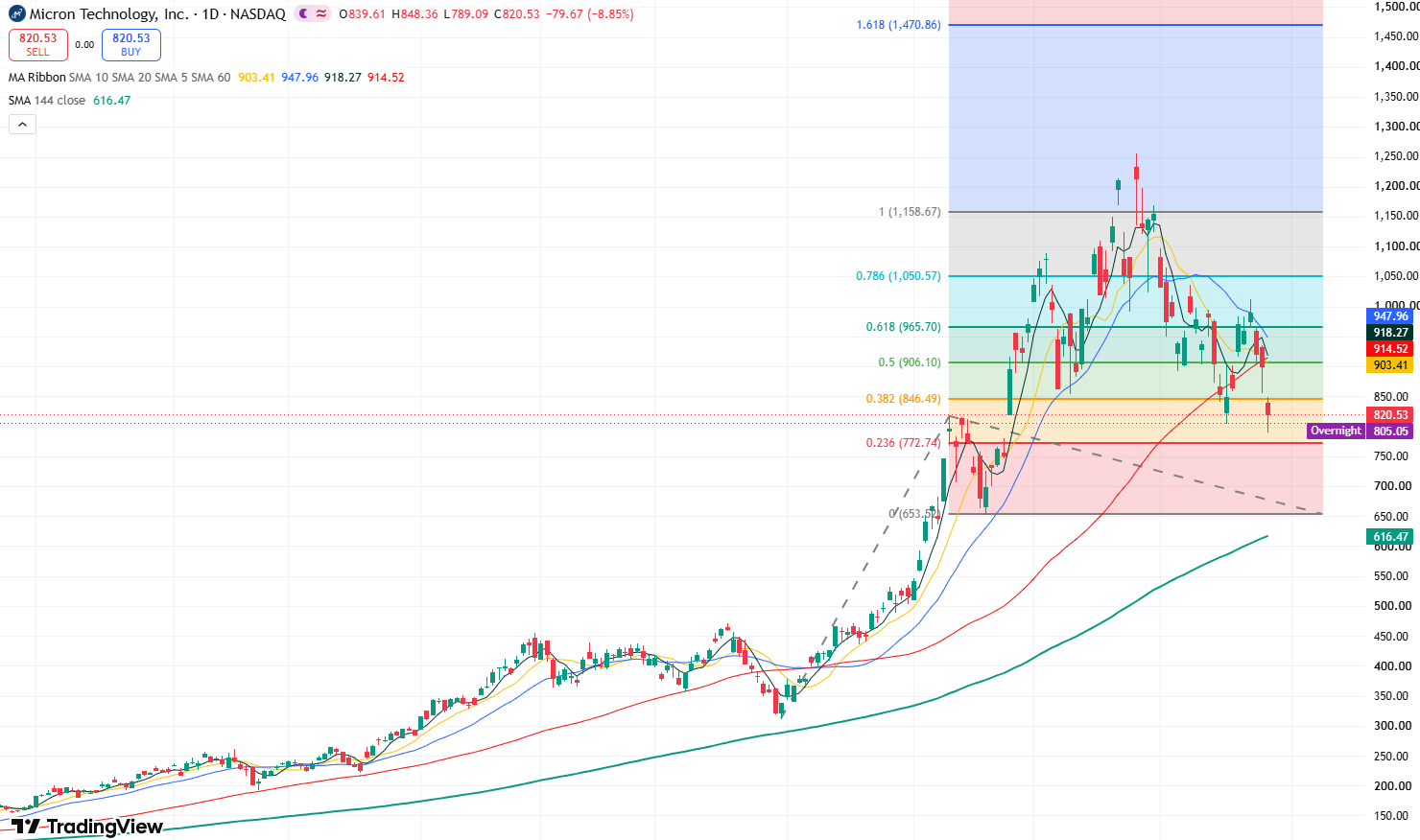
Micron daily stock chart, Source: TradingView
Looking at Micron's daily stock chart, after hitting an all-time high of $1,255 at the end of June, the stock price has continued to pull back recently. As the stock price broke below the $850 support level, the upward trend was disrupted, indicating that the recent movement has entered a deeper correction phase.
Currently, the stock price is trading within a descending channel, and trading volume has expanded during the decline, indicating that some profit-takers are still exiting the market. There may still be downside potential in the short term.
On the downside, the primary support level below to watch is the $800-$750 range. If the stock price breaks below $750, it may further test the support level around $650.
On the upside, the key resistance level to watch above is $850. If it breaks through this level, the stock price may move upward to fill the gap between $840 and $900, and further up, attention should be paid to the $1,000 mark.
This content was translated using AI and reviewed for clarity. It is for informational purposes only.
Recommended Articles










Comments (0)
Click the $ button, enter the symbol, and select to link a stock, ETF, or other ticker.