


Microsoft Q4 Earnings Beat Expectations Across the Board: Why Shares Surged 9%



AI Podcast


Microsoft reported strong fiscal fourth-quarter 2026 results on Eastern Time July 29, with revenue of $90.01 billion and adjusted EPS of $4.74, both exceeding expectations. Azure revenue grew 43% year-over-year, surpassing $100 billion annually as AI infrastructure investments translate into tangible demand. Management maintained existing capital expenditure plans while improving utilization efficiency, alleviating market concerns regarding margin erosion. Furthermore, a 84% increase in commercial remaining performance obligations to $678 billion highlights diversified long-term enterprise demand. The company expects Azure growth to accelerate further in the first quarter of fiscal 2027, signaling robust momentum in cloud operations.

TradingKey - Microsoft ( MSFT) earnings proved to the market that large-scale AI spending does not mean profitability is being eroded.
After the market close on July 29, Eastern Time, Microsoft announced its fourth-quarter fiscal 2026 financial results for the period ended June 30, 2026, with revenue, profit, and cloud business performance all exceeding Wall Street expectations.
Specifically, Azure and other cloud services revenue grew 43% year-over-year, significantly higher than market estimates, driving Azure's full-year revenue past the $100 billion mark for the first time, and showing investors that AI infrastructure investments are gradually translating into actual results.
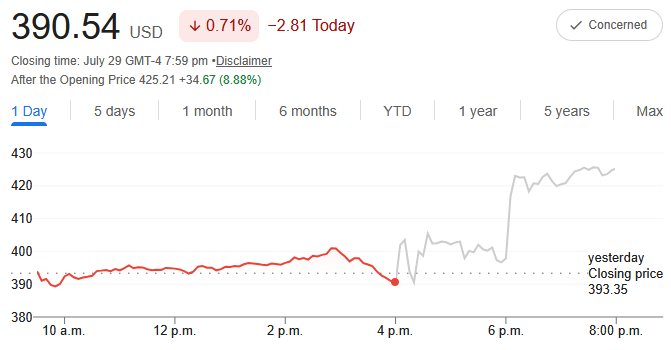
Boosted by the strong earnings, Microsoft's stock price surged as much as 8.88% in after-hours trading. Year-to-date, the company's stock price had at one point fallen by a cumulative total of more than 17%.
Source: Google Finance
Microsoft Beats Expectations Across the Board With Azure as Biggest Highlight
Microsoft's fiscal fourth-quarter revenue reached $90.01 billion, up 18% year-over-year, which was about 2.6% higher than market expectations; adjusted earnings per share (EPS) was $4.74, up 23% year-over-year, beating the market consensus by over 11%; operating income reached $40.6 billion, also exceeding market estimates.
This means that although Microsoft continues to ramp up its AI infrastructure investment, its core business still maintained strong profitability, avoiding the significant margin decline previously feared by the market.
Meanwhile, Azure was the business that attracted the most market attention in this earnings report.
In the fiscal fourth quarter, revenue from Microsoft's Azure and other cloud services grew 43% year-over-year, further accelerating from 40% in the previous quarter and also significantly higher than the market's prior expectation of about 40%. Revenue from the Intelligent Cloud segment, which includes Azure, server products, and enterprise services, reached $39.306 billion, up 32% year-over-year.
Microsoft's overall cloud revenue reached $59.3 billion, up 27% year-over-year. For the full year, Azure revenue surpassed $100 billion for the first time, marking a major milestone in Microsoft's history.
These figures directly addressed the question investors have been most concerned about over the past few quarters: whether Microsoft's investments in AI data centers and computing power can generate fast enough revenue growth.
As more enterprises transition generative AI from the experimental phase to actual deployment, demand for GPU computing power, data storage, model training, and inference services continues to rise. After some of the computing capacity bottlenecks previously faced by Microsoft were alleviated, the newly added capacity was quickly converted into Azure revenue, driving a re-acceleration of the cloud business.
Microsoft Chief Financial Officer Amy Hood stated that customer demand still exceeds the company's available capacity. This means that Azure's growth is not driven simply by price adjustments, but is supported by real demand for computing power.
The company expects Azure's constant-currency revenue growth to further rise to about 45% in the first quarter of fiscal 2027, higher than the market's prior forecast of about 41%. If this guidance is achieved, Microsoft's cloud business is still expected to maintain accelerated growth in the short term.
Focus on Hundreds of Billions of Dollars in Order Backlog
In addition to its current-quarter results, the long-term bookings disclosed by Microsoft are also worthy of attention.
As of the end of the fourth fiscal quarter, the company's commercial remaining performance obligations (RPO) reached $678 billion, up 84% year-over-year, which is approximately twice its full-year revenue scale, indicating that a large number of enterprise customers have signed long-term cloud computing and software service contracts for the coming years.
The $678 billion is approximately twice Microsoft's total revenue for fiscal year 2026, meaning the company's future revenue has high visibility. Microsoft also stated that the quarter-over-quarter growth in RPO this quarter was mainly driven by customers outside of large AI model developers, indicating that new bookings for the cloud business do not rely entirely on a few partners like OpenAI.
This is particularly important for Microsoft. Previously, about 45% of the company's commercial remaining performance obligations were related to OpenAI, leading the market to worry about customer concentration risk in its cloud business. Contract growth from other enterprise customers this quarter shows that Azure demand is spreading to a broader range of industries and customer segments.
AI Capital Expenditure Continues to Surge as Markets See Returns
Microsoft's cash expenditures for property and equipment in the fourth fiscal quarter reached $35.802 billion, more than double that of the same period last year. Including finance leases, capital expenditures for the quarter were approximately $41 billion, representing a year-over-year increase of nearly 70%.
Although the scale of spending remains massive, the market reaction differed from the past. This is because, while reporting strong Azure growth, Microsoft did not further raise its existing investment plans.
The company previously projected capital expenditures for calendar year 2026 to be approximately $190 billion. After extending the estimated useful lives of some office buildings and data centers and adjusting the accounting treatment for certain leases, the corresponding reported figure is approximately $175 billion. Microsoft emphasized that this is primarily a change in accounting basis, and actual infrastructure construction plans have not scaled back significantly.
Compared with other tech giants that continue to raise their capital expenditure forecasts, Microsoft keeping its spending plans unchanged was viewed by the market as a more rational capital allocation strategy, which also eased investor concerns over persistent pressure on cash flow.
Microsoft CEO Satya Nadella said that the company is improving the utilization efficiency of CPUs and GPUs, and reducing AI service costs through in-house models, custom chips, and flexible model architectures. As computing power utilization improves, the same scale of infrastructure is expected to support more customer demand, helping Microsoft boost the return efficiency of its AI investments.
This content was translated using AI and reviewed for clarity. It is for informational purposes only.
Recommended Articles










Comments (0)
Click the $ button, enter the symbol, and select to link a stock, ETF, or other ticker.