


Japan and South Korea Stocks Diverge as KOSPI Falls 1% and SK Hynix Drops Over 6%



AI Podcast


During the Asian session on July 30, Japanese and South Korean markets diverged. The Nikkei 225 rebounded 0.93% to 62,003.09, while the KOSPI fell 1.10% amid persistent volatility. Significant declines in tech heavyweights, including SK Hynix and Samsung, have heightened concerns regarding systemic risk following substantial two-day losses. To stabilize the market, the South Korean government has implemented stricter regulations on leveraged single-stock ETFs, capping retail allocation at 20% to mitigate volatility amplification. The frequent triggering of circuit breakers this year underscores an unprecedented level of market instability requiring active regulatory intervention.
TradingKey - During the Asian trading session on July 30, Japanese and South Korean stock markets diverged in morning trade, with SK Hynix falling over 6%, Samsung down 1%, and SoftBank falling 2%.
The South Korea composite stock index (KOSPI) fluctuated repeatedly after opening higher, and is currently down 1.10% at 5,650.19 points, as market sentiment remains cautious.
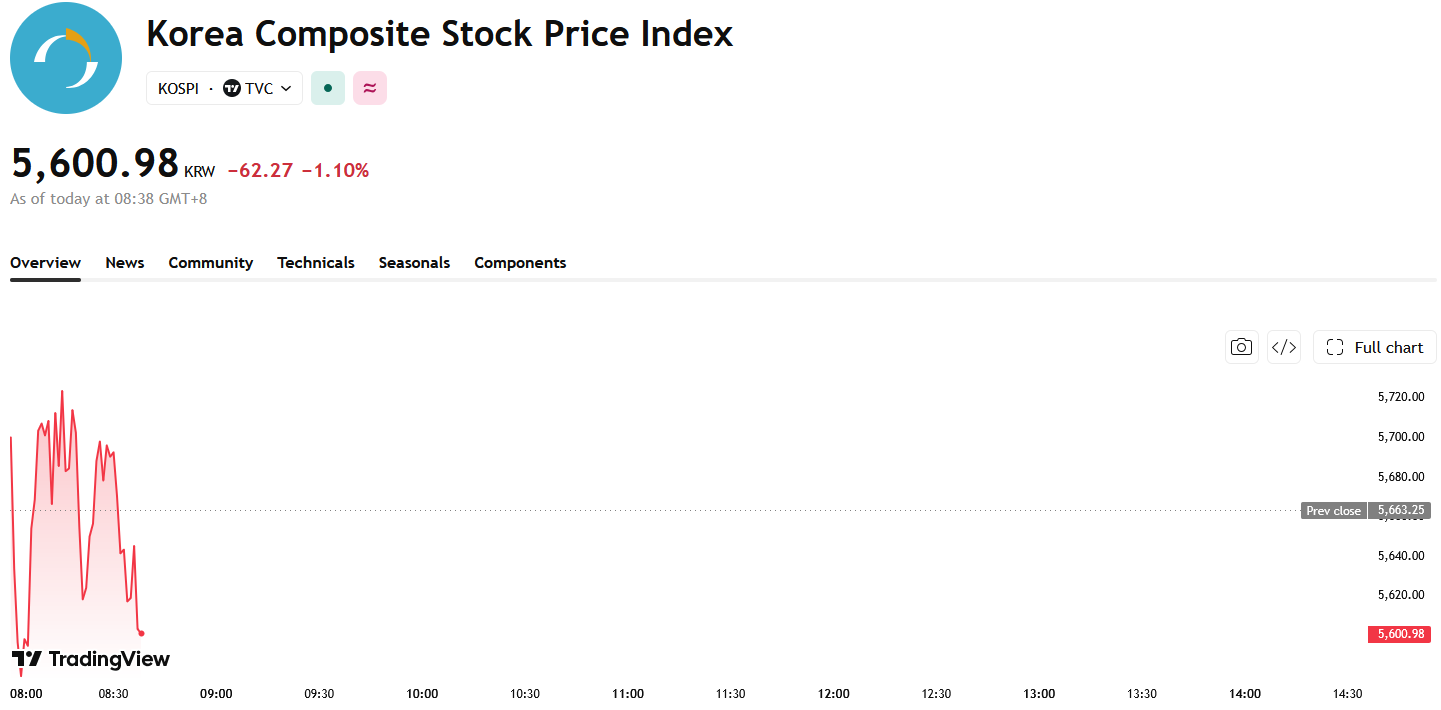
Source: TradingView
Japanese stocks opened lower, dragged down by financial shares, but later rebounded, with the Nikkei 225 index last up 0.93% at 62,003.09 points, recouping some of the losses from the previous trading session.
Among individual stocks, Samsung Electronics fell 1.21% to 206,000 won (about $143); SK Hynix's decline widened to 6.50% to 1,310,000 won, becoming the major drag on the KOSPI.
Kioxia fell 0.34% to 38,250 yen (about $234); SoftBank Group fell 2.27% to 4,612 yen.
Recent continuous and severe volatility in South Korean stock markets has also triggered market concerns over systemic risk. On July 29, the KOSPI closed down 5.98%, and the KOSDAQ index fell 6.12%; in the preceding trading session, both indexes plummeted by 10.84% and 7.72% respectively, suffering heavy losses for two consecutive days.
Data shows that since South Korea established its stock market circuit breaker mechanism, it has been triggered 15 times in total, with 9 of those instances occurring this year alone, reflecting that current market volatility has reached levels rarely seen in recent years.
Following two consecutive trading days of sharp declines in South Korean stocks, the South Korean government swiftly introduced a new round of market stabilization measures. Affected by the KOSPI falling to around 5,600 points, the South Korean government decided to implement stricter regulation on leveraged single-stock ETFs, such as those for Samsung Electronics and SK Hynix, limiting retail investors' allocation in related products to within 20% of their total investment amount to mitigate the magnifying effect of leveraged funds on market volatility.
This content was translated using AI and reviewed for clarity. It is for informational purposes only.
Recommended Articles









Comments (0)
Click the $ button, enter the symbol, and select to link a stock, ETF, or other ticker.