


Micron, SanDisk Rebound Strongly. Morgan Stanley Reveals Truth of Nvidia Spec Cut, Jensen Huang Says Memory Demand Boom May Last Years.



AI Podcast


Storage stocks rebounded after Morgan Stanley refuted market rumors that Nvidia’s reduction in memory configurations for Vera Rubin racks signaled weakening demand. Morgan Stanley clarified the adjustment stems from supply-side constraints, not demand, aiming to mitigate DRAM shortages. This change is expected to be temporary, with higher configurations resuming once supply catches up. The report highlights a potential 2% impact on global DRAM demand in an extreme scenario. Separately, Nvidia and SK Hynix announced a multi-year partnership for next-generation AI memory development, with Nvidia’s CEO indicating a continued memory shortage for several years.
Tradingkey - Last Friday, storage stocks plummeted following rumors that Nvidia would reduce memory configurations for its Vera Rubin racks. For details, see " Market Rumors Nvidia Rubin Platform Plans to Reduce Memory Capacity… ".
The market interpreted news of Nvidia ( NVDA) reducing memory capacity for Vera Rubin racks as a sign of declining memory demand, leading to a 13.25% plunge in Micron and an 11.39% drop in SanDisk that day, marking their largest single-day declines since last year's U.S.-China tariff war.
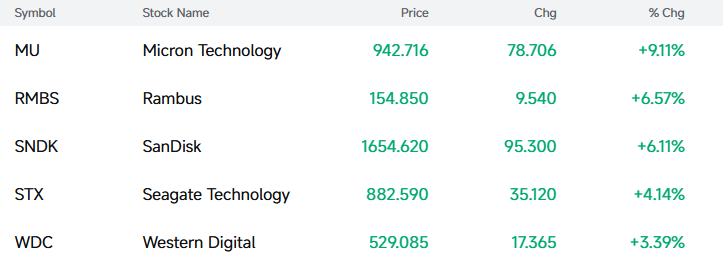
However, Morgan Stanley's latest research report refuted this bearish view, serving as the biggest catalyst for today's rebound in storage stocks. As of press time, Micron Technology ( MU) was up 9.11%, SanDisk ( SNDK) rose 6.11%, Seagate Technology ( STX) rose 4.14%, and Western Digital ( WDC) rose 3.39%.
Morgan Stanley stated that while the reduction in memory configurations for Nvidia's Vera Rubin racks is indeed occurring, it emphasized that the adjustment is driven entirely by supply-side constraints rather than weak demand, suggesting the market's interpretation was completely backward.
The firm noted the sole purpose of the adjustment is to minimize the impact of DRAM shortages on GPU rack sales, which serves as evidence of a genuine shortage. Nvidia and its cloud computing customers are willing to purchase every gigabyte of SOCAMM memory available and will immediately revert to higher configurations once supply catches up.
Regarding the scale of impact, assuming 53,000 to 70,000 racks are built next year with a 55TB configuration, SOCAMM demand from these racks would approach nearly 5% of total global DRAM demand. In an extreme case where configurations are halved, demand would decrease by approximately 1.4 million TB, or more than 2% of the total 6.2 million TB market, specifically affecting high-value segments. Morgan Stanley expects higher-capacity configurations to resume supply shortly after shipments begin.
In terms of market size, JPMorgan expects significant upward revisions to the global memory market size for 2026–2028, with the potential to reach $1.7 trillion by 2028 ($1.237 trillion for DRAM and $454.5 billion for NAND).
Trendforce analysts also pointed out that as HBM technology generations continue to evolve through 2027, increasing chip sizes and rising demand are expected to further exacerbate the displacement of conventional DRAM capacity. This will provide suppliers with justification for raising HBM prices and strengthen their pricing power in next year's HBM negotiations.
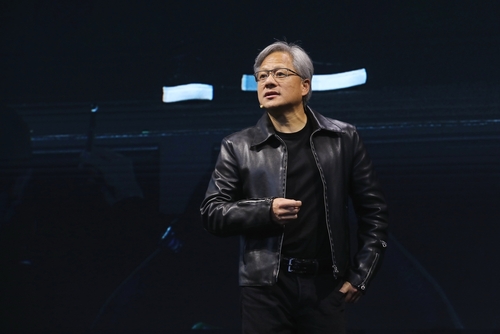
Additionally, amid the market panic, Nvidia CEO Jensen Huang shared positive news: there is currently no end in sight for the memory shortage cycle, as the entire supply chain remains undersupplied and the demand boom could last for several years.
Today, Nvidia and SK Hynix announced a multi-year technical partnership to conduct joint research and development on next-generation memory required for the construction of global AI factories.
Under the agreement, SK Hynix will develop dedicated memory for Nvidia's Vera Rubin AI supercomputer, Vera CPU, RTX Spark PC, and Jetson Thor robotics computing platform.
This content was translated using AI and reviewed for clarity. It is for informational purposes only.
Recommended Articles





Comments (0)
Click the $ button, enter the symbol, and select to link a stock, ETF, or other ticker.