


Tesla (TSLA) Fell 14% After Q2 - Margins Dropped, FCF Negative, Cybercab Under $30K



AI Podcast


Tesla shares fell 14.41% on July 23 after Q2 2026 earnings showed a 38% EPS miss, declining auto margins (16%), and negative free cash flow of $1.09 billion. Despite record deliveries and revenue of $28.24 billion, aggressive promotional pricing and a 142% spike in capex weighed on profitability. Management emphasized long-term growth via Cybercab production and AI investments, supported by the largest order backlog since 2023. Technically, the stock is deeply oversold (RSI 19.9). Investors must monitor the $316.47 Fibonacci support; failure to hold this level could trigger a decline toward the 52-week low of $297.82.

TradingKey - Tesla (NASDAQ: TSLA) saw its shares drop 14.41% on July 23 as second quarter 2026 financials came out showing a 39% earnings per share shortfall, a decline in automotive gross margins in the quarter to 16% from 19% in the prior quarter and for the first time in more than two years Tesla reported negative free cash flow. At $323.55 as of July 24, it was yesterday’s price, it ranged from $315.74 to $352.71 on 114.78 million shares, a far higher 114.78 million than the 31.69 million daily average. The 52-week high is $498.83 and the low has been $297.82.
Yesterday’s decline put Tesla almost at its one year low. The RSI at 19 is deeply oversold. The key price to watch now is the $316.47 Fibonacci support level. Backing that up, Musk said Tesla has started producing Cybercabs which will sell for less than $30,000 prior to 2027 and that Tesla finished second quarter of 2026 with the largest backlog of auto orders since 2023.
What the Q2 Numbers Actually Showed
Tesla’s second quarter results came in mixed, with the market weighing in decisively with a negative outcome. $28.24 billion of revenue came in at 6.84% above the $26.43 billion Wall Street consensus estimate. Tesla reported vehicle deliveries of a record 480,126 units for the second quarter of 2026 and also reported a significant year-over-year rise in energy storage revenue from 13.5 gigawatt hours. Tesla’s vehicle deliveries and energy storage deployments alone suggest that second quarter of 2026 was another volume driven quarter of success.
On the profitability end of things though, a different result. Adjusted earnings per share of $0.33 fell 38.35% short of the $0.54 per share estimate, the largest earnings miss in several quarters. For the second quarter of 2026 GAAP net income came in at $1.11 billion, a figure bolstered by unrealised gains from equity in SpaceX, as was the case for the Alphabet quarter.
The CFO stated on the earnings call that excluding regulatory credits Tesla’s auto margins in Q2 2026 came in at 16% down from 19% in the first quarter of 2026, indicating the promotional financing and rebates used to get the record second quarter 2026 delivery numbers in actually had a significant impact on per vehicle profits.
Operating income for the second quarter 2026 declined 57% to $398 million as operating margin fell from 4.1% to 1.4%. For the second quarter 2026 free cash flow came in at minus $1.09 billion as capex rose 142% to $5.79 billion, with the CFO saying that capital expenditures will continue to rise for the next couple years of time, the guidance for second quarter 2026 total capex over the full year being more than $25 billion.
What Musk Said on the Call That Changes the Long-Term Thesis
Three specific disclosures made by Musk during the July 22 earnings call are important beyond the quarterly numbers. For starters, Musk stated that Tesla has started production of Cybercabs that are going to sell for less than $30,000 before 2027. That price point, confirmed on record, addresses the main concern about whether or not the autonomous ride hailing business can scale at those margins.
Musk said at less than $30,000 per vehicle Tesla can get enough of them into a fleet to have meaningful per-mile profit economics at prices competitive with ride hailing. The same is true of Optimus where Musk acknowledged that getting Optimus robot production to scale was a lot of work, an unusually candid admission that the Optimus robotics timeline is an execution problem, not just an ambition problem.
Second, Tesla CFO said that Tesla ended the second quarter of 2026 with the largest backlog of auto orders since 2023. That’s a positive number directionally that doesn’t fit with a number of the narrative that has been put out there by bears of a second quarter collapse in auto demand. A large backlog means that orders exceed deliveries and this can support future quarter revenues, especially when the current quarter profits are under pressure from promotional pricing.
Third, when talking about second quarter capex Musk said 2026 will be a year of major capital expenditures, a frank acknowledgment that explains the negative free cash flow and the thesis at the same time. The $323.55 Tesla share price represents a decision by Tesla to make big investments in Cybercab, Optimus, and AI computing rather than focus on near-term profit margins in 2026. The 14% single day stock price decline indicates that the market believes it has correctly valued the trade-off between investing in the future and near-term profitability with a trailing P/E of 357.
The Cybertruck Lawsuit and Regulatory Developments
A woman in Texas filed a legal complaint against Tesla this week, saying she lost control of her Cybertruck in autopilot which ran into a barrier on an overpass, while her baby was in the back seat without being hurt, and also Tesla agreed to stop referring to the technology as autopilot in advertisements after a California DMV order regarding deceptive advertising.
The Cybertruck lawsuit adds to the regulatory and litigation context around Tesla’s autonomy claims, without it being a new or structural threat to Tesla. However, the lawsuit underscores the worry of many investors about a perceived gap between how Tesla markets autonomous driving and what autonomous driving currently can do.
TSLA Technical Setup
On the 4-hour chart, at a price of $324.20, TSLA sits beneath its 50-period moving average of $377.17, the 200-period moving average at $394.82, and a major descending trendline. The RSI has hit 19.9, registering deeply oversold levels and marking its lowest point for at least a year.
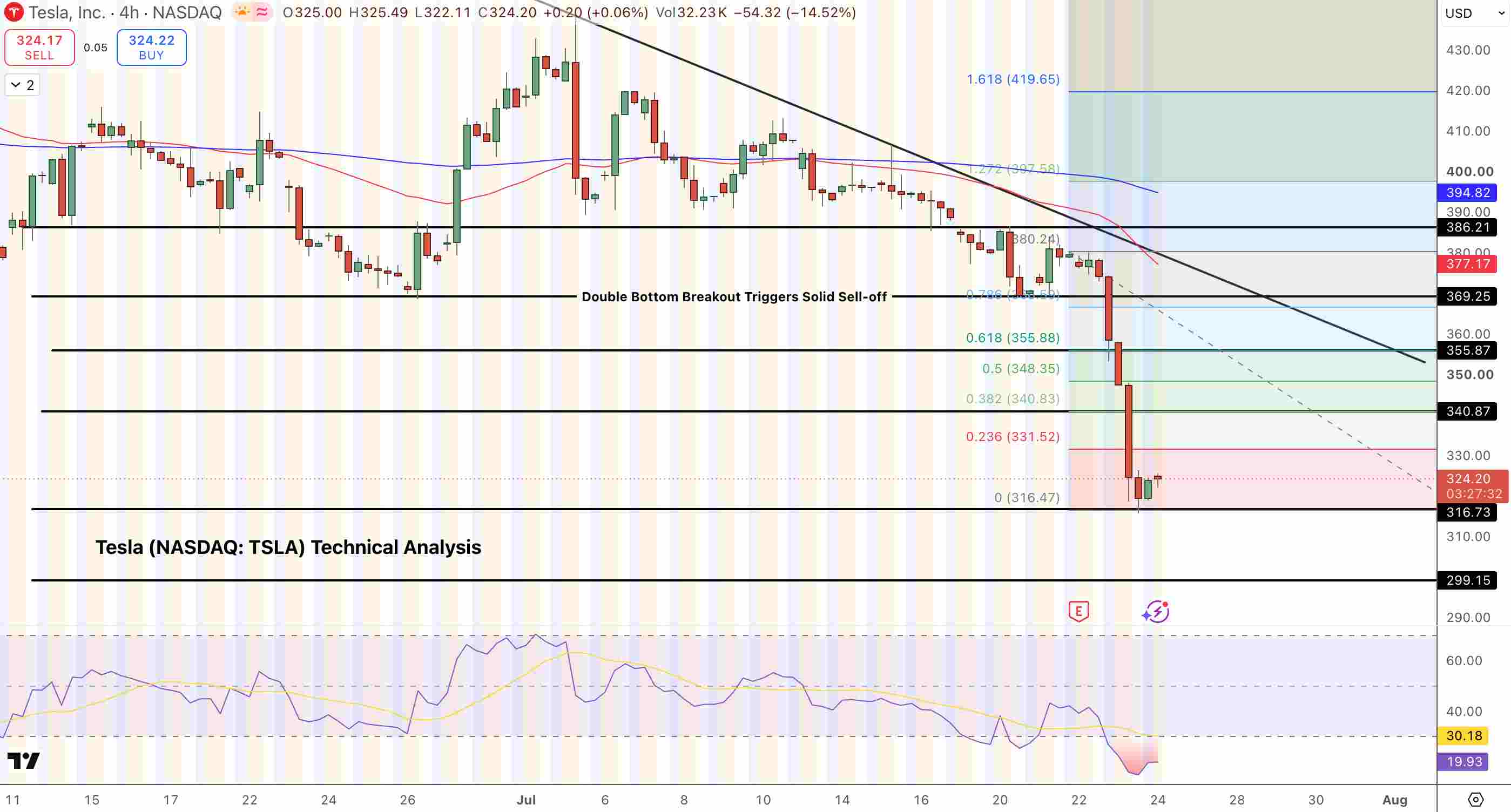
Tesla (TSLA) Price Chart - Source: Tradingview
Yesterday, the stock touched $315.74, testing the $316.47 Fibonacci support zone. Provided it holds above the $316.47 mark, we may expect a relief rally toward $331.52 (the 23.6% Fibonacci extension), followed by potential targets at $340.83 and $348.35. However, should the price close below $316.47, the next support appears at $299.15, with the 52-week low of $297.82 coming into play.
While the oversold RSI suggests a bounce is the more likely short-term scenario, the overall trend remains bearish as long as TSLA is priced under $377.
Key Levels
- Q2 Earnings Per Share: $0.33 vs. $0.54 consensus (a drop of -38.35%). Non-credit adjusted auto margins are 16%, a decline from 19%.
- Revenue: $28.24 billion, outpacing the $26.43 billion forecast (+6.84%). Free cash flow (FCF) came in at -$1.09 billion. Capital expenditures were $5.79 billion, representing a 142% year-over-year increase.
- Cybercab: Production is underway, with confirmed pricing under $30,000 prior to 2027.
- Backlog: By the end of Q2, Tesla held its biggest car backlog since 2023.
- RSI: 19.9. For comparison, the 52-week trading range sits between $297.82 and $498.83.
- Support: The $316.47 level (critical 0% Fib) is key. If it breaks, look at $299.15 and $297.82 (the 52-week low).
- Resistance/Bounce Targets: $331.52 (23.6% Fib), $340.83, and $348.35.
Bottom Line
TSLA is down 14.41% on July 23, driven by Q2 EPS falling short by 38%, the auto segment margin at 16% down from 19%, and the company posting a negative FCF. The bullish side is the announcement at the earnings call: Cybercab production is starting before 2027 for under $30,000 per vehicle, and the company ended the quarter with its largest car order book since 2023. At $323.55, TSLA is within striking distance of the 52-week low at $297.82 with its RSI at 19.9 (i.e., extremely oversold).
At $316.47 the 0% Fibonacci level is critical for short-term survival. A successful defense of that level sets up a bounce toward $331 to $340. A failure to defend $316.47 opens up $299.15 and then $297.82. The long-term autonomy investment looks good. But the near-term profitability picture is not so rosy.
Recommended Articles






Comments (0)
Click the $ button, enter the symbol, and select to link a stock, ETF, or other ticker.