


Rocket Lab Earnings Greatly Exceed Expectations, Ignoring Risks as Stock Price Surges?



AI Podcast


Rocket Lab shares surged 34.22% on May 8 following a strong Q1 earnings report, with revenue reaching $200.3 million, up 63.5% YoY, and a record GAAP gross margin of 38.2%. The company secured significant launch contracts, pushing its backlog to a record $2.2 billion. However, the Neutron rocket's maiden flight, crucial for valuation, faces execution risks and potential delays, impacting future revenue. Rocket Lab remains unprofitable, with substantial R&D investment in Neutron. The current market valuation appears to price in optimistic assumptions regarding Neutron's timely launch and profitability, with institutional price targets already surpassed.

TradingKey - On May 8, ET, shares of aerospace and space systems company Rocket Lab (RKLB.US) surged 34.22% to close at $105.47 following its first-quarter earnings report. The stock's year-to-date gain has reached 51.19%.
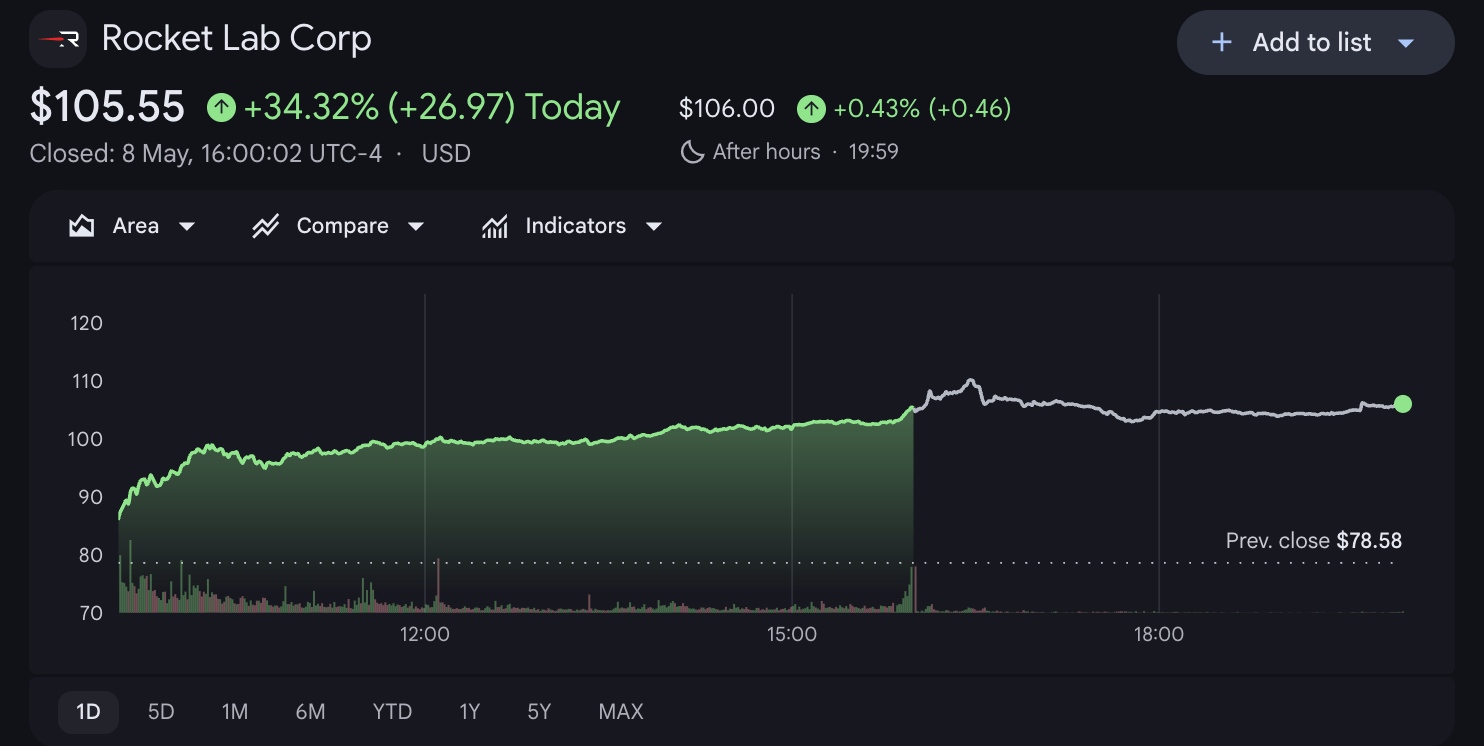
[Rocket Lab shares soared over 34% on the day; Source: Google Finance]
Concurrently, Rocket Lab disclosed multiple commercial contracts.
In terms of financial highlights, Rocket Lab's quarterly revenue surpassed the $200 million mark for the first time, reaching $200.3 million—a 63.5% year-over-year increase that beat analyst expectations of $189.6 million. GAAP gross margin reached a record high of 38.2%, reflecting a significant improvement in earnings quality, while the loss per share narrowed sharply to 7 cents from 12 cents in the prior-year period.
Meanwhile, the company secured significant wins in its order book, signing 31 Electron and hypersonic launch contracts in the first quarter, plus 5 orders for the next-generation medium-lift Neutron rocket. This drove total backlog to a record $2.2 billion, representing a 20.2% quarter-over-quarter increase.
In addition, Rocket Lab announced several milestones, including its largest launch contract to date with a confidential customer, a partnership with Raytheon for selection in the Trump administration's "Golden Dome" space-based interceptor program, a $30 million hypersonic flight test agreement with Anduril Industries, and plans to acquire space robotics company Motiv Space Systems.
CEO Peter Beck stated that the record contract sends a clear signal that the "space industry needs more launch capacity and providers who can truly deliver on their promises."
Furthermore, Rocket Lab provided Q2 guidance, projecting revenue between $225 million and $240 million, well above the analyst consensus of $205 million. Additionally, the company confirmed that the target maiden flight window for the first Neutron medium-lift rocket remains set for the fourth quarter of 2026.
Despite these milestone achievements, the challenges facing Rocket Lab remain equally serious.
Timing of Neutron’s Maiden Flight Remains Uncertain
The core pillar of Rocket Lab's current valuation expansion is the Neutron medium-lift launch vehicle. According to management, the maiden flight window remains set for the fourth quarter of 2026, and five commercial launch orders have already been signed, including a "largest-ever contract" valued at over $190 million.
However, execution risks for aerospace projects have historically been extremely high. Neutron was originally scheduled for a maiden flight in 2024 but has since been postponed several times. Every phase, from engine testing to full vehicle integration and static fire testing at the launch site, carries the potential for further delays.
Calculations from several investment banks indicate that each quarter of delay for Neutron will directly drag down revenue expectations for 2027-2028 by approximately 10%-15%. Rocket Lab has yet to achieve overall profitability, and its valuation already incorporates the optimistic assumption that "Neutron will launch on schedule and scale up rapidly." Should management signal any delays in future earnings calls, the stock's accumulated gains will face a systemic re-rating.
Following the earnings release, CEO Peter Beck reiterated that the Q4 2026 maiden flight window remains unchanged, calling it an "aggressive but achievable schedule," though execution risks for aerospace projects remain exceptionally high.
Narrowing Losses Do Not Signify a Profitability Inflection Point
The first-quarter net loss narrowed to $45 million, and operating cash flow also improved, though the company remains unprofitable. On a GAAP basis, operating expenses rose 40.2% year-over-year and R&D expenses grew by 46.1%, with nearly all of these expenditures directed toward upfront investment in Neutron. Under non-GAAP metrics, adjusted EBITDA remains negative. In other words, the company has merely entered a more efficient state of cash burn.
Against a backdrop of tight financing and sustained high interest rates, intensive capital expenditures will continue to weigh on the income statement in the near term. The market is currently pricing in 'profitability on the horizon,' but the actual timeline for earnings remains dependent on order conversion rates and gross margin realization once Neutron enters service. Market estimates suggest this process will take at least four to six quarters.
Shadows Persist Over SpaceX IPO
Rocket Lab's market capitalization has surged to approximately $50 billion, while market estimates place SpaceX's valuation between $1.75 trillion and $2 trillion. Rocket Lab is unable to compete head-to-head with SpaceX in terms of launch frequency, technological maturity, or the Starlink ecosystem.
More critically, SpaceX's Starlink program is occupying significant low-Earth orbit satellite manufacturing and launch resources, potentially squeezing Rocket Lab's commercial order pipeline. The 'differentiated competitive moat' currently priced in by the market requires sustained policy support and a unique customer structure to maintain, and this is by no means guaranteed.
Valuations Have Already Priced in a "Future Perfect Scenario"
Institutions have aggressively raised price targets following the earnings report: Craig-Hallum hiked its target to $98, Cowen to $120, and Roth MKM to $100.
TipRanks data shows a 12-month average price target of approximately $86.16, meaning the current $105 share price has already surpassed the upper end of institutional estimates.
In other words, Rocket Lab’s pricing already factors in a series of "perfect assumptions," such as the timely maiden flight of Neutron, smooth order conversion, and a rapid narrowing of losses. Any failure to meet expectations would trigger a sharp correction from its high valuation.
This content was translated using AI and reviewed for clarity. It is for informational purposes only.
Recommended Articles






Comments (0)
Click the $ button, enter the symbol, and select to link a stock, ETF, or other ticker.