


Anthropic Gets Massive Compute From Broadcom, Google: What Can It Bring?



AI Podcast


Broadcom and Google have extended their partnership through 2031 for next-generation TPU chips and networking components. Starting in 2027, Anthropic will secure 3.5 gigawatts of TPU computing capacity, contingent on its commercial success. This deal solidifies Broadcom's revenue outlook, expands its networking equipment business, and positions its custom chip design capabilities favorably. For Google, it strengthens control over R&D and bargaining power with Nvidia. The capacity allocation to Anthropic functions as a conditional option, tied to its revenue growth and customer acquisition. This reflects a trend towards long-term AI computing power contracts.
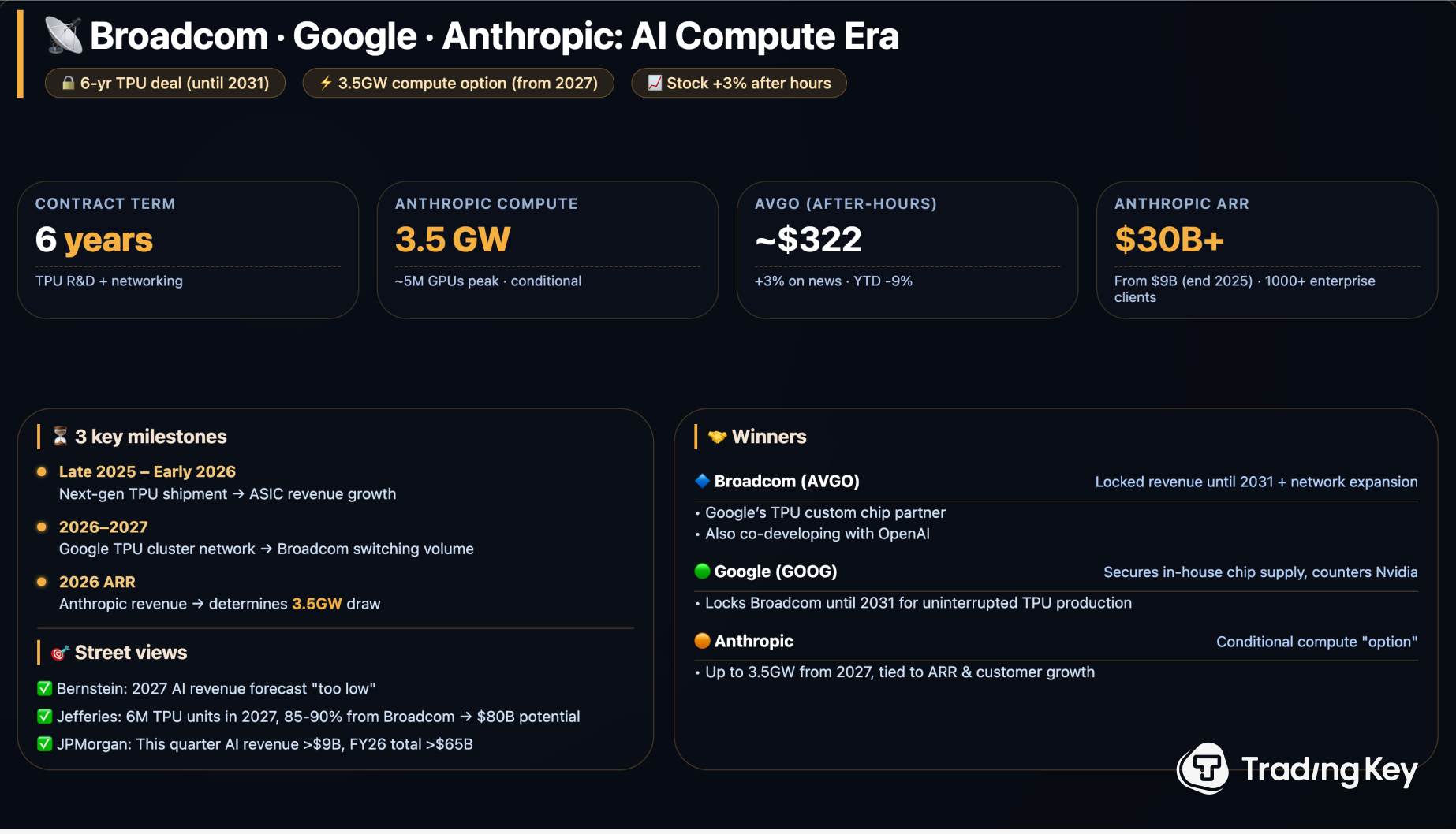
TradingKey - Broadcom ( AVGO) announced on Monday that, in conjunction with Google ( GOOGL ), it has entered into a long-term agreement extending through 2031 to design and supply next-generation TPU chips and networking components. Concurrently, the tripartite collaboration has expanded further: starting in 2027, AI firm Anthropic will access 3.5 gigawatts (GW) of TPU computing capacity provided by Broadcom. Following the announcement, Broadcom shares rose about 3% in after-hours trading, while Google parent Alphabet was largely flat. Analysts believe the new deal refocuses market attention on Broadcom as a "major winner."
I. What Happened? Two Events, Three Key Players
Broadcom + Google: Broadcom announced it has signed a new long-term agreement with Google to design and supply custom Tensor Processing Units (TPUs) for its next-generation AI accelerators. It will also provide networking equipment and related components for Google's next-generation AI data racks, with the partnership continuing through 2031.
Broadcom + Google + Anthropic: The three companies are further deepening their strategic collaboration. Starting in 2027, Anthropic will secure approximately 3.5 gigawatts (GW) of next-generation TPU-based AI computing power through Broadcom. This arrangement is contingent on Anthropic's commercial growth trajectory—the actual fulfillment of computing power will depend on Anthropic's own business success.
II. Is Broadcom the Biggest Winner?
1. Revenue outlook secured for the coming years
Broadcom's custom chip business has been locked in by Google for five years (through 2031). This serves as a tailwind for the stock price, as it reduces the need to navigate the supply constraints of the GPU market. Huatai Securities noted that major tech firms developing proprietary AI chips are pivoting toward custom development to secure their supply chains.
2. Expansion into networking equipment beyond chips
The contract explicitly includes providing networking and other components for Google's next-generation AI data racks. This implies that Broadcom's switches and interconnect solutions will be integrated into Google's TPU clusters, establishing another significant revenue stream.
3. Strategic focus on custom chips proves successful
Tech giants aiming to develop proprietary chips (such as Google's TPU) rely on partners like Broadcom for design assistance and mass production. Research firm Counterpoint projects that Broadcom will maintain its leadership as the premier ASIC design partner for AI server computing through 2027, with its market share expected to expand further to 60%.
III. Can Google Break Its Dependence on NVIDIA?
1. Maintaining Direct Control Over R&D and Capacity
Google's commitment to self-developed chips remains unchanged, with Broadcom serving as its most critical "external chip partner." Securing Broadcom through 2031 ensures that future generations of TPUs proceed seamlessly from design to production.
2. Strengthening Bargaining Power with Nvidia
Developing its own TPUs gives Google significant leverage when negotiating prices with Nvidia ( NVDA ). The contract specifically highlights "networking components," indicating Google’s ambition to build a comprehensive AI cluster solution.
IV. What Can 3.5GW of Compute Capacity Bring to Anthropic?
1. Just how big is 3.5GW?
By a rough estimate, it is enough to run several million AI accelerators at full capacity simultaneously. But note: The actual amount utilized will depend on Anthropic's own future sales performance. Broadcom CEO Hock Tan stated during an earnings call that Anthropic's demand for TPU compute power is expected to surge from 1GW in 2026 to over 3GW in 2027.
2. It is essentially a conditional "allocation"
This is like a bank approving a high credit limit, but the actual amount you can spend depends on your proof of income.
- If revenue from Anthropic's Claude models and enterprise APIs surges → compute power will be fully supplied.
- If commercialization is unsuccessful → compute power will not be provided for free.
Anthropic expects its annualized revenue to exceed $30 billion by 2026, up from approximately $9 billion at the end of 2025. The number of enterprise customers with annualized spending exceeding $1 million has doubled in less than two months, from about 500 in February to over 1,000.
3. Starting in 2027, there is still time to prepare
The contract does not take effect until 2027, providing Anthropic a window of opportunity to prove its profitability.
V. Why is Broadcom Reserving 3.5GW of Compute Capacity for Anthropic?
This is not a coincidental move, but a deliberate strategic action driven by three intersecting forces.
1. Anthropic's computing power demand is exploding exponentially
Anthropic expects its annualized revenue to exceed $30 billion by 2026, with the number of large enterprise customers doubling in two months. To support model training and inference, its TPU computing demand is projected to surge from 1GW in 2026 to over 3GW in 2027. Securing 3.5GW in advance is Anthropic's way of securing the resources necessary to ensure future competitiveness.
2. Broadcom's Win-Win Strategy: Securing High-Growth Customers and Reducing Dependency on a Single Client
- Deep Integration: By signing directly with Anthropic, Broadcom locks the company into its ASIC ecosystem. Mizuho Securities estimates that Anthropic's orders alone could generate approximately $21 billion and $42 billion in AI-related revenue for Broadcom in 2026 and 2027, respectively.
- Customer Diversification: Reducing over-reliance on Google, opening new revenue growth drivers, and consolidating its core position in the field of custom AI chip design.
3. Google's "Open Strategy": Positioning TPUs as a Formidable Rival to Nvidia
By supplying TPUs to Anthropic at scale through Broadcom, Google has successfully transitioned TPUs from internal use to external sales, creating a secondary supply chain consisting of "Google TPU + Broadcom manufacturing" alongside Nvidia GPUs, directly challenging Nvidia's pricing power.
4. A Unique Cooperation Mechanism: Computing Power as an "Option," Not a "Gift"
Broadcom specified in its filings that the scale of computing power deployment depends on Anthropic's "continued commercial success." This 3.5GW functions more like a conditional computing option—Anthropic's commercial performance, such as revenue metrics, is the key factor in determining how much capacity is ultimately fulfilled. This design ensures that input is linked to output, following a rigorous business logic.
VI. Industry Trends: AI Computing Power Shifts to Long-Term Contracts, Moving Away from Spot Market Scrambling
Past (2023-2024) | Present (2025-2026) |
Scrambling for spot GPU supply and leasing chips on a quarterly basis | Signing 5-6 year agreements for custom R&D and capacity lock-ins |
Compute power as a generic commodity | Compute power has become a resource allocated based on sales performance—'supply based on sales' |
Large model companies rely on financing to secure chips | Raised capital must be quickly converted into revenue; otherwise, compute quotas are merely empty promises |
Leading companies are no longer satisfied with short-term leases, opting instead for long-term contracts. Broadcom is not just betting on Google, but is also collaborating with OpenAI to develop custom chips; the world's two most iconic large model companies are both seeking to move away from reliance on a single GPU supplier.
VII. Three Key Time Points
- When will Broadcom's next-generation TPU ship? : This will directly impact the growth rate of Broadcom's chip revenue, with shipments expected between late 2025 and early 2026.
- Google's TPU cluster network architecture for 2026-2027: This will determine whether Broadcom's networking business (switches, interconnects, etc.) can achieve significant volume.
- Anthropic's 2026 ARR (Annualized Revenue Run Rate) data: This will determine how much of the 3.5GW compute capacity allocation can ultimately be realized, which also impacts Broadcom's future revenue.
VIII. Core Market Questions
Q: Approximately how many GPUs does 3.5GW of computing power equate to?
A: Based on a rough estimate of peak power consumption of approximately 700 watts per GPU, 3.5GW corresponds to the power capacity for about 5 million GPUs. However, actual clusters do not run at full capacity; this figure is closer to a theoretical upper limit.
Q: Is the contract signed between Broadcom and Google an exclusive partnership?
A: Broadcom produces custom chips for multiple cloud providers (Meta, Google, etc.) simultaneously, rather than serving just one. Industry analysis predicts that Broadcom will still hold an 85%-90% supply share of Google’s TPU orders by 2027.
Q: Why doesn't Anthropic obtain computing power directly from Google?
A: Anthropic was already using Google TPUs to train its models. This move via Broadcom adds an independent source of computing power, which helps diversify risk and potentially secure better pricing. Anthropic's official statement confirms this: "We train and run Claude on a variety of hardware, including AWS Trainium, Google TPU, and NVIDIA GPUs. This allows us to match workloads to the most appropriate chips."
Q: Is Broadcom still worth chasing after this latest rally?
A: Based on analyst sentiment, multiple institutions believe current expectations are "still low." However, with Broadcom shares down approximately 9% year-to-date, whether this positive news can trigger a trend reversal will depend on verification from upcoming earnings reports.
Recommended Articles






Comments (0)
Click the $ button, enter the symbol, and select to link a stock, ETF, or other ticker.