


Why Beyond Meat Remains a High-Risk Choice in 2026?



AI Podcast


Beyond Meat (BYND) faces significant challenges, including shareholder dilution from new SEC filings and stock-based loan repayments. The company's stock has fallen dramatically from its IPO highs, currently trading as a penny stock. Despite a recent uptick in gross margin due to cost reductions, revenues have plummeted, and net losses remain substantial, compounded by $1.2 billion in debt. Analysts forecast continued revenue decline and widening losses. While management aims for positive EBITDA and improved margins by late 2026, sustained revenue growth and robust internal controls are needed for a genuine comeback, making it a "show-me" story for investors.
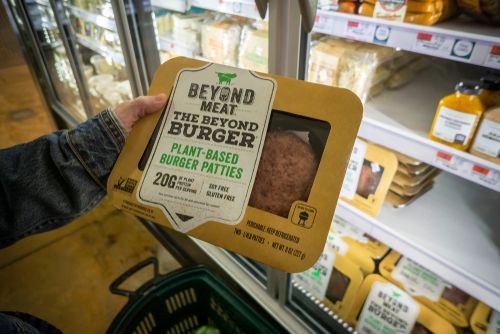
TradingKey - Beyond Meat, Inc. (BYND) is a producer of plant-based meat substitutes headquartered in Los Angeles that was established in 2009 by Ethan Brown. It listed in 2019, turning into the face of the “alternative protein” trend by attempting to imitate the taste, texture and experience of animal meat with plant-based ingredients. Although Beyond Meat had a booming IPO in 2019, the company has struggled in the recent years.
Beyond Meat Collapsed in December 2025
Beyond Meat shares fell 8.1% at the close on December 23, 2025. The sell-off came after the company made two filings with the SEC that essentially reconfirmed what the investors had been guessing all along: there is an impending shareholder dilution, as per the company’s modus operandi.
Two separate filings with regulators are being blamed for stoking pressure in the markets starting Monday evening (Dec. 22). Here is what went down: A Beyond Meat Form S-3 “Shelf” Registration with the SEC was filed. This will enable the company to obtain proceeds through various financing means (common stock, preferred stock, debt, and warrants), retain flexibility over the timing of any such offerings as well as the determination as to the amount of any such offerings, and to negotiate the terms of any such offerings, including the pricing, quantity, term of payment, among other factors, that relate to any such offering, while also stating that the proposed offering will not be through an underwriting agreement with the underwriters.
This S-3 filing has not clarified the situation, instead causing the share price volatility, as at any time new shares or debt securities may be issued. The market is left to react to the potential for a new share creation, as yet unpriced.
The second incident happened the next Tuesday (Dec. 23), Beyond Meat 8-K disclosed that the SEC that Beyond Meat will have to pay part of its loans in stock, not in cash. To “Unprocessed Foods” (the lender), Beyond Meat has announced that for some, the exercise price of the warrants has been reduced from $3.26 to $1.95.
The institution lowering the exercise price thought they were going to receive some cash from the lenders and also entice lenders. But there was one big problem. Beyond Meat was sinking to now being classified as a legitimate penny stock, and was selling at around $0.99 per share on December 23. Just like with “Unprocessed Foods,” there’s very little to no sense in them shelling out $1.95 for a share when they could get one from the market at $0.99. It was also a significant testament as to how much Beyond Meat was worth at that point in time.
This revealed that the stock price had fallen at an astounding 70% of that price from five dollars, and this was the year 2025. Not a revision was made to the paper through the end of January, and Beyond Meat remained impotent. The company couldn't generate cash—so it was (as it always had been, now more than ever) entirely at the mercy of its financial structure and obligations, and utterly without any means to generate value for its shareholders.
How did Beyond Meat Drop to a Penny Stock
Anyone who has followed the category expansion and the Beyond Meat narrative will by the above facts readily infer the company has scaled and is scaling. It was that when the company went public on May 2 2019 at US$25.00 a share, but concluded its first month on the trading at $234.90 a share, which resulted in astonishing profits. Within their first month of being public, Beyond Meat reached a total market capitalization of $14.1 billion — that’s 47 times the company’s total revenue for 2019. Since their growth in sales has currently slowed down drastically, their stock tumbled from the high sales growth rates and losses increasing along with the rising interest rate which are pressures on the value of the company. Now Beyond Meat trades at about $1.00 per stock.
Beyond Meat’s Earnings: Growth Stalled, Losses and Dilution Mounted
Early adopters played a huge role in the industry as demand for restaurants, retail, and food consumers were all on the rise and revenue grew 239% in 2019. Amid the pandemic, however, restaurants were forced to shutter, retailers to pare down stock and price-conscious consumers to turn to cheaper cuts of meat from animals, and the industry’s revenue climbed by just 37% in 2020. From 2021 to 2024 revenues are increasing at a decreasing rate of 14%, -10%, -18% and -5% in 2021, 2022, 2023 and 2024, respectively, to the total revenue of 326.5 million dollars.
The company’s net loss narrowed from an estimated $366.1 million in 2022 to $160.3 million in 2024, but it still carries roughly $1.1 billion in total debt. Since the IPO, they have seen a 678% increase in shares as a result of secondary offerings and employee stock incentives. The firm is presumed to be continuing diluting shares. With the market shrinking, sales have fallen off amid competition from Tyson and Impossible. Also said pricing power of the company is reduced in face of inflation. To manage the buildup of inventory, the company offered discounts on their products, leading to gross profit margin decreases to below 5% in 2022 and 2023 from more than 33.5% in 2019. The company has also suffered a deceleration in growth as a result of the controversial and unsuccessful PepsiCo tie-up to co-brand and market plant-based jerky.
Beyond Meat Renewed Pressure After a Margin in 2024
Having been deemed a fad stock for almost half a decade, Beyond Meat has so far delivered an uptick in its gross margin, recouping 12.8% in 2024. The turnaround was brought about by a range of factors, such as reduction in costs for purchased goods per pound, better management of inventory levels, and decrease of markdowns, manufacturing and distribution expenses, as well as fewer non-cash charges attributable to excessive/obsolete stocks.
But the first three quarters of 2025 are a different story: revenues have plummeted 14% from last year’s total; gross margin has dropped to 6.9%; and management blamed sluggish demand for items sold in retail and food service in the U.S., as well as competition from lower-priced conventional (meat-based) products. There were more non-cash charges associated with the closure of the company’s operations in China, the company said. At the end of the third quarter, Beyond Meat had $117.3 million in cash and cash equivalents, whereas its total debt had risen to $1.2 billion. Analysts were expecting a 15% decrease in revenue (down to $277 million) in 2025 and an even greater net loss of $232 million. In the meantime, based on the company’s ~ $1. 7 billion enterprise value (which includes debt), the stock is still not inexpensive; at roughly 6x anticipated 2025 revenues, it seems like a very high-value stock.
Management expects to achieve at least 20% gross margin and positive annual EBITDA run rate in the second half of 2026 owing to continued right-sizing measures and launch of new better-for-you products that will expand the consumer base. Revenue is expected to decline 1% to $272.8 million in 2027, while the net loss narrows to $64.1 million, suggesting growth is not going to return any time soon, according to analysts. It creates a situation that from a contrarian standpoint is not particularly attractive unless the company can show a few quarters of rising revenues.
Beyond Meat is Just a Meme Stock?
Most investors consider Beyond Meat stock through the meme lens. In mid October, the stock jumped from about $0.50 to almost $8 because of a frenzy of retail investors, most of whom were social media driven. These gains were not sustained: on Dec. 19, the stock was $1.11 and once again, Beyond Meat was a penny stock. Expecting a repeat of this phenomenon, driven by the same positive news (like debt reduction news) is a dangerous bet.
Short interest is 26% (FinViz) and that fuels the conversation, but in order for a short squeeze to happen, the shorts have to buy to cover, leaving the squeeze catalyst unaddressed. The news that Beyond Meat has a bigger partnership with Walmart that once excited investors is stale, and with no news of that caliber, the stock has little to no chance of a big run.
It’s Hard to Raise the Bull Case, Right?
The company’s own governance headlines haven’t helped the bull case. It recently fired Controller Yi Luo in response to an “existing material weakness in our internal control over financial reporting” previously disclosed in a November filing. “We just did not have the resource to do some of these more complex deals that we used to go and do,” management admitted. The takeaway for investors is simple: Get the back office cleaned up and then maybe there will be a sustained rally.
Beyond Meat’s third quarter scorecard Beef Up Amid Losses provided few bright spots. All segments except the international foodservice segment registering 2.4% were down from 2024. The U.S. segment was the sour spot, with a 21 per cent year-over-year decline in revenue; regional revenue fell 13.3 per cent year-over-year. Operating losses to net increase compared to last year; net operating loss, excluding a $77.4 million long-lived asset impairment, was $34.9 million, compared to a loss of $30.9 million, in the comparable prior-year quarter. Falling sales and increasing losses are hard enough to take in a growing market—especially when it’s also at the peak of the category’s 2021-2022 hype, as it was when BYND reached its zenith.
Consumer tastes have turned against convenience foods, and plant-based burgers — once a company staple — are becoming collateral damage in that whiplash. Some research has even suggested that meat alternatives are among the least nutritious vegan products, and offer little, if any, benefit over finished meat — not exactly a reason to bring them back. Price tags make the problem worse: plant-based meat is typically two to four times more expensive per pound than real meat. With the cost of living rising and a little less enthusiasm for virtue signalling in the ESG space — spurned by political backlash, regulatory complexity, and concerns about greenwashing — the products seems less practical. “Another short squeeze too is well within the realm of what could be, but that’s not what investors want, they want future profits."
Could Beyond Meat Make a Genuine Comeback in 2026?
The goals are on the horizon: 20%+ gross margin, positive EBITDA run rate in the second half and a refreshed line targeted at the health-conscious consumer. But the core business is still shrinking, margins are volatile and the turnaround plan is opaque. Add in the risk of dilution from the new shelf and stock-based lender repayments, as well as warrants resetting at $1.95 below the current stock price at $0.99 and the capital structure is still a headwind.
Beyond Meat stock looks like a show-me story at least until sequential revenue growth is sustained for several quarters — and until the company implements internal controls that keep pace with the complexity of its business. For now, hope is not a strategy, even if hope is what the market is trading on.
Recommended Articles










Comments (0)
Click the $ button, enter the symbol, and select to link a stock, ETF, or other ticker.