


Wall Street Banks Said to Tighten Leverage, South Korean Stocks Plunge Intraday. Samsung, SK Hynix Gains Pull Back Significantly



AI Podcast


Major Wall Street banks, including Citigroup and JPMorgan Chase, have restricted hedge funds' leveraged bets on Samsung Electronics, SK Hynix, and TSM by increasing financing costs and tightening transaction scales. This led to a sharp narrowing of intraday gains for these chip stocks and the KOSPI index, down from over 8% to 4.6%. The restrictions stem from over-concentration in these stocks within the KOSPI, exceeding fund limits and triggering significant passive selling. The rise of leveraged ETFs and substantial foreign capital outflows further contribute to market volatility. These measures are seen as preventive risk management rather than a negative outlook on semiconductor fundamentals.

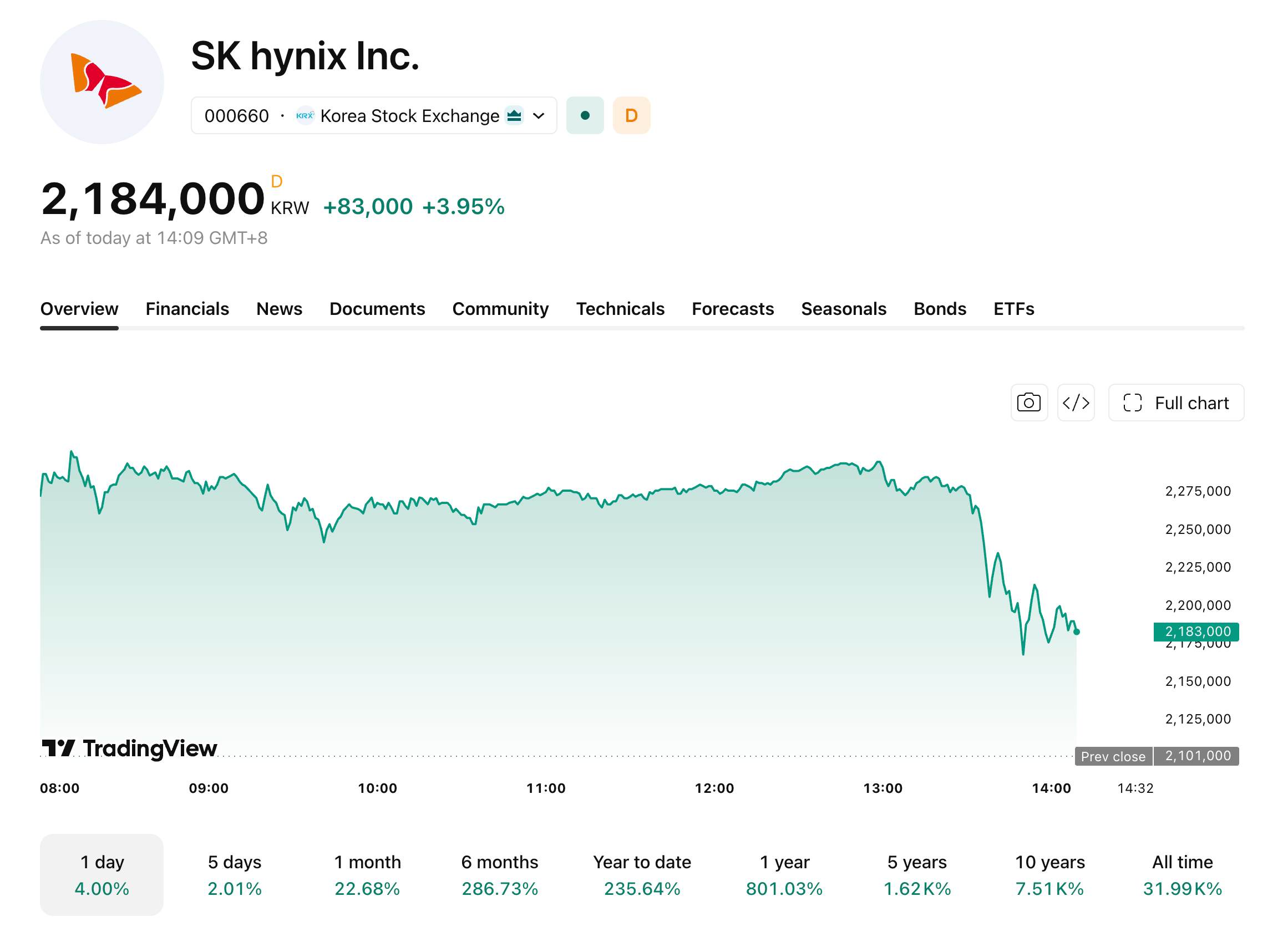
TradingKey - During the Asian trading session on June 12, Samsung Electronics and SK Hynix briefly drove the South Korean KOSPI index up by more than 8%. However, news emerged during the session that several major Wall Street banks are restricting hedge funds' leveraged bets on these two stocks and Taiwan Semiconductor Manufacturing Co. ( TSM ), following which the South Korean stock market took a short-term dive, and the gains of the two major chip stocks narrowed significantly.
According to people familiar with the matter, global banks such as Citigroup ( C ), JPMorgan Chase ( JPM ), and Goldman Sachs ( GS) have increased financing costs for long positions on these stocks through swaps, tightened the scale of new transactions, and even rejected some new swap requests. Morgan Stanley ( MS) has clearly stated it will no longer accept new swap transactions for Samsung and SK Hynix, while Bank of America ( BAC ), BNP Paribas, and UBS Group ( UBS) have also followed suit with adjustments.
As a result, Samsung Electronics' intraday gain retreated from over 12% to under 8%, and SK Hynix's gain narrowed from 9% to under 4%. As of press time, the KOSPI index's gain narrowed from 8.6% to 4.6%.
[Source: TradingView]
This is not the first time the market has seen cooling signals. Samsung Electronics and SK Hynix together account for about 50% of the KOSPI’s total market capitalization, far exceeding the single-holding limits applicable to most funds, forcing global fund managers to systematically reduce positions. According to Goldman Sachs estimates, since the end of last October, this rule has triggered about $69 billion in passive selling, involving nearly $200 billion in assets under management. During the slump in Korean stocks in early June this year, cumulative forced liquidations by individual investors totaled approximately 300 billion won.
Another factor drawing attention is the rapid expansion of leveraged ETFs. In late May, the South Korean market launched 16 double-leveraged ETFs linked to Samsung Electronics and SK Hynix, with total assets of approximately $2.8 billion on their first day of listing. Goldman Sachs previously noted that the daily rebalancing mechanism of such products could amplify market volatility.
From a macro perspective, the South Korean stock market in 2026 is experiencing its largest foreign capital outflow on record. A UBS report shows that net foreign outflows in the first half of the year were about $70 billion, far exceeding the approximately $20 billion during the 2020 pandemic. In this context, the tightening of leverage by major Wall Street banks is not a bearish take on the fundamentals of the two companies—global AI investment and South Korean semiconductor exports remain strong—but rather a preventive cooling measure targeting overly concentrated position structures. The narrowing of intraday gains that day is a direct reflection of the disconnect between market sentiment and institutional risk management.
This content was translated using AI and reviewed for clarity. It is for informational purposes only.
Recommended Articles







Comments (0)
Click the $ button, enter the symbol, and select to link a stock, ETF, or other ticker.