


Why Did Ethereum Price Fall? What Will ETH Price Be in 2030?



AI Podcast


Ethereum experienced significant 2025 volatility, mirroring Bitcoin's trends, driven by economic policies, regulatory shifts, and speculation. Factors influencing its price include technological upgrades, ecosystem applications, and strategic reserves. Regulatory friendliness and economic policy uncertainty present short-term challenges. Long-term outlooks vary, with some analysts projecting substantial growth by 2030, contingent on successful upgrades, asset tokenization, and ecosystem expansion, suggesting a re-evaluation of its core value.

How Is Ethereum’s Current Price Performing?
TradingKey - In 2025, Ethereum, the world's second-largest cryptocurrency (ETH), experienced two "rollercoaster" price movements, with both retracements reaching approximately 50% , and the current price has fallen below the $3,000 mark, temporarily trading at $2,924.
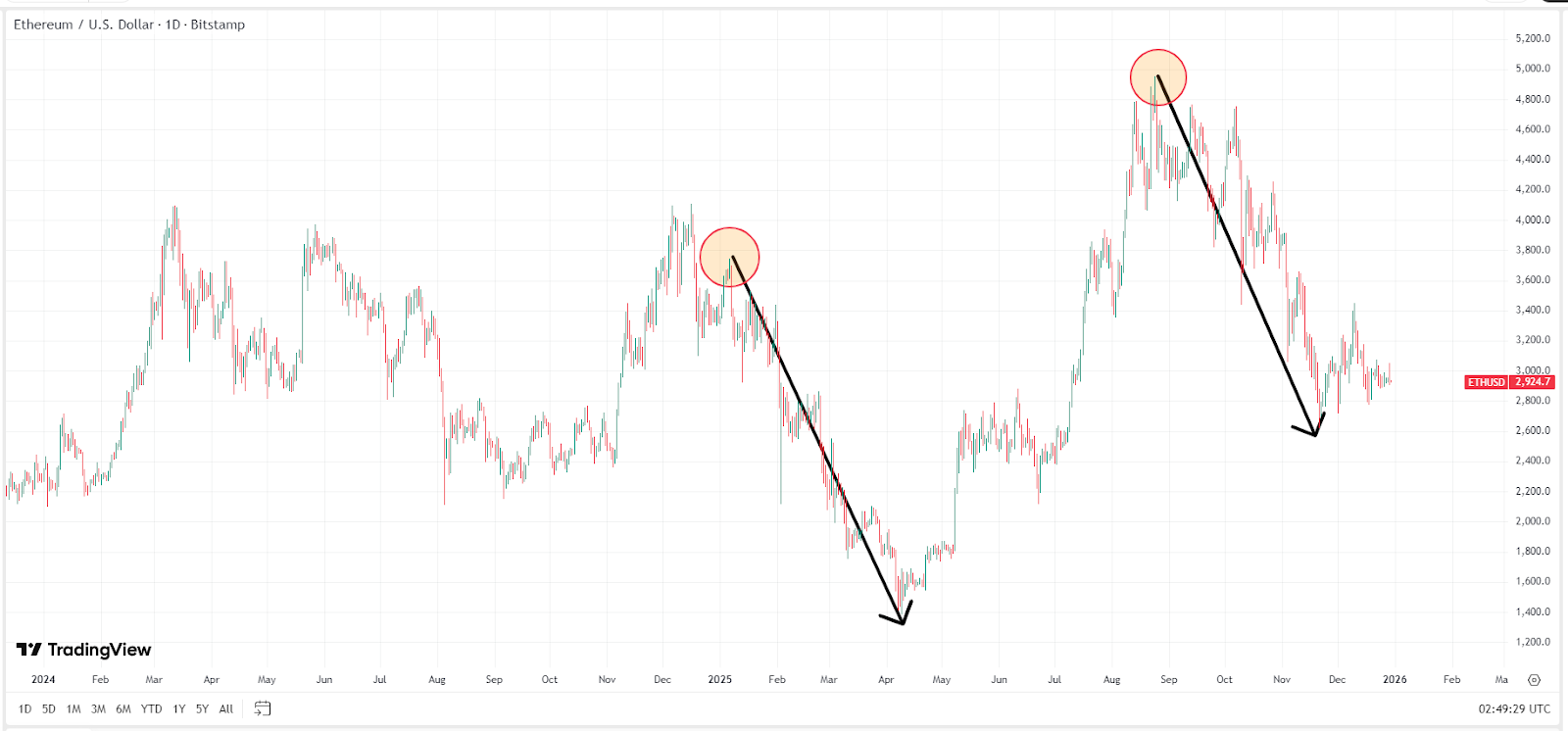 Ethereum Price Chart, Source: TradingView.
In January 2025, Ethereum's price briefly surged to around $3,700, subsequently triggering a frenzied sell-off that caused its price to plunge by over 60%. In April 2025, Ethereum's price fell to a low of $1,400, then gradually rebounded and strengthened, surging to nearly $5,000 in August, setting a new all-time high.
After two months of high-level consolidation, Ethereum's price failed in three attempts to break upwards. It eventually reversed course in October and gradually weakened, falling to $2,600 by November 20, marking a maximum retracement of 48%. Currently, the price remains subdued, oscillating within a narrow range below $3,000.
Why Did Ethereum's Price Fall?
As shown in the chart below, Ethereum's price trajectory in 2025 broadly aligns with Bitcoin's price movements, exhibiting similar upward and downward trends. Specifically, it is characterized by a rise followed by a fall in the first quarter, a bottoming out and rebound in the second quarter, further strengthening in the third quarter, and a new high followed by a retreat in the fourth quarter. Ethereum's price fluctuations and Bitcoin prices are highly correlated because they are both driven by the same forces, primarily including the four-year cycle, Donald Trump's election as president, a shift in U.S. crypto regulation from hostile to friendly, and Federal Reserve interest rate cuts.
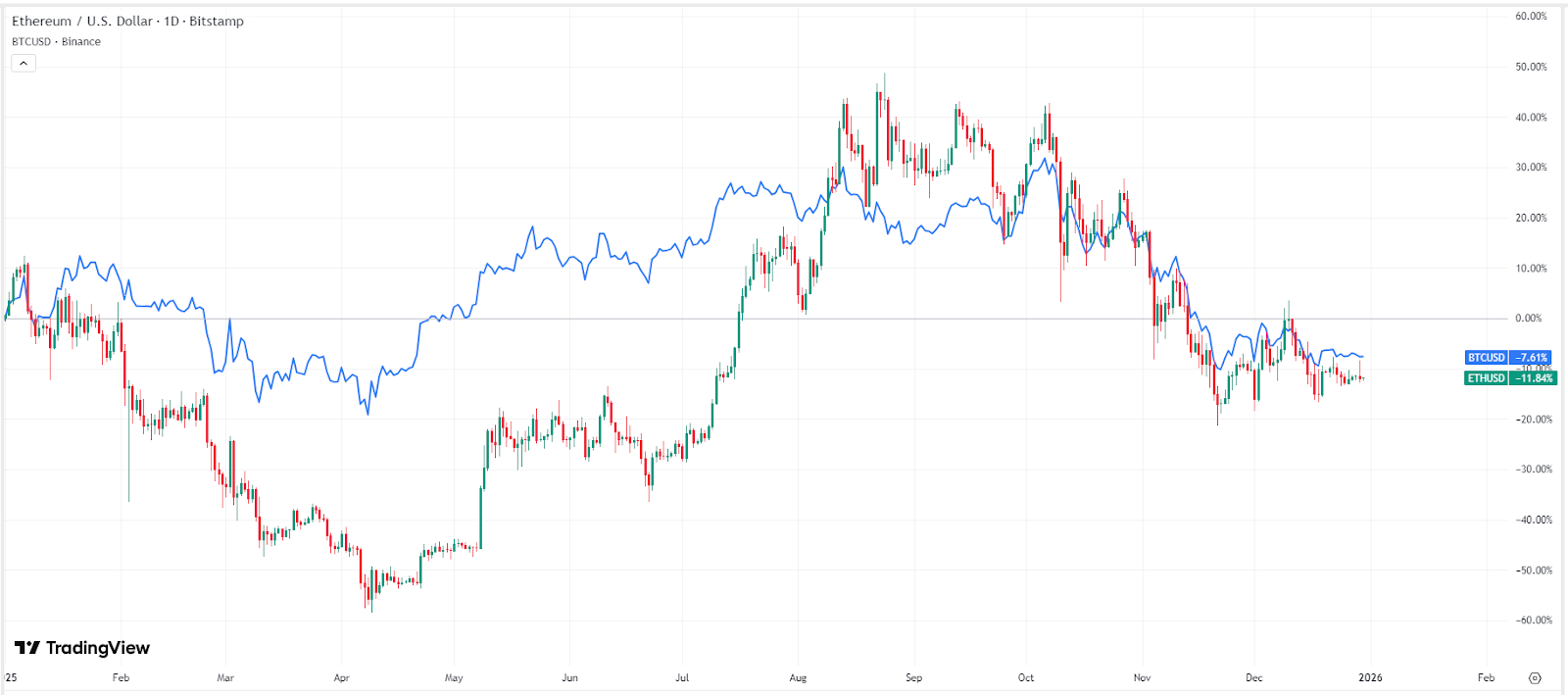 Ethereum and Bitcoin: 2025 Price Performance, Source: TradingView.
Specifically, Ethereum's price decline in 2025 was divided into two phases. The first phase occurred in the first quarter, when the positive sentiment surrounding Trump's election materialized and faded, leading to massive profit-taking and a sharp drop in ETH prices; the second phase was in the fourth quarter, as the Federal Reserve cut interest rates, it also released dovish signals, hinting at potential future rate cuts, This move severely impacted market confidence, leading to a continuous correction in Ethereum's price from October onwards.
Although Ethereum's price fluctuations largely mirrored Bitcoin's, its volatility was greater. Most notably, Ethereum plummeted 60% in April, while Bitcoin only fell 10%. This discrepancy was primarily due to Ethereum's higher speculative nature. CryptoQuant analyst Darkfost pointed out, "Ethereum's contract trading volume in 2025 far exceeded previous annual levels, and the spot-to-futures ratio was 0.2. This record-high trading volume combined with such an imbalanced ratio suggests that futures largely dictated Ethereum's price movements."
Ethereum Price Analysis: What Factors Influence Future Price Movements?
Currently, Ethereum's price over the next five years will primarily be influenced by regulatory and economic policies, economic policies, industry cycles, and factors inherent to Ethereum itself. three main aspects related to Ethereum itself. These internal Ethereum factors primarily include technological upgrades, ecosystem applications, and strategic reserves.
Since Donald Trump was re-elected president, the U.S. has ended the high-pressure cryptocurrency regulation of the Biden era, gradually shifting towards a friendly and open approach. This approach is likely to become the new regulatory norm, as candidates are compelled to adopt it to secure support from crypto voters, which will be a positive factor. However, U.S. economic policy may not necessarily follow suit. In September 2025, the Federal Reserve initiated a rate-cutting cycle again after many years. Nevertheless, serious internal divisions within the institution regarding future rate cuts will introduce significant uncertainty, making Ethereum's price more volatile.
Based on Bitcoin's halving cycles, the cryptocurrency market is likely to enter a new bear market in 2026. Ethereum's price could follow suit and decline until a new halving cycle arrives in 2028. Currently, many views, particularly among most Wall Street investment banks, suggest that the four-year cycle is no longer valid, and the crypto bull market will extend. Nevertheless, the crypto market will eventually experience its bear market, and Ethereum's price cannot simply rise indefinitely.
In the first half of 2026, Ethereum will undergo the Glamsterdam upgrade, with a potential 'Hegota' upgrade towards the end of the year. These could provide a certain boost to Ethereum's price. In the long term, Ethereum's most crucial aspect is its ecosystem applications, represented by its Total Value Locked (TVL), which directly impacts Ethereum's value and price.
As illustrated in the chart below, Ethereum's TVL demonstrates a high correlation with its price movements. As of this writing, Ethereum's TVL has pulled back somewhat, currently standing at $68 billion. The co-CEO of Sharplink, Ethereum's second-largest holder, remains highly optimistic about its TVL, having stated, 'As Ethereum’s adoption expands across multiple use cases and among institutional investors, its Total Value Locked (TVL) could grow tenfold by 2026.' From the perspective of future possibilities, the key to whether Ethereum's TVL will surge lies in the prosperity of real-world asset tokenization (RWA)'s prosperity. Paul Atkins, the incoming Chairman of the U.S. SEC, previously explicitly stated that he would promote U.S. asset tokenization next year.
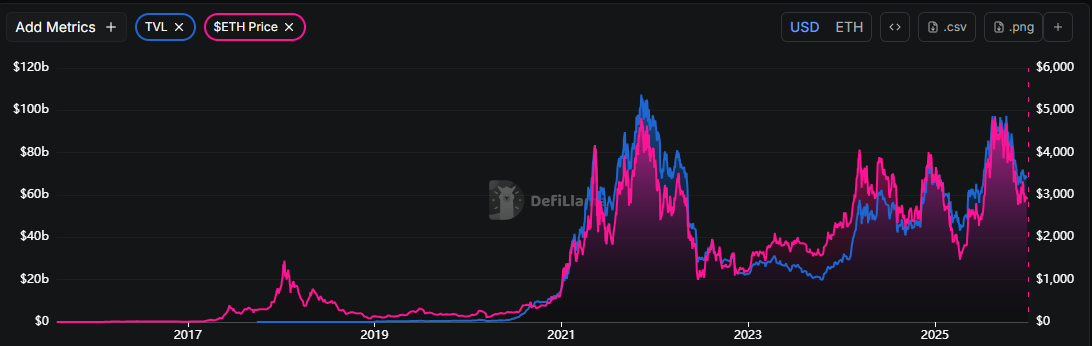 Ethereum Price and TVL, Source: DefiLlama.
Although Ethereum may face a new bear market, the cryptocurrency reserve craze initiated by U.S. President Trump has not subsided. Furthermore, Ethereum reserves are showing an upward trend, a force that will likely explode during future bull markets. As of this writing, a total of 67 entities hold 6.81 million ETH, accounting for 5.63% of the supply and valued at over $20 billion, already surpassing the holdings of spot Ethereum ETFs.
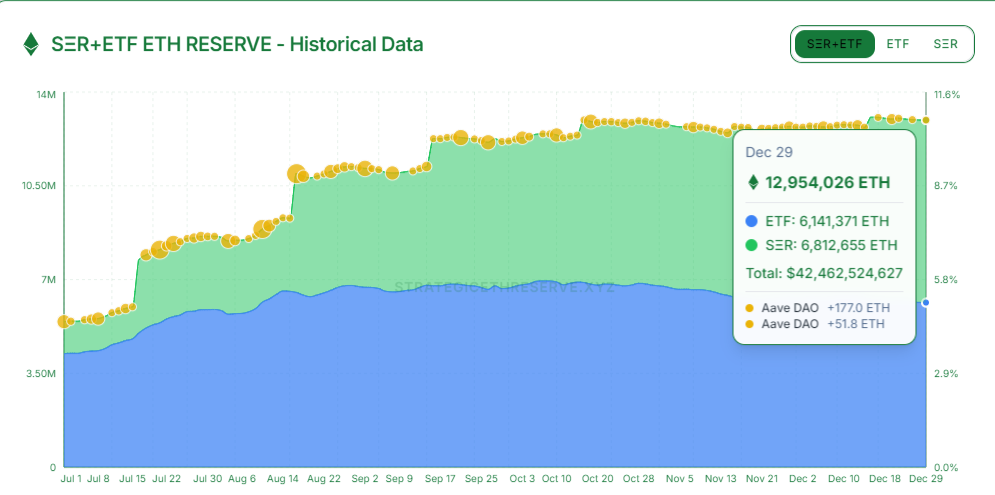 Ethereum Reserves, Spot Ethereum ETF Holdings, Source: Strategic Eth Reserve.
Ethereum Technical Analysis: 2026 Will Make a Decisive Directional Move
According to cryptocurrency services platform Matrixport, although Ethereum's price has experienced two 'false signals' – a downside breakout in April 2025 and an upside breakout in October – both were ultimately pulled back by the market, causing it to continue consolidating within a large triangle. Matrixport noted in a social media post that 'as the triangle continues to converge and space gradually diminishes, Ethereum could face a critical decision point in 2026.'
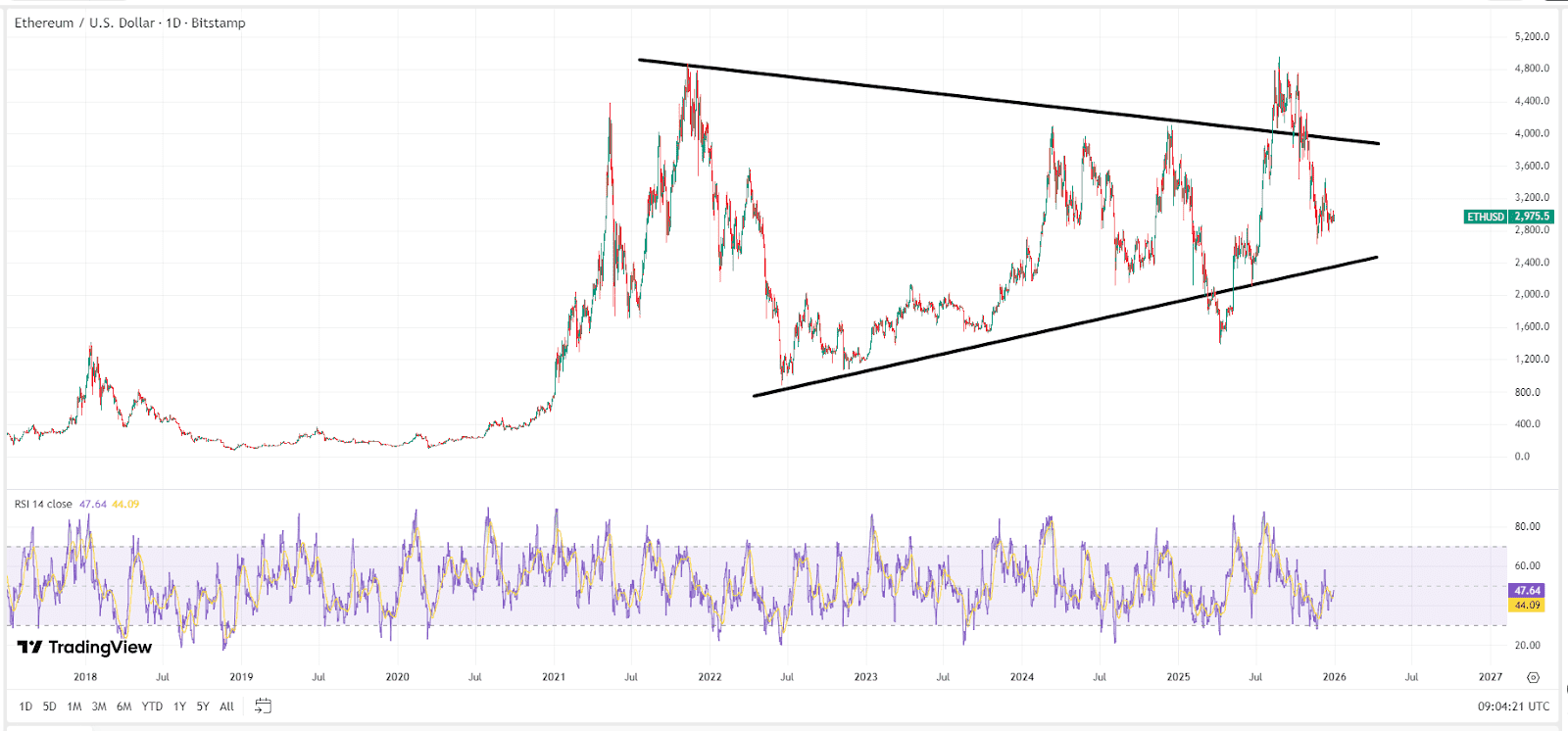 Ethereum Price Chart, Source: TradingView.
Cryptocurrency research firm 10x Research suggests Ethereum could see a turning point in January 2026, citing that Ethereum's technical indicators are on the verge of triggering a trend reversal signal. Specifically, Ethereum's Relative Strength Index (RSI) is 44, indicating a bullish outlook; while its Stochastic Oscillator is 30, suggesting a bearish outlook. Ideally, an RSI below 30 and a Stochastic Oscillator below 10 would presage an uptrend, and Ethereum is gradually approaching this reversal trend.
Examining a shorter timeframe, Ethereum is currently in an upward trend. Since bottoming out at $2,600 on November 21, Ethereum's price has retreated twice but has not broken below its previous low; instead, it has gradually moved higher, indicating that bulls are keen to defend this support line. However, the bullish momentum for an ascent is not very strong, weakening near the $3,500 mark as they await new catalysts.
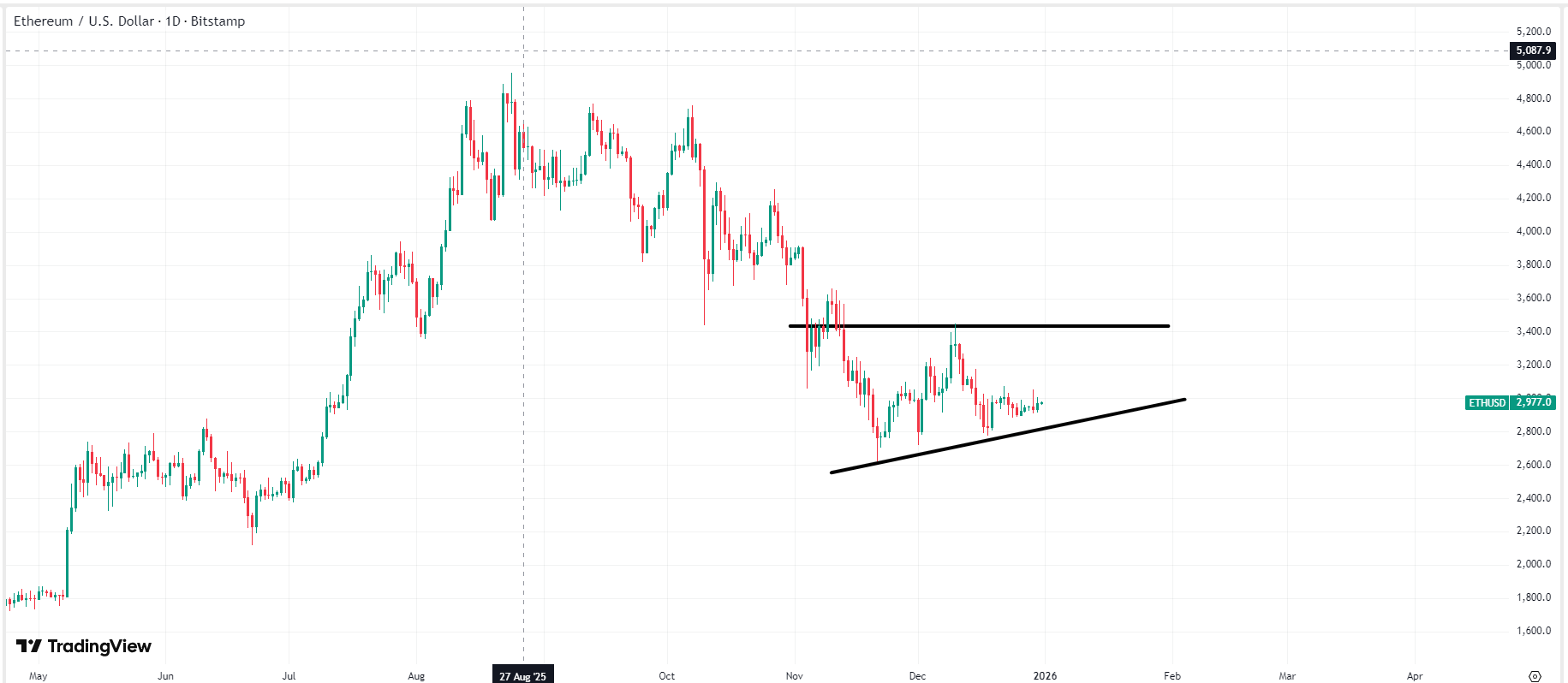
Ethereum Price Chart, Source: TradingView
Ethereum Price Prediction: How High Will It Reach by 2030?
In the view of cryptocurrency analyst Benjamin Cowen, the probability of Ethereum's price reaching a new all-time high in 2026 is low. Cowen stated on the Bankless podcast that, considering Bitcoin's current market conditions, Ethereum is unlikely to set a new high in 2026. Furthermore, Cowen also suggested that "Ethereum's price returning to its historical highs could also be a 'bull trap,' followed by a sharp decline to $2,000. "
However, Wall Street veteran and Fundstrat co-founder Tom Lee believes that Ethereum's price could reach by early 2026, $7,000-$9,000, continuing its historical highs. From a longer-term perspective, Ethereum's price could also rise to $20,000.
Although Ethereum might enter a new bear market, Wall Street is optimistic about its price performance in 2030. Specifically, Standard Chartered analyst Geoff Kendrick believes that Ethereum's price could rise to by 2030, $8,000-$12,000, while Bernstein projects ETH's price will climb to $15,000, and Cathie Wood is even more optimistic, believing Ethereum will surge to $20,000-$30,000 .
Conclusion
Ethereum experienced significant volatility in 2025, with its price movements highly correlated with Bitcoin, primarily driven by a confluence of macroeconomic policies, regulatory shifts, and market speculative sentiment. In the short term, its price is expected to navigate a complex interplay of bullish factors, such as regulatory friendliness and its own technological advancements, against bearish pressures from economic policy uncertainty. In the long term, while Wall Street remains divided on Ethereum's outlook through 2030, the prevailing consensus suggests that if Ethereum successfully implements technological upgrades, facilitates asset tokenization, and expands its ecosystem applications, its inherent value as a core blockchain platform will be significantly re-evaluated in the upcoming market cycle.
This content was translated using AI and reviewed for clarity. It is for informational purposes only.
Recommended Articles







Comments (0)
Click the $ button, enter the symbol, and select to link a stock, ETF, or other ticker.