


End of the Powell Era: Will Fed ‘Defensive’ Regulation Shift? What the ‘Most Crypto-Friendly’ Warsh Will Bring?



AI Podcast


Jerome Powell's tenure as Fed Chair emphasized "same activity, same rules" for cryptocurrencies, viewing Bitcoin as a speculative gold substitute, stablecoins as payment tools needing bank-like oversight, and the digital dollar cautiously. Kevin Warsh, expected to succeed Powell in May 2026, adopts a contrasting "integration and innovation" approach. Warsh considers Bitcoin a legitimate macro asset and an inflation monitor, holds significant crypto investments, and supports private stablecoins over CBDCs. This shift suggests a potential catalyst for institutional adoption and may influence future Fed rate-cut decisions, potentially driving Bitcoin towards $100,000, especially if AI-driven productivity gains are seen as a disinflationary factor.
TradingKey - On May 15, 2026, Jerome Powell will officially step down as Federal Reserve Chair, and the Fed will welcome the most "crypto-savvy" chair in its history—Kevin Warsh. This transition of power is more than just a change in personnel; it symbolizes a seismic shift in U.S. cryptocurrency policy from "defense and prevention" to "integration and innovation." What does this change imply? Will it be a bullish or bearish signal for the crypto market?
How Jerome Powell Approaches Cryptocurrency
Powell's policy stance on cryptocurrencies may appear volatile, shifting between support and opposition; however, it has consistently adhered to the core principle of "same activity, same rules," primarily manifested in three areas: Bitcoin ( BTC ), stablecoins, and CBDCs.
Bitcoin
What exactly is Bitcoin? Is it a commodity or a security? U.S. regulators have previously held differing stances, with the SEC and CFTC maintaining divergent views, leading to regulatory confusion. Regarding the classification of Bitcoin, Powell has been clear and consistent, viewing it as a speculative asset that serves more as a "substitute for gold" rather than a competitor to the U.S. dollar. Furthermore, he has consistently emphasized consumer protection, arguing that due to Bitcoin's high volatility and lack of government insurance, investors should be prepared to bear the loss of their entire investment.
Stablecoins
In Powell's view, stablecoins have the potential to become a mainstream payment tool, yet they also pose potential threats to financial stability. Regarding the CLARITY Act, Powell has expressed support for its congressional passage several times this year, while also emphasizing that stablecoin issuers should be subject to bank-like prudential supervision and meet strict auditing requirements.
Digital Dollar
Although many central banks globally have introduced digital currencies, Powell has maintained a highly cautious stance, stating that the Federal Reserve will not unilaterally issue a digital dollar without explicit authorization from Congress. Despite his term as chair nearing its end, Powell remains skeptical about whether the "benefits of a digital dollar outweigh the costs."
Warsh and Powell: Starkly Different Policy Stances
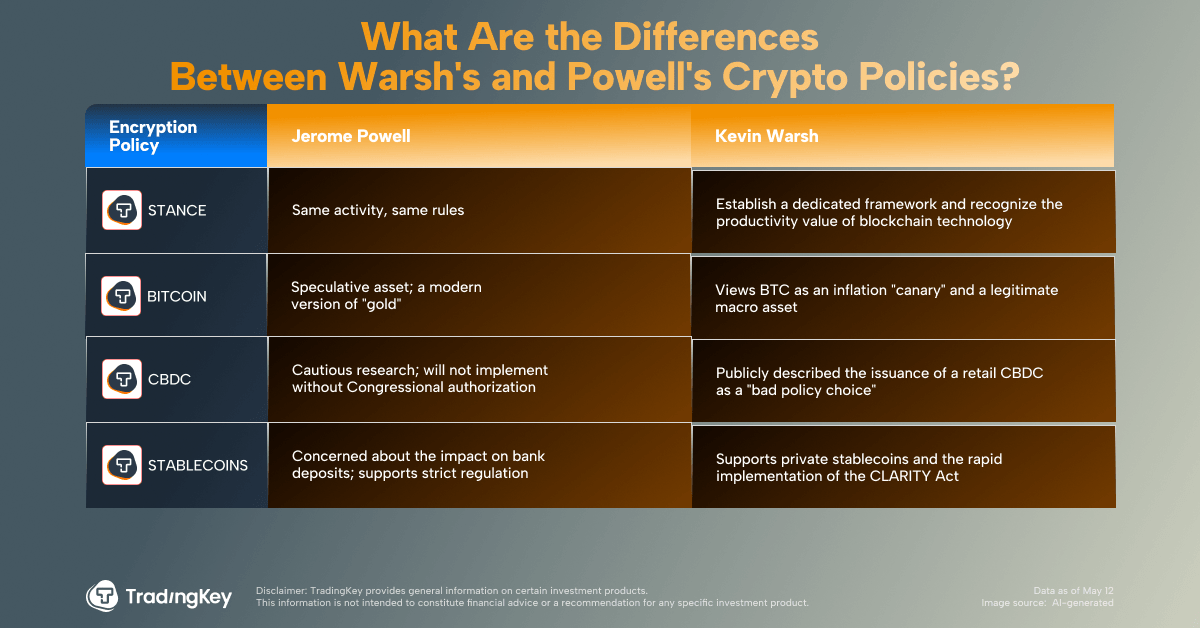
Powell emphasizes "defensive regulation," focusing on establishing a firewall to prevent crypto market volatility from spreading to traditional banks; in contrast, Warsh is more inclined to view digital assets as an integral part of the modern financial system, resulting in stark differences regarding Bitcoin, stablecoins, and other matters, as detailed below:
Policy Area | Jerome Powell (2018-2026) | Kevin Warsh (Expected 2026-) |
Core Stance | Same activity, same rules | Establish a dedicated framework and recognize the productivity value of blockchain technology |
Bitcoin | Speculative asset; a modern version of "gold" | Views BTC as an inflation "canary" and a legitimate macro asset |
Digital Dollar (CBDC) | Cautious research; will not implement without Congressional authorization | Publicly described the issuance of a retail CBDC as a "bad policy choice" |
Stablecoins | Concerned about the impact on bank deposits; supports strict regulation | Supports private stablecoins and the rapid implementation of the CLARITY Act |
Warsh is the key to BTC’s march toward $100,000.
Warsh calls Bitcoin a "monitor for monetary policy" and holds over $100 million in crypto-related investments. His appointment is viewed as a milestone for cryptocurrency officially attaining the status of a "legitimate macro asset," which is expected to attract more traditional pension funds and insurance capital into the market. Warsh opposes CBDCs and favors private-sector-issued stablecoins, a move that could accelerate the final legislation of the Clarity Act.
Warsh’s appointment is highly likely to shift Federal Reserve rate-cut expectations, which has become the market's primary focus. In Warsh’s view, productivity gains from AI are a "structural disinflationary factor." This implies that if AI suppresses inflation, the Fed could still implement rate cuts even amid economic strength. Since low-interest-rate environments typically drive up valuations for scarce assets, Bitcoin prices are poised to return to the $100,000 threshold.
This content was translated using AI and reviewed for clarity. It is for informational purposes only.
Recommended Articles








Comments (0)
Click the $ button, enter the symbol, and select to link a stock, ETF, or other ticker.