


WTI Crude Pulls Back From Highs Near $100 as US and Iran Plan Talks, Risking 20% Correction



AI Podcast


Plans by the US and Iran to resume negotiations have reduced Middle Eastern tail risks, causing international crude oil prices to drop nearly 2%. WTI crude fell to $100.58 per barrel, unwinding its geopolitical blockade premium. Technically, WTI formed a high-level false breakout, with potential downside risks toward its fundamental equilibrium price near $80 if diplomatic breakthroughs continue. However, ongoing military threats from Iran indicate that regional conflicts could still trigger sharp price rebounds until a substantive ceasefire is officially secured.

TradingKey - US and Iran plan to resume negotiations to ease geopolitical tensions; WTI crude plummets nearly 2% in response, facing a potential 20% deep pullback on technicals.
On November 2, driven by news that the US and Iran plan to resume negotiations, international crude oil prices stumbled, falling about 2%. Among them, spot Brent crude prices fell 2.01% to $109.480 per barrel, while WTI crude (USOIL) prices similarly retreated from intraday highs, dropping 1.98% on the day to $100.58 per barrel.
Last weekend, rumors of US-Iran negotiations signaled a diplomatic thaw. Through Qatari mediation, the US side delivered a proposal letter to senior Iranian officials to resume dialogue, outlining the general principles and overall framework for renegotiation. Although the two sides have not yet reached a concrete, complete plan, and the Iranian Ministry of Foreign Affairs clarified that there is currently no specific schedule for talks, the re-establishment of diplomatic contacts has significantly lowered the global crude oil market's expectations of extreme tail risk regarding a full-scale, high-intensity direct military conflict in the Middle East.
The core condition proposed by Iran is securing a guarantee of a permanent and comprehensive cessation of hostilities, using it as bargaining leverage in exchange for reopening the world's most critical crude oil bottleneck—the Strait of Hormuz. Market panic over the extreme scenario of permanent disruptions to crude oil shipments of tens of millions of barrels per day has begun to cool, leading to a concentrated unwinding of the heavily priced-in "geopolitical blockade premium" in crude oil contracts.
Technically, after failing to break above the previous high at the round figure of $105, WTI crude formed an inverted hammer with a long upper shadow or a giant bearish candlestick at high levels, completing a classic high-level false breakout pattern. If WTI crude breaks below the short-term support of $98.00 intraday, long leverage stop-losses will trigger a first wave of profit-taking liquidations, sending oil prices lower to test the 50-day moving average and the previous bullish gap created during the escalation of geopolitical tensions.
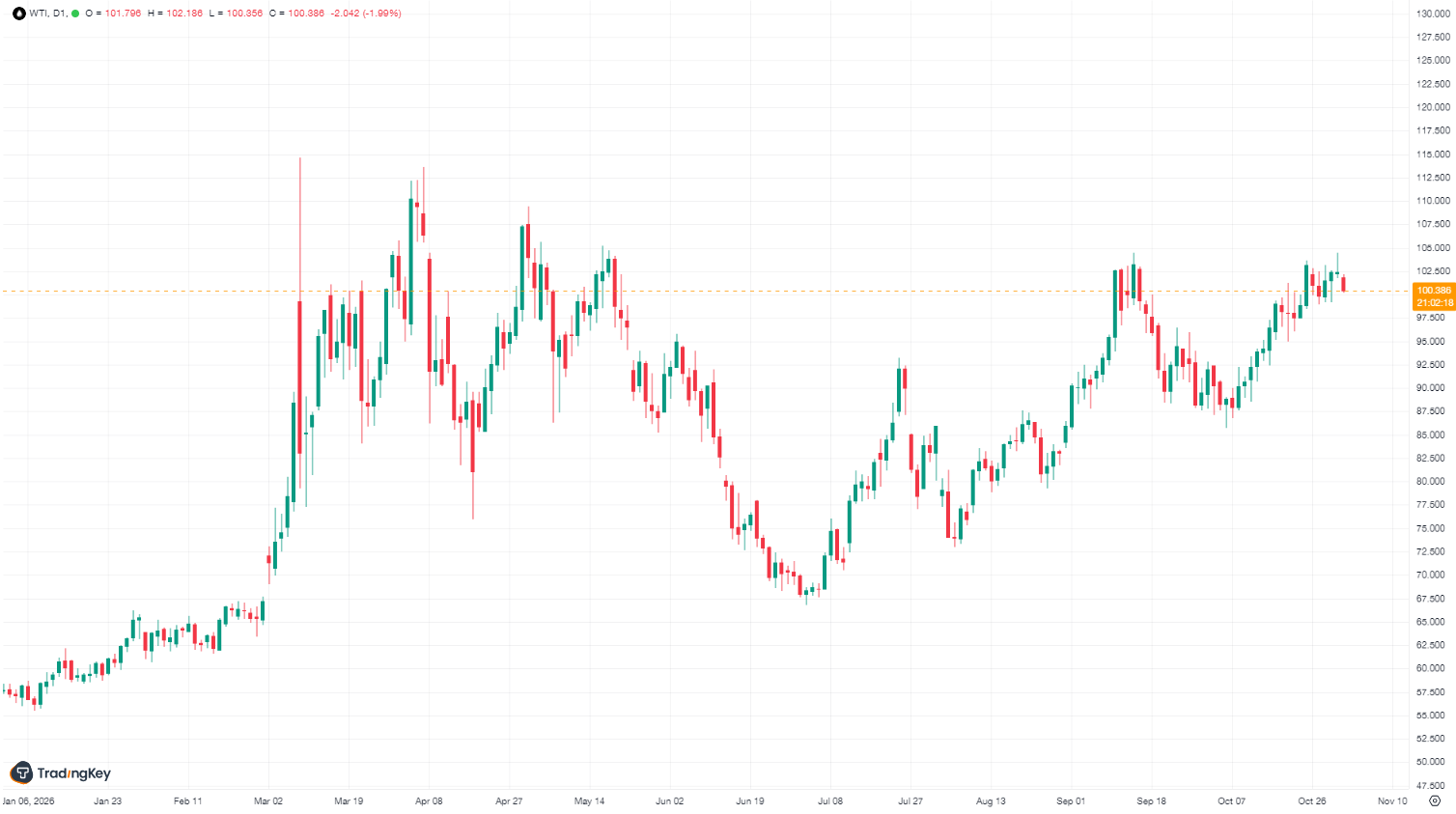 WTI crude oil price chart, Source: TradingKey
Furthermore, if the US-Iran negotiations achieve a breakthrough, a comprehensive ceasefire agreement materializes, or full navigation through the Strait of Hormuz is restored, the geopolitical premium in oil prices will be completely erased. According to global crude oil supply-demand balance models from Goldman Sachs and Citi, the fundamental equilibrium price for WTI excluding the geopolitical premium is around $80, which was also the pullback low in early October this year.
Although diplomatic channels have reopened, senior Iranian military officials simultaneously issued warnings that they would counter the US and Israel in a manner that is "high-intensity and geographically unrestricted." Iranian military spokesperson Akraminia stated on November 1 that if the US initiates hostilities again, it will immediately face a devastating counterstrike on a scale far exceeding previous actions. It is evident that until a substantive ceasefire agreement in the Middle East is officially signed, regional conflicts could still trigger a sharp rebound in oil prices at any time.
This content was translated using AI and reviewed for clarity. It is for informational purposes only.
Recommended Articles







Comments (0)
Click the $ button, enter the symbol, and select to link a stock, ETF, or other ticker.