


AMD Stock Forecast: Intel's PC Warning Sends AMD Toward $513 Support Before Tuesday's Earnings



AI Podcast


Advanced Micro Devices fell 9% premarket following Intel’s weak fourth-quarter outlook and warning of an extended personal computer slowdown. Ahead of its upcoming third-quarter report, AMD faces heightened scrutiny regarding its data center growth and Helios system rollout. Analysts expect strong revenue expansion driven by artificial intelligence demand, though technical indicators show short-term momentum turning negative. Key support lies at $513.39 and $502.66, with a daily close below the latter risking a deeper correction toward $440.49. Conversely, holding support and surpassing resistance at $551.62 would restore bullish momentum.

TradingKey - Advanced Micro Devices (NASDAQ: AMD) fell to $517.08 in premarket trading on Friday, October 30, down about 9%, after Intel's weak fourth-quarter outlook hit chip stocks. AMD had already slipped 2.08% to $566.42 on Thursday after failing to break $579.63 resistance.
The drop came just days before AMD's own third-quarter report, due after the close on Tuesday, November 3, with the call at 5 p.m. ET. Intel blamed a memory-driven PC slump, and AMD sells PC chips too. But most of AMD's growth now comes from data centers, the same area where Intel just posted 78% growth.
Why Intel's Report Hit AMD
Intel guided Q4 revenue to $15.0 billion to $16.0 billion, well below estimates, and CFO David Zinsner said "we see the PC slowdown continuing at least through the first half of next year." Intel expects PC units to fall about 12% this year and 10% in 2027, as high memory prices push up PC costs.
AMD competes with Intel in both PC and server processors. Its Client segment is expected to bring in about $3.03 billion in Q3, roughly 23% of revenue, according to Zacks, so the PC slump matters but does not define the quarter.
What Wall Street Expects
Analysts expect adjusted EPS of about $1.95, up from $1.20 a year earlier, on revenue of about $13.09 billion, up roughly 42% from $9.25 billion, according to MarketBeat. Zacks estimates show Data Center revenue of about $8.27 billion, up about 91%, with Embedded up about 25% and Gaming down about 51%.
AMD guided Q3 revenue to about $13.0 billion, plus or minus $300 million, with an adjusted gross margin, the share of revenue left after production costs, of about 56%.
Q2 Set the Pace
In Q2, revenue rose 50% to a record $11.54 billion, and adjusted EPS of $1.66 beat estimates. Data Center revenue more than doubled, up 107% to $6.7 billion, while Client revenue rose 23% to $3.1 billion. CFO Jean Hu said, "We expect Data Center sales to accelerate in the second half of 2026," and CEO Lisa Su said AMD now expects data center revenue to more than double in 2027.
The AI Deals Behind the Growth
AMD's Helios systems, full server racks built around its Instinct GPUs, begin ramping in the second half of this year, with Meta, OpenAI, Anthropic, Microsoft and Oracle among the customers named in the Q2 release. Meta's deal covers up to 6 gigawatts of Instinct GPUs and comes with a warrant for up to 160 million AMD shares, and AMD has committed $1 billion to Meta's latest equity offering.
In my view, the Helios ramp matters more on Tuesday than the Client number. Any sign of delay would hit the stock harder than a soft PC outlook.
Valuation and the Reaction Risk
At about $517, AMD trades at roughly 68 times 2026 and 33 times 2027 normalized EPS estimates, according to TIKR. The stock has more than doubled this year, but Friday's premarket price was about 20% below its October 6 record close of $649.42. AMD has also sold off on good news before: shares fell 17.3% on February 4 after its Q1 guidance.
AMD Technical Analysis: $513 Trendline Support Is the Make-or-Break Level
The Intel news showed up as a premarket gap on the daily chart. Friday's drop took AMD back toward the rising trendline from July and the 100-day EMA at $513.39, erasing most of its recovery from the prior week and leaving it below the 50-day EMA at $551.62. EMAs are moving averages that give more weight to recent prices, so falling below the faster one shows short-term momentum has turned.
RSI, a momentum gauge that runs from 0 to 100, was near 51 at Thursday's close, before the premarket drop. The MACD, a trend-following momentum indicator, is still below zero, which shows weak momentum.
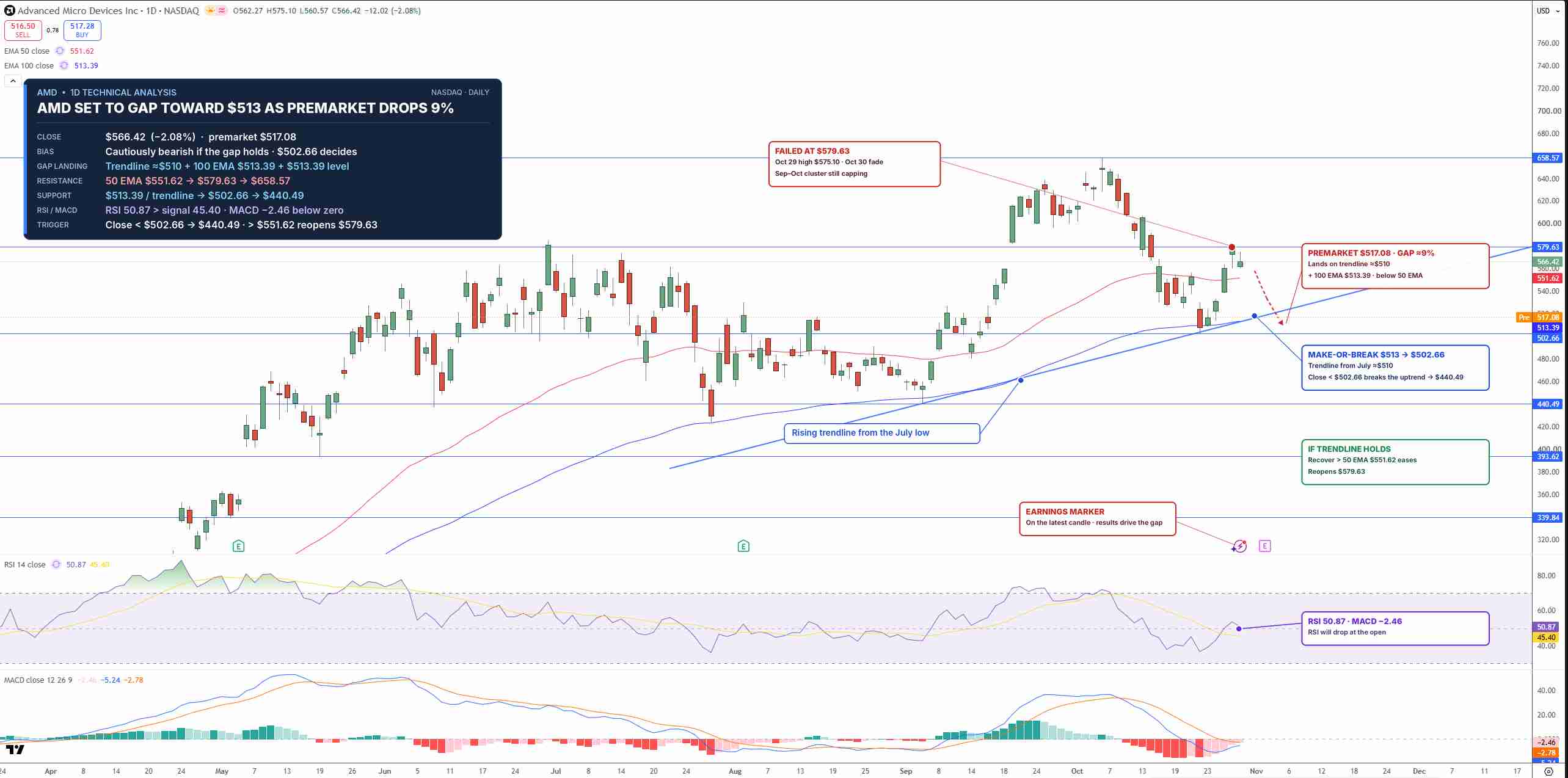
AMD Price Chart - Source: Tradingview
If buyers defend the trendline, a recovery above $551.62 would ease the pressure and reopen $579.63. A daily close below $502.66, however, would break the uptrend from July and could send AMD toward $440.49.
I'm cautiously bearish while AMD trades below $551.62, and everything hinges on $502.66.
Key Levels
- October 29 close: $566.42, down 2.08% (October 30 premarket: $517.08)
- Support: $513.39, $502.66, $440.49
- Resistance: $551.62, $579.63
- RSI: 50.87 at Thursday's close, before the premarket drop
- Bullish trigger: Daily close above $551.62
- Bearish trigger: Daily close below $502.66
FAQs
Why did AMD stock fall before earnings?
AMD dropped about 9% premarket on Friday after Intel guided Q4 revenue well below estimates and warned that the PC slowdown will last at least through the first half of 2027. AMD reports its own Q3 results after the close on Tuesday, November 3.
What is the AMD stock forecast before earnings?
The bias is cautiously bearish below $551.62. AMD needs to hold the $513 trendline area, and a daily close below $502.66 would open $440.49, while a recovery above $551.62 would reopen $579.63.
Bottom Line
Intel's warning hit AMD's PC business, but Tuesday's report will be judged mostly on data center growth and the Helios ramp. The level that matters is $502.66, just below the trendline. I expect buyers to defend the $513 area if they see Data Center topping $8 billion, while a daily close below $502.66 would confirm a deeper pullback toward $440.49.
Recommended Articles











Comments (0)
Click the $ button, enter the symbol, and select to link a stock, ETF, or other ticker.