


Crude Oil Price Forecast: US-Iran Tensions Push Brent Crude Above $100 Mark, What's Next for Oil Prices?



AI Podcast


On Thursday (September 10), escalating US-Iran tensions and Middle Eastern supply disruptions drove WTI crude past $95 and Brent crude above $100 per barrel, reaching new highs since July. Additional pressure stems from Ukrainian strikes on Russian export terminals. Elevated oil prices threaten to reignite secondary inflation, potentially forcing central banks to maintain higher interest rates and dampening global economic activity. Persistent geopolitical conflict could sustain a prolonged blockade of the Strait of Hormuz, with analysts eyeing $110–$120 targets, while a rare ceasefire could risk a pullback toward $75.

TradingKey - Escalating US-Iran Tensions Drive Oil Prices Higher as Brent Crude Crosses $100; How Will the Market Evolve?
On Thursday (September 10), international crude oil prices rose further, driven by re-escalating US-Iran tensions. Among them, WTI crude oil (USOIL) prices briefly surged past $95/barrel this morning, while Brent crude oil (UKOIL) prices breached the key $100/barrel mark, both hitting new highs since July this year.
Deteriorating geopolitical tensions are the core driver of this rally in oil prices. Recently, military skirmishes between the US and Iran in the Strait of Hormuz and the Persian Gulf region have intensified, sparking market fears that shipping through the Strait of Hormuz—a vital artery for nearly one-fifth of the world's crude oil transport—could be completely cut off.
In addition, Yemen's Houthis attacked energy facilities in Saudi Arabia, forcing a temporary halt to some local oil production operations and further worsening fears of supply disruptions in the Middle East. Meanwhile, Ukrainian drone strikes on infrastructure at Novorossiysk, a major Russian oil export terminal on the Black Sea, sounded the alarm over potential disruptions to Russian oil exports.
Currently, crude oil prices breaking $100 are reigniting market concerns over secondary inflation, which could force major central banks such as the Federal Reserve (Fed) to maintain higher interest rates for longer, thereby dampening medium-to-long-term global economic activity and energy demand. To make matters worse, the US-Iran conflict could persist, providing strong support for oil prices.
According to The Wall Street Journal, US officials stated that "senior White House advisors privately suggested to President Trump that a war with Iran could last through the remainder of his term." If so, the Strait of Hormuz could face a prolonged total blockade, potentially driving oil prices even higher. Notably, Goldman Sachs analysts pointed out that if the break above $100 is confirmed on weekly charts, upside technical room will quickly open toward the $110–$120 range.
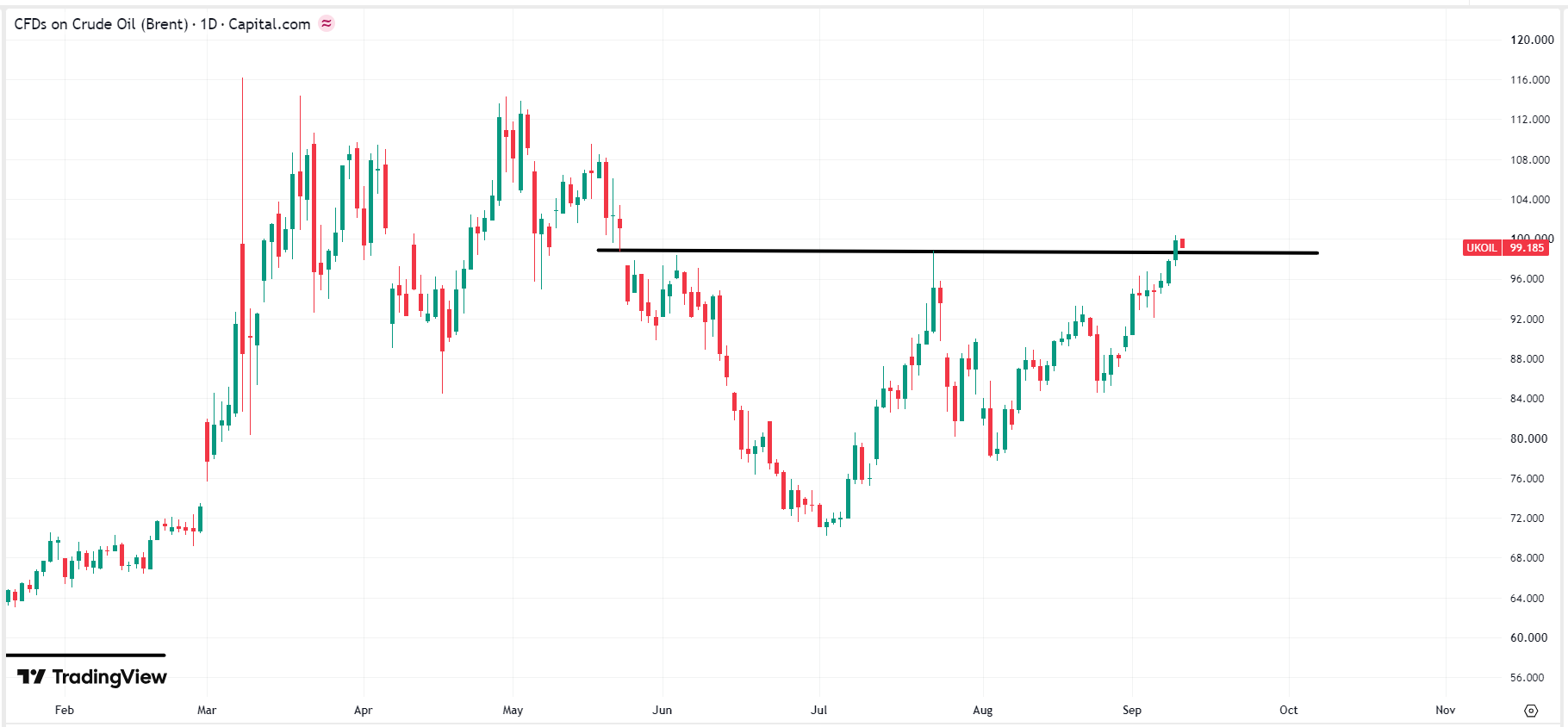 Brent Crude Oil Price Chart, Source: TradingView
The prevailing market view holds that the Strait of Hormuz remains in a state of fragile operation or partial blockade, keeping risk premiums high and oil prices fluctuating within the $90–$100 range. If the US and Iran unexpectedly reach a short-term ceasefire or escort agreement and shipping traffic through the strait gradually recovers, oil prices could fall back to $75/barrel, although this scenario is considered unlikely.
This content was translated using AI and reviewed for clarity. It is for informational purposes only.
Recommended Articles










Comments (0)
Click the $ button, enter the symbol, and select to link a stock, ETF, or other ticker.