


October 2026 FOMC Meeting Preview: Will the Fed Raise Rates Again? What Does This Mean for US Stocks?



AI Podcast


The upcoming Federal Reserve FOMC meeting focuses on potential rate adjustments amid persistent inflation and shifting labor markets, with markets largely anticipating a rate pause in October while pricing in future tightening risks. Rising interest rates elevate Treasury yields and borrowing costs, creating capital pressure for high-valuation tech and AI infrastructure firms like Oracle and CoreWeave, which rely heavily on substantial capital investments. Investors must monitor rate expectations, Treasury yields, and corporate cash flows to evaluate how financing costs and investment returns impact growth stock valuations and AI sector profitability.

TradingKey - The Federal Reserve will hold its Federal Open Market Committee (FOMC) meeting from October 27 to 28, Eastern Time. Inflationary pressures and labor market shifts have heightened monetary policy uncertainty, with the market focusing on whether the Fed will raise interest rates again and how subsequent policy signals will affect US stocks.
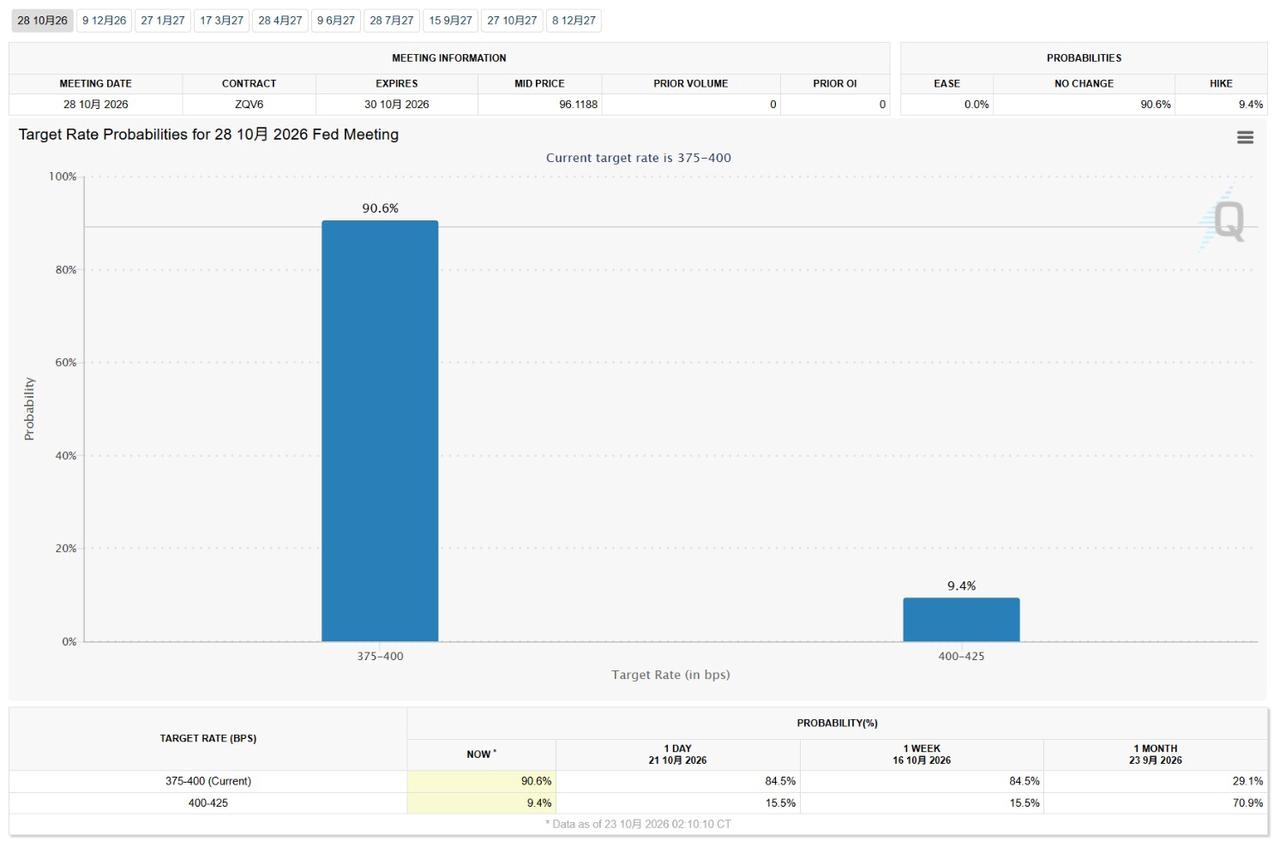
As of October 22, according to the CME FedWatch Tool, the market estimated an approximately 90.6% probability that the Fed would keep interest rates unchanged in October, and an approximately 9.4% probability of a 25-basis-point rate hike.
On September 16, the Fed raised the target range for the federal funds rate by 25 basis points to 3.75%–4.00%. The key focus of this meeting lies in whether the Fed will continue to tighten policy and what signals it will release regarding the future rate path.
[Source: CME]
Will the Fed Raise Rates Again?
The market currently expects the Federal Reserve to keep interest rates unchanged in October, but inflationary pressures remain an important factor influencing subsequent policy. US CPI rose 3.7% year-on-year in September, higher than August's 3.4%; core CPI rose 2.6% year-on-year, also higher than the previous reading of 2.4%, showing that inflationary pressures have not yet fully eased.
Meanwhile, slowing job growth may limit room for the Federal Reserve to tighten policy further. The Fed needs to comprehensively evaluate inflation trends, the labor market, and economic growth to balance price stability and employment goals.
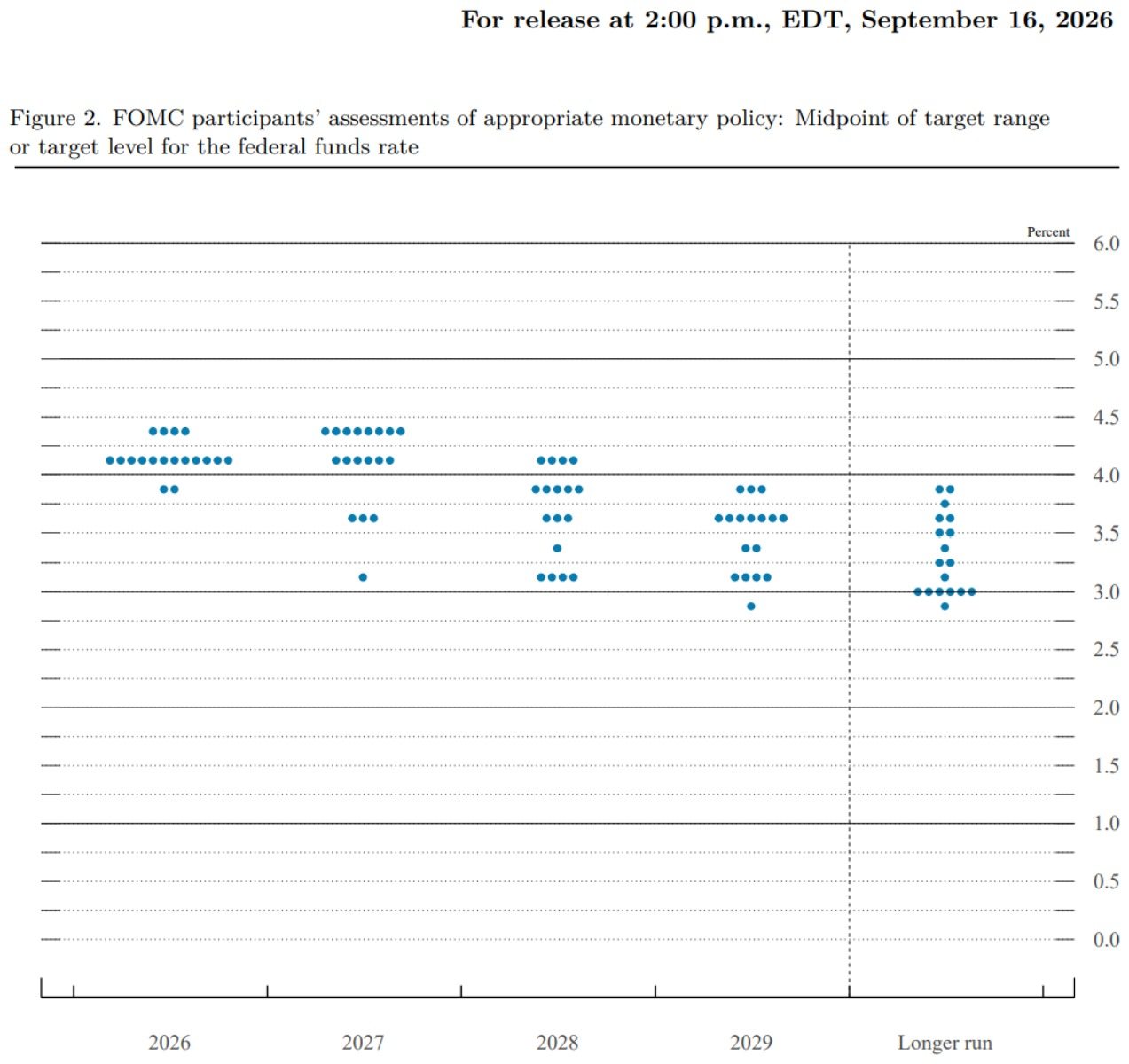
According to the September dot plot, Fed officials' median forecast for the federal funds rate at the end of 2026 and 2027 was 4.1%, higher than the June forecasts of 3.8% and 3.6%. This reflects a more hawkish stance among officials regarding the future rate path compared to before, but it does not mean the Fed has committed to continuing rate hikes.
[Source: Federalreserve]
Therefore, even if rate hikes are paused in October, the risk of subsequent rate increases has not disappeared. Investors should focus on the Fed's assessment of inflation and employment, as well as whether the post-meeting statement signals further policy tightening in December.
Why Rate Hike Risks Affect AI Stocks
Rising interest rates may push up Treasury yields and corporate borrowing costs, putting pressure on high-valuation growth stocks. The construction of AI data centers and GPU procurement require substantial capital investments; as a result, financing costs, project commissioning timelines, and investment returns have become key market focuses.
Take Oracle (ORCL) and CoreWeave (CRWV) as examples. In the first quarter of fiscal year 2027, Oracle's capital expenditures were approximately $28.5 billion, and free cash flow stood at negative $5.4 billion, reflecting the capital demands driven by AI infrastructure expansion. During the same period, the company's operating cash flow was approximately $23.1 billion, demonstrating that it still possesses strong operating cash flow generation capabilities.
CoreWeave, meanwhile, relies more heavily on external financing to support its data center expansion. In the second quarter of 2026, its net interest expense was approximately $640 million, making financing costs and debt service pressures key areas of concern.
If interest rates remain high for an extended period, costs for new financing and debt refinancing for certain companies may rise. However, the ultimate impact will depend on debt maturities, fixed or floating rate arrangements, and credit spreads.
For AI infrastructure companies, investors should also focus on whether revenue growth can translate into profits and cash flow, as well as whether additional capital expenditures can yield reasonable returns.
How the Fed’s Rate Decision Affects US Stocks?
If the Federal Reserve holds interest rates steady and signals that inflation is gradually easing, growth stock valuations could find support. However, if the Fed delivers a surprise rate hike or hints at potential policy tightening in December, Treasury yields and borrowing costs may rise further, putting greater pressure on high-valuation tech stocks and AI infrastructure companies with substantial financing needs.
Investors should focus on three key metrics: first, changes in rate futures pricing for the December meeting; second, U.S. Treasury yields and corporate credit spreads to gauge shifting interest rate expectations and financing risks; and third, the capital expenditures, free cash flow, and financing arrangements of companies like Oracle and CoreWeave to assess whether AI investments can translate into actual returns.
Overall, the key to the October meeting lies not only in whether a rate hike occurs, but also in how the Federal Reserve shapes future rate expectations. For AI-related stocks, the interest rate environment must be evaluated alongside corporate earnings, cash flows, and returns on investment, making it difficult to determine future stock price trends based on a single rate decision alone.
This content was translated using AI and reviewed for clarity. It is for informational purposes only.
Recommended Articles






Comments (0)
Click the $ button, enter the symbol, and select to link a stock, ETF, or other ticker.