


WTI Crude Oil Price Forecast: Oil Falls Below $80 as Trump Halts Iran Strikes; Will Prices Rise?



AI Podcast


As of the Asian session on August 3, WTI and Brent crude prices plummeted by over 9% and 8% respectively, breaching key psychological levels. This decline follows President Trump’s suspension of military strikes against Iran and plans for diplomatic negotiations, significantly reducing geopolitical risk premiums. Concurrently, OPEC+ members announced a production increase of 188,000 barrels per day starting in September, exacerbating downward pressure. Technically, WTI has shifted to a bearish trend, with $80 now acting as resistance. Primary support lies at $79–$78; failure to hold these levels could trigger further declines toward $76.

TradingKey - As of the Asian session on August 3, WTI crude oil ( USOIL) prices fell sharply, breaking below the $80 mark during intraday trading, with an intraday decline of over 9%, while Brent crude ( UKOIL) also plunged by over 8%. Last week, the crude oil market was supported by the risk of Middle East crude oil supply disruptions, but last Saturday Trump said he would suspend a new round of military strikes on Iran. Coupled with OPEC+ announcing a continuation of production increases, crude oil prices opened under pressure this week and fell back.
Why Are Oil Prices Falling?
The direct cause of today's decline in WTI crude oil was US President Donald Trump signaling a fresh de-escalation in the US-Iran situation. Trump stated that after Iran and some Middle Eastern countries requested more time to reach an agreement, the US decided to temporarily hold off on launching new military strikes against Iran and plans to push for negotiations to achieve a full restoration of navigation in the Strait of Hormuz, while also resolving the Iranian nuclear issue. Trump also noted that US-Iran talks would begin on Monday, but did not announce the location of the talks, the participants, or a clear deadline for reaching an agreement.
This statement significantly eased market concerns over a further escalation of the conflict. Previously, the conflict between the US and Iran had repeatedly escalated, with multiple oil tankers attacked near Oman and the Strait of Hormuz, prompting some shipping companies to reduce entry into the Persian Gulf, which led to cumulative gains of over 20% for both WTI and Brent crude in July. Now that the US has put military action on hold, the market has begun betting that shipping conditions in the strait could improve, driving oil prices to quickly give back some of their war risk premium.
The latest statement from the Iranian side also signaled some willingness to negotiate. Iran's Ministry of Foreign Affairs stated that Iran is close to reaching an agreement with Oman on a new shipping route for the Strait of Hormuz, which will take into account the sovereignty, security, and navigation needs of both sides. However, Iran also emphasized that this does not mean the strait will return to the fully open state it was in before the conflict broke out.
In addition, OPEC+'s latest decision to increase production has also added downward pressure on oil prices. Saudi Arabia, Russia, Iraq, Kuwait, Kazakhstan, Algeria, and Oman have decided to raise their crude oil production targets by 188,000 barrels per day starting in September. This means OPEC+ is further unwinding the voluntary production cuts implemented in 2023 and signaling increased supply to the market.
WTI Crude Oil Technical Analysis
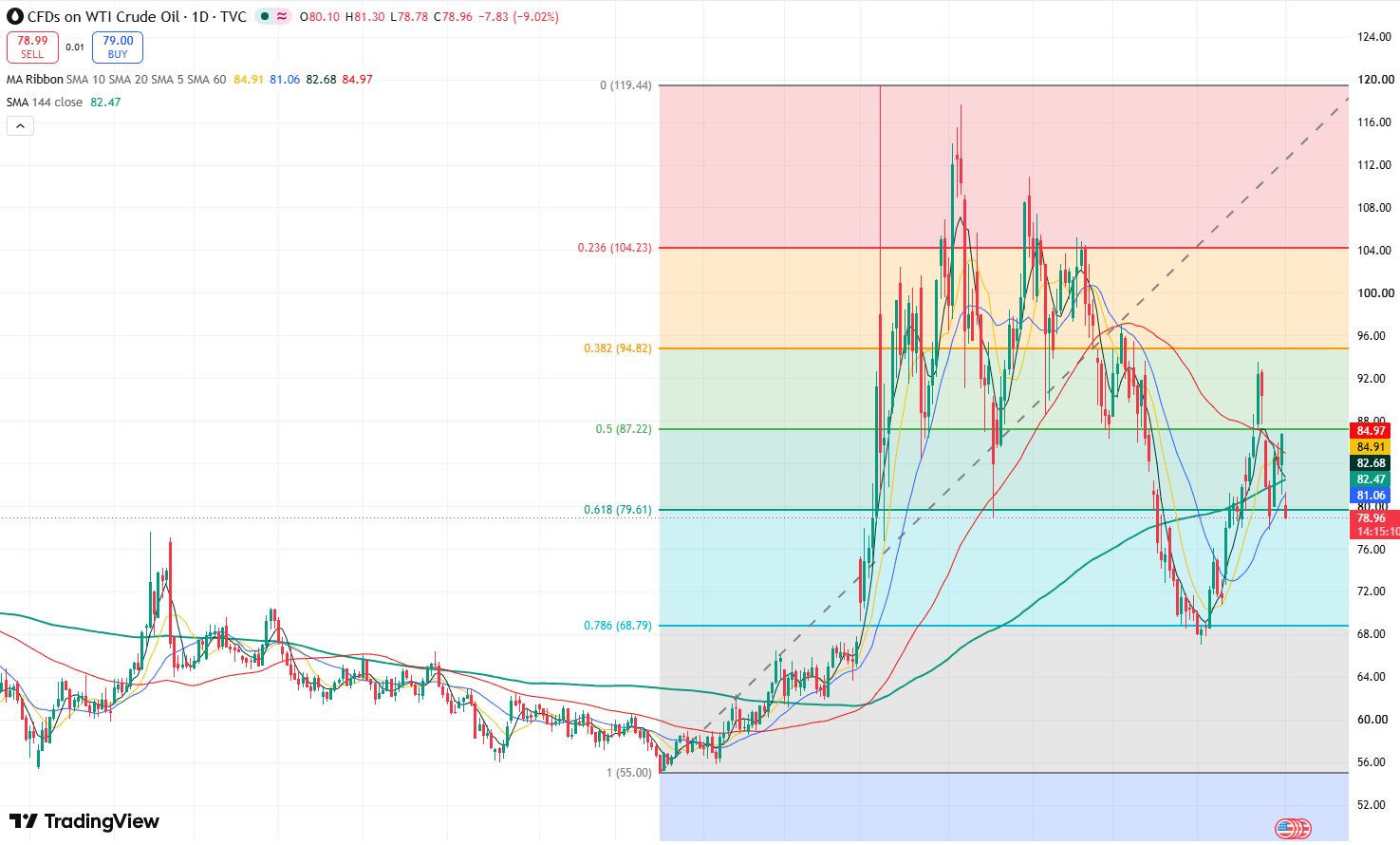
WTI crude oil price daily chart, Source: TradingView
Looking at the daily chart of WTI crude oil, oil prices gap-opened sharply lower today and broke below the key $80 psychological level, indicating that the previous upward trend driven by geopolitical risks has clearly cooled down. As $80 is an important psychological support for the market, breaking below it now may turn it into short-term resistance, and market sentiment has temporarily shifted from bull-dominated to bear-dominated.
On the downside, the primary support for WTI crude oil is in the $79-$78 range. If oil prices can find support in this area, a short-term technical rebound may occur to retest the $80 level. If $78 is decisively broken, oil prices may head further down to test $76.
On the upside, $80 to $81 has become the first line of resistance. If there is a lack of progress in US-Iran negotiations, or if another tanker attack occurs in the Strait of Hormuz, WTI may reclaim $81 and rebound toward the $83-$85 range.
This content was translated using AI and reviewed for clarity. It is for informational purposes only.
Recommended Articles











Comments (0)
Click the $ button, enter the symbol, and select to link a stock, ETF, or other ticker.