


Kioxia Tumbles Over 13% to Lowest Since April After Four-Day Decline



AI Podcast


On November 4, Kioxia shares plunged over 13%, marking four consecutive days of losses and hitting a near six-month low below the 10,000-yen mark. The sell-off was triggered by conservative forward guidance on contract prices and shipments, combined with heavy reliance on conventional NAND Flash rather than high-margin HBM. A surge in leveraged margin buying sparked a liquidity stampede of programmatic forced liquidations, breaking key moving averages. Investors are now closely monitoring whether the 10,000-yen psychological level will attract institutional value buyers and if US peers like Micron and SanDisk will signal a sector-wide bottom.
TradingKey - Kioxia drops over 13% in a single day, stock plunges for four straight days to hit a nearly six-month low; focus remains on the 10,000-yen mark.
On November 4, Japanese memory chip giant Kioxia's stock plunged into a sell-off storm of four consecutive days of losses, dropping over 13% in a single day today. Intraday, it briefly fell below the 10,000-yen mark, hitting a low of 9,820 yen (approximately $62.24), setting a new low since April of this year. As of press time, Kioxia's stock has rebounded above 10,000 yen.
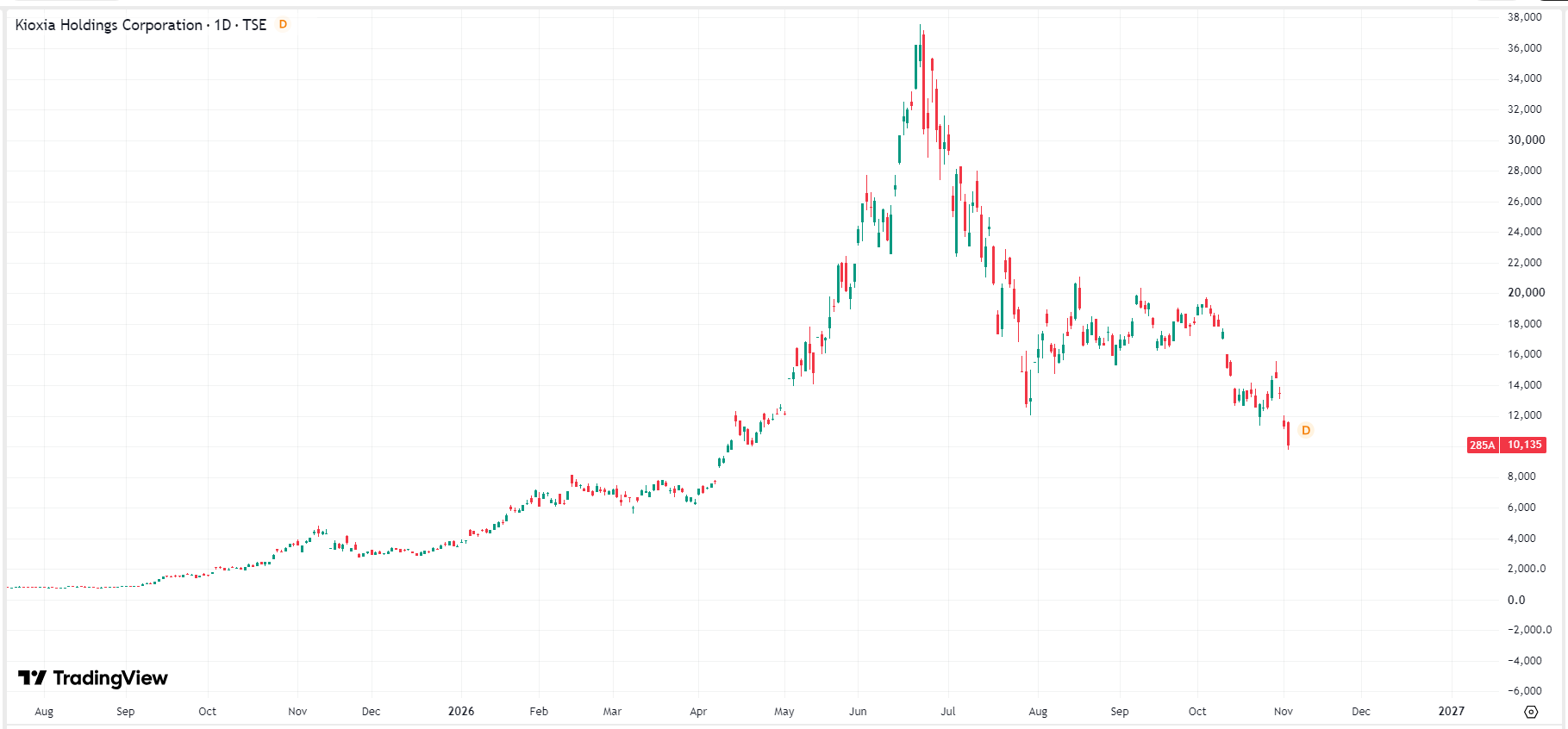 Kioxia stock chart, Source: TradingView
Although Kioxia's latest quarterly revenue remains high, management's projections for contract prices and shipment volumes in the next phase fell significantly short of Wall Street's extremely optimistic expectations. Furthermore, compared to SK Hynix and Samsung Electronics, which enjoy the high-margin defense and premium pricing of HBM, Kioxia's revenue is heavily concentrated in conventional NAND Flash.
Over the past few weeks, a massive volume of margin buying long positions accumulated in Kioxia's stock. However, as the stock price relentlessly broke below 12,000 yen and the dense April rally bottom during the four-day slump, large volumes of leveraged long positions triggered margin calls and programmatic forced liquidation thresholds. This chain-reaction liquidation of long positions created a textbook liquidity stampede and bottomless selling.
Kioxia's four-day slump sent its stock price below all short-, medium-, and long-term moving averages, completely erasing the rally built since April of this year. Close attention should be paid to whether the 10,000-yen psychological level can attract local Japanese long-term value funds (such as GPIF or sovereign wealth funds) to enter and form a bottom, as well as whether U.S. stocks Micron (MU) and SanDisk (SNDK) can show bottoming signals with long lower shadows during regular trading hours.
This content was translated using AI and reviewed for clarity. It is for informational purposes only.
Recommended Articles










Comments (0)
Click the $ button, enter the symbol, and select to link a stock, ETF, or other ticker.