


US-Iran Tensions Worsen: Brent Crude Breaks $90, WTI Crude Tops $84



AI Podcast


As of the early Asian session on July 20, WTI and Brent crude prices surged by 2.21% and 2.27%, respectively, driven by escalating U.S.-Iran hostilities. Military strikes against Iran-linked targets and maritime restrictions have renewed concerns over supply disruptions in the Strait of Hormuz. Markets are currently pricing in a higher geopolitical risk premium, with Brent potentially targeting $95–$100 if tensions persist. While supply security remains the primary catalyst for the current rally, future oil price stability hinges on potential conflict de-escalation or assurances from major producers to maintain steady global supply chains.

TradingKey - As of the early Asian session on July 20, international oil prices opened significantly higher, with WTI crude ( USOIL) rising 2.21%, peaking at $84.60; Brent crude ( UKOIL) rising 2.27%, peaking at $91.42. The main driver behind the jump in oil prices is the ongoing escalation of the conflict between the U.S. and Iran, which has renewed market concerns over Middle East supply disruptions and shipping safety in the Strait of Hormuz.
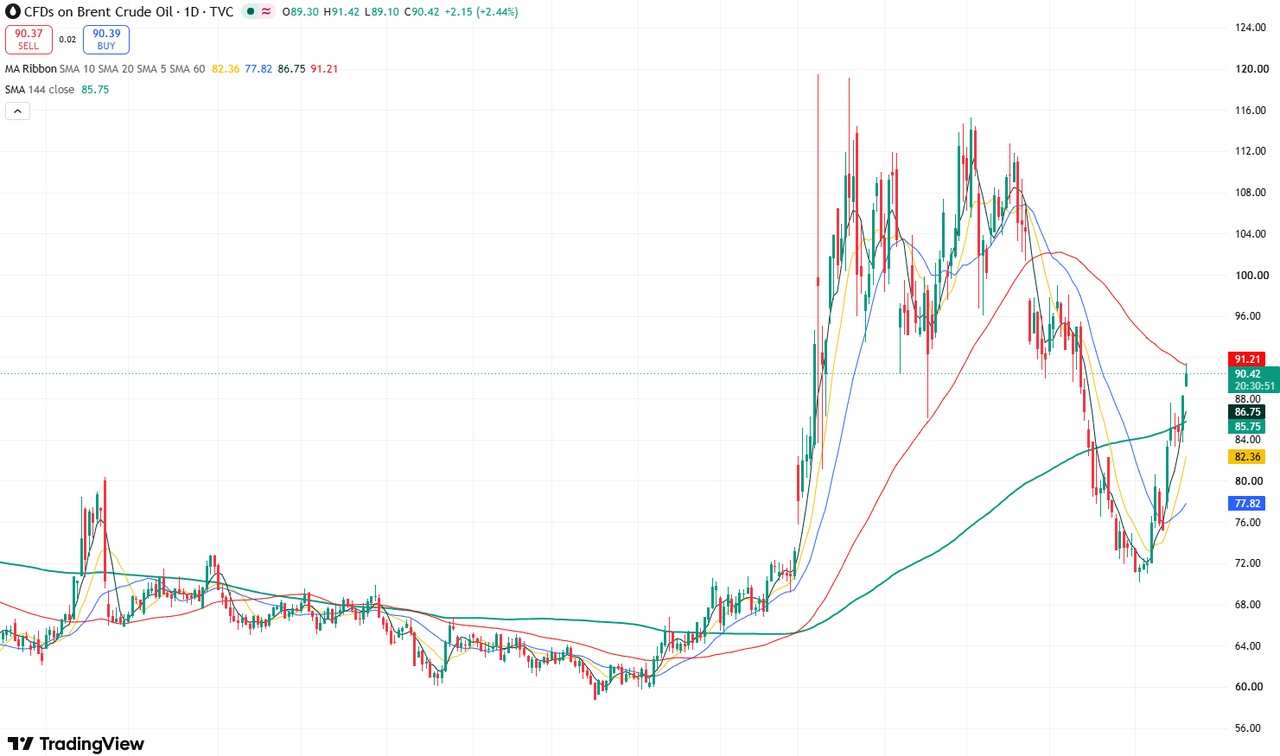
Daily chart of Brent crude oil prices, Source: TradingView
Last Friday, oil prices had already risen significantly due to escalating hostilities between the U.S. and Iran. WTI crude settled higher at $81.78 per barrel, and Brent crude closed up at $88.27, both recording strong weekly gains. Opening with another jump this week indicates that traders are pricing back in a higher geopolitical risk premium.
On the news front, the U.S. Central Command stated that the U.S. military has launched strikes against Iran-linked targets for the ninth consecutive night, aiming to degrade Iran's military capabilities used to threaten commercial vessels and civilian mariners. Since the Strait of Hormuz is one of the world's most critical energy transit corridors, any military action or signs of shipping disruptions will quickly push up the oil risk premium.
Meanwhile, the maritime blockade imposed by the U.S. on Iranian ports has also heightened market tensions. According to reports, the U.S. has rerouted several commercial vessels and restricted shipping activities near Iranian ports in related operations. The market fears that if Iran takes further retaliatory measures, the Strait of Hormuz or Red Sea shipping routes could face greater disruptions, thereby affecting Middle East crude oil and liquefied natural gas (LNG) exports.
Analysts pointed out that the current rise in oil prices is driven by fears of supply disruptions. If navigation through the Strait of Hormuz remains threatened, Brent oil prices could edge closer to the $95 or even $100 mark; WTI crude could also continue to test the $86 to $88 range. However, if there are signs of de-escalation in the conflict going forward, or if major oil-producing nations issue commitments to stabilize supply, short-term gains in oil prices could face profit-taking.
This content was translated using AI and reviewed for clarity. It is for informational purposes only.
Recommended Articles









Comments (0)
Click the $ button, enter the symbol, and select to link a stock, ETF, or other ticker.