


A Kevin Warsh–Jerome Powell Fed Showdown Could Rattle Markets -- Here's What Investors Should Brace For



Key Points
Former Fed Chair Jerome Powell is staying on the Federal Reserve Board of Governors.
This could set the stage for a clash between Powell and new Fed Chair Kevin Warsh.
Investors should brace for uncertainty resulting from the two men's competing ideologies.
Most of us have heard the adage "out with the old, in with the new." But what happens when the "old" remains "in" alongside the "new"? We're about to find out with the changing of the guard at the Federal Reserve.
Jerome Powell's term as Fed Chair concluded on May 15, 2026. His replacement, Kevin Warsh, has officially taken the baton. For decades, previous Fed Chairs have stepped down from the Federal Reserve Board of Governors at the same time their term as Chair ended. But Powell is breaking that 78-year tradition.
Will AI create the world's first trillionaire? Our team just released a report on the one little-known company, called an "Indispensable Monopoly" providing the critical technology Nvidia and Intel both need. Continue »
Powell plans to stay on because the Trump administration's investigation into renovations of the Fed's headquarters and the president's personal attacks are "battering the institution and putting at risk the thing that really matters to the public, which is the ability to conduct monetary policy without taking into consideration political factors."
This unprecedented scenario of a longtime Fed Chair continuing to serve alongside a new Chair may set the stage for fireworks at the central bank like never seen before. And a showdown between Warsh and Powell could rattle markets.
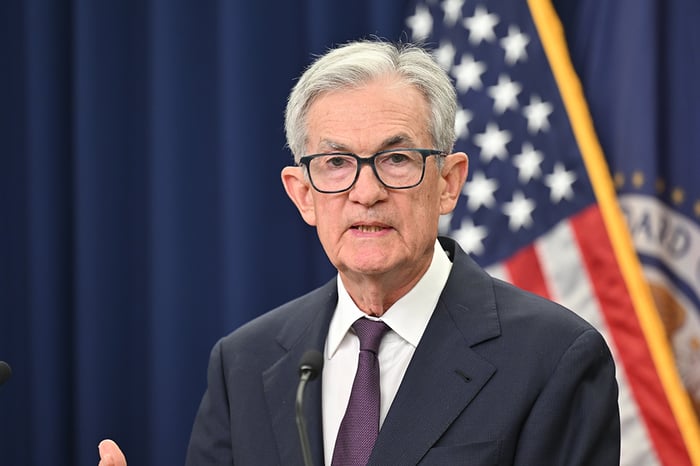
Former Federal Reserve Chair Jerome Powell answers reporters' questions at the FOMC press conference on Sept.17, 2025. Official Federal Reserve Photo.
Competing ideologies
Powell became Chair of the Board of Governors of the Federal Reserve System on Feb. 15, 2018, after being nominated for the position by Trump in his first presidential term. Like his predecessors, he believed in using the Fed's capacity to set federal funds rates and its balance sheet to help stabilize the market, boost employment, and control inflation.
Warsh, on the other hand, wants to aggressively shrink the Fed's $6.7 trillion balance sheet and rely on setting rates to achieve monetary policy goals. He stated during his Senate confirmation hearings, "The balance sheet tool disproportionately helps those with financial assets. The interest rate tool hits the entire economy."
President Trump clearly wants Warsh to reduce interest rates and repeatedly criticized Powell for not doing so. Warsh's view that artificial intelligence (AI) is a "significant disinflationary force" could provide the flexibility to lower rates and satisfy the president. However, Powell has gone on record stating that AI is contributing to higher inflation.
Under Powell's helm, the Fed released its quarterly "dot plot" that revealed where each Federal Open Market Committee (FOMC) member projected interest rates were headed (albeit anonymously). Powell also used his public statements to subtly telegraph coming Fed actions so that the markets weren't blindsided.
Warsh, though, has ridiculed the "dot plot" by calling it "central bank fast food." He also thinks the Fed communicates too much, telling the International Monetary Fund last year, "The central bank should find new comfort in working without applause and without the audience at the edge of its seats."
What investors should brace for
The competing ideologies held by Warsh and Powell could lead to a showdown between the two men and their allies in the coming months. But would a Warsh-Powell clash rattle markets? Bet on it.
For one thing, markets hate uncertainty -- both the stock market and the bond market. If the Fed is less communicative with Warsh as Chair, Wall Street won't like it. It wouldn't be shocking, though, if Powell or other FOMC members who share his views tried to telegraph future Fed moves that investors prefer. The downside to this approach, though, is that it could set the stage for heightened animosity among the Federal Reserve Governors, which would add more uncertainty.
An even bigger confrontation could come if Powell believes that Warsh is acting in a way that compromises the Fed's political independence. We may see a full-blown battle at the Fed if Warsh pushes for further rate cuts while inflation continues to rise and the jobs market is strong. Whichever side wins this battle, the tumult would almost certainly lead to increased stock market volatility.
Increased bond market volatility seems likely if Warsh achieves his goal of aggressively shrinking the Fed's balance sheet. Higher long-term yields are likely to result from this move.
Smart steps to take
Investors can take several smart steps to prepare for a possible Warsh-Powell conflict at the Fed. One thing to do is to increase your cash position. If markets are indeed rattled by the current and previous Fed Chairs butting heads, the stocks of excellent companies could become available at attractive prices.
Another good move is to reduce your exposure to stocks that are highly sensitive to overall market volatility. The best stocks to own in such an environment are high-quality stocks with strong fundamentals, especially those in defensive sectors.
Probably the most important thing for investors to do, though, is avoid overreacting. Policy clashes already happen within the Fed. Markets adapt to new central bank policies. And who knows -- maybe Warsh and Powell will sing from the same hymnbook more than anyone expects.
Where to invest $1,000 right now
When our analyst team has a stock tip, it can pay to listen. After all, Stock Advisor’s total average return is 993%* — a market-crushing outperformance compared to 207% for the S&P 500.
They just revealed what they believe are the 10 best stocks for investors to buy right now, available when you join Stock Advisor.
*Stock Advisor returns as of May 18, 2026.
The Motley Fool has a disclosure policy.
Recommended Articles








Comments (0)
Click the $ button, enter the symbol, and select to link a stock, ETF, or other ticker.