


Vir Biotech Catapults 58% on A $1.71 Billion Deal With Astellas



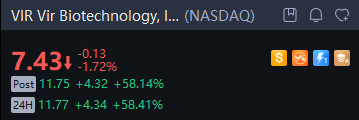
Vir Biotechnology, Inc. stock catapulted 58% in overnight trading after the small biotech company smashed Wall Street's fourth-quarter sales expectations and signed a collaboration deal with Astellas Pharma (ALPMY).
The Astellas deal comes after Vir Biotechnology (VIR) reported promising first-phase results for its drug, VIR-5500, in patients with prostate cancer. Fourteen of 17 patients showed at least a 50% reduction in prostate-specific antigen, or PSA. Elevated PSA can indicate a patient has prostate cancer. Nine patients showed at least a 90% decrease in PSA.
Dr. Johann de Bono, the study's principal investigator and director of the Drug Development Unit at the Institute of Cancer Research called the results "remarkable." De Bono also heads up the institute's Prostate Cancer Targeted Therapy Group.
"It is remarkable to see these early signs of profound anticancer activity in heavily pretreated mCPRC (metastatic castration-resistant prostate cancer) patients," he said in a written statement. He expects VIR-5500 to "play a role in treating earlier disease."
Vir Stock Flies On Astellas Deal
Following the strong results, Astellas pledged to pay $335 million in up-front and near-term milestones to co-develop and co-commercialize VIR-5500. Vir could also receive up to $1.37 billion in additional development, regulatory and sales milestones, along with tiered double-digit royalties on sales outside the U.S.
Astellas will lead commercialization in the U.S., with Vir retaining the option to co-promote. Astellas will also have exclusive rights to commercialize VIR-5500 outside the U.S.
"Our deep expertise in this disease area, combined with a growing immuno-oncology (IO) pipeline of biologics, including T-cell engagers, uniquely positions us to help advance VIR-5500, a potentially best-in-class T-cell engager for prostate cancer," Adam Pearson, Astellas' chief strategy officer, said in a written statement.
VIR-5500 works by directing T cells, members of the immune system, to destroy cancer cells. Vir's technology works by keeping the T cell engagers inactive until they reach the tumor microenvironment. This circumvents the traditionally high toxicity associated with other T cell engagers, Vir said in its news release.
Street-Beating Fourth-Quarter Sales
Vir also reported $64.1 million in fourth-quarter sales, absolutely obliterating forecasts for $19.9 million, according to FactSet. Sales grew more than fivefold year over year. The sales jump was due to the recognition of license revenue related to an agreement with privately held Norgine. The duo have an exclusive agreement for Vir's chronic hepatitis delta treatment.
Vir stock has long been in dollar-stock territory after pulling back steeply from its Covid darling days when the company sold a treatment in partnership with GSK (GSK). Still, Vir stock has climbed recently, up 18% this year.
Recommended Articles








Comments (0)
Click the $ button, enter the symbol, and select to link a stock, ETF, or other ticker.