Retirees: This Is the Average Social Security Benefit at Ages 62, 67, and 70

Key Points
The age at which you file for Social Security will affect the size of your checks for the rest of your life.
Claiming earlier will reduce your payments, while delaying will earn you more per month.
There's no one-size-fits-all time to claim, but it's important to understand how your age affects your payments.
Social Security benefits go a long way for millions of retirees, lifting around 16 million adults age 65 and older out of poverty, according to 2023 data from the Center on Budget and Policy Priorities.
The age at which you begin taking benefits will have an enormous impact on the size of your checks, which can make or break retirement for some older adults. Here's exactly what the average retiree collects at various ages from 62 to 70.
Where to invest $1,000 right now? Our analyst team just revealed what they believe are the 10 best stocks to buy right now, when you join Stock Advisor. See the stocks »
The average benefit by age
In most cases, you can begin taking retirement benefits as early as age 62. But to receive the full amount you're entitled to based on your work history, you'll need to wait until your full retirement age -- which is between ages 66 and 67, depending on your birth year.
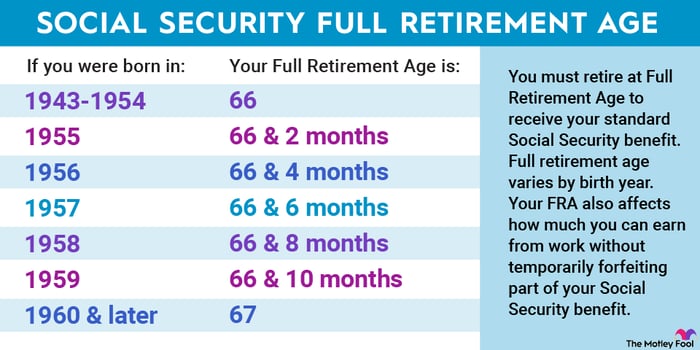
Image source: The Motley Fool.
Waiting a few more years and claiming at age 70 will earn you even larger checks. While filing at 62 will shrink your benefit by up to 30% compared to what you'd receive at your full retirement age, claiming at 70 will earn you a bonus of up to 32% on top of your full benefit.
Everyone's benefit will differ slightly, as it's based on your career earnings and the number of years you've worked. But this is what the average retiree receives each month by age, according to December 2025 data from the Social Security Administration:
| Age | Average Monthly Benefit Amount |
|---|---|
| 62 | $1,424 |
| 63 | $1,436 |
| 64 | $1,478 |
| 65 | $1,607 |
| 66 | $1,807 |
| 67 | $2,017 |
| 68 | $2,053 |
| 69 | $2,097 |
| 70 | $2,275 |
Data source: Social Security Administration.
The average retired worker collects around $851 more per month at age 70 than at 62, adding up to roughly $10,212 per year.
There's no single best age to take Social Security, as the right choice will depend on your specific circumstances and goals. If you have a solid nest egg, filing earlier can help you enjoy a longer retirement. But if you're looking to maximize your monthly income, delaying claiming could boost your benefit amount by thousands of dollars per year.
The $23,760 Social Security bonus most retirees completely overlook
If you're like most Americans, you're a few years (or more) behind on your retirement savings. But a handful of little-known "Social Security secrets" could help ensure a boost in your retirement income.
One easy trick could pay you as much as $23,760 more... each year! Once you learn how to maximize your Social Security benefits, we think you could retire confidently with the peace of mind we're all after. Join Stock Advisor to learn more about these strategies.
The Motley Fool has a disclosure policy.
Related Articles
International Copper Prices Rise for 7 Straight Months; Will Bull Market Continue in 2026?
TradingKey - As the "king of industrial metals," every fluctuation in international copper prices impacts the nerves of global investors. In early 2026, international copper prices continued to rise, extending the upward trend from 2025 and reaching a new high above $14,500, marking seven consecutive months of gains. Meanwhile, London Metal Exchange (LME) copper prices have climbed from $7,800 per tonne in July 2025 to over $9,000 per tonne today.
How Bitcoin Miners Are Scaling Revenue Through AI Data Center Integration
Discover how Bitcoin miners like Core Scientific and IREN are scaling revenue by pivoting to AI data centers. Explore 2026 hashprice trends, ASIC-to-GPU retrofitting, and the "hashrate-to-HPC" revolution.
Stock Market Crash 2026: What Fed Signals and Economic Data Mean for Investors
TradingKey - The possibility of a stock market crash occurring in 2026 is becoming increasingly likely as investor sentiment continues to decline.
New Fed Chair Warsh Takes Office: Major Shift in Monetary Policy? US Dollar Short-Term Rebound, 2026 Investment Strategy Analysis
TradingKey - At the start of 2026, global financial markets witnessed a major leadership change as U.S. President Trump officially nominated Kevin Warsh as the next Federal Reserve Chair. Pending Senate confirmation, he will succeed Jerome Powell this May to lead the world’s most influential central bank.