Should You Buy the Dip in Microsoft Stock?

Key Points
Microsoft faces intensifying competition from Amazon and Alphabet in the cloud computing space.
Some investors worry that Microsoft's rising infrastructure costs aren't yielding a sufficient return.
However, Microsoft stock is hovering near its cheapest levels since the AI revolution started.
A little more than three years ago, Microsoft (NASDAQ: MSFT) helped kick off the artificial intelligence (AI) revolution after the company invested billions into ChatGPT developer OpenAI. Since then, the Windows maker has swiftly integrated AI throughout its massive ecosystem -- from cloud computing to data analytics, software coding, and more.
Despite Microsoft being one of the most influential leaders of the AI boom, investors have been punishing its stock as of late -- with shares plummeting 16% since the company reported earnings on Jan. 28. Let's dive into the factors plaguing Microsoft stock right now and assess if the ongoing sell-off is actually an opportunity for smart investors to buy the dip.
Will AI create the world's first trillionaire? Our team just released a report on the one little-known company, called an "Indispensable Monopoly" providing the critical technology Nvidia and Intel both need. Continue »
Image source: Getty Images.
Why is Microsoft stock dropping?
One of the primary use cases for AI is how hyperscalers integrate the technology into their cloud platforms. While Amazon Web Services (AWS) holds the largest market share among major cloud services providers, Microsoft Azure is right behind it.
With each passing earnings report, investors dial in on Azure's growth relative to its peers. For the quarter ended Dec. 31, Azure's revenue increased 39% year over year. By comparison, AWS grew by 24% and Google Cloud Platform (GCP) rose 48%. While GCP is accelerating at a much faster pace than Azure and AWS, it's also a far smaller business.
With this in mind, I don't think concerns over Azure's growth are the only culprit behind Microsoft's sell-off. Rather, the company's rising infrastructure costs are beginning to make investors nervous.
During the earnings call, Microsoft CFO Amy Hood said she thinks investors are making a "direct correlation" between Microsoft's capital expenditures (capex) and Azure's revenue. This is a subtle way of saying management realizes that investors are questioning the return on investment around Microsoft's accelerating AI infrastructure build-outs.
Is Microsoft a good stock to buy now?
From a valuation perspective, Microsoft stock hasn't been this cheap since the dawn of the AI revolution. The company's price-to-earnings (P/E) multiple of 25 is hovering near its lowest levels in roughly three years.
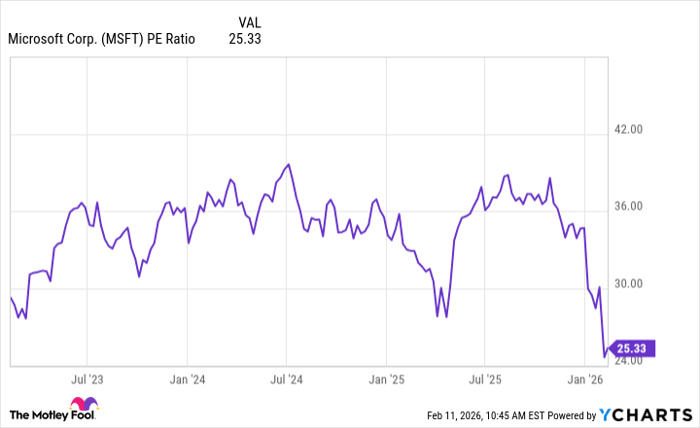
MSFT PE Ratio data by YCharts
On top of that, the consensus price target for Microsoft stock among sell-side analysts is $596 -- implying 48% upside from current levels. To me, this suggests that Wall Street remains bullish on Microsoft's AI road map and is confident in management's ability to allocate capital strategically.
Given its attractive valuation profile and upside potential, buying Microsoft stock hand over fist might seem like a no-brainer. That said, there is still some execution risk when it comes to the company's infrastructure build-outs and their ability to bear fruit and impact Azure, as well as other pockets of Microsoft's ecosystem, in an accretive way.
For this reason, I would cautiously buy the dip in Microsoft stock right now but wouldn't bet the farm. I think the sell-off is overblown and taking advantage of the depressed price action could prove to be a savvy choice in the long run.
Should you buy stock in Microsoft right now?
Before you buy stock in Microsoft, consider this:
The Motley Fool Stock Advisor analyst team just identified what they believe are the 10 best stocks for investors to buy now… and Microsoft wasn’t one of them. The 10 stocks that made the cut could produce monster returns in the coming years.
Consider when Netflix made this list on December 17, 2004... if you invested $1,000 at the time of our recommendation, you’d have $414,554!* Or when Nvidia made this list on April 15, 2005... if you invested $1,000 at the time of our recommendation, you’d have $1,120,663!*
Now, it’s worth noting Stock Advisor’s total average return is 884% — a market-crushing outperformance compared to 193% for the S&P 500. Don't miss the latest top 10 list, available with Stock Advisor, and join an investing community built by individual investors for individual investors.
*Stock Advisor returns as of February 15, 2026.
Adam Spatacco has positions in Amazon and Microsoft. The Motley Fool has positions in and recommends Amazon and Microsoft. The Motley Fool has a disclosure policy.
Related Articles
January CPI Revives Rate-Cut Hopes; Gold and Silver Rebound, But Is the Bull Run Intact?
TradingKey - During Friday's US session, spot gold surged back above $5,000 to close at $5,043, while silver resumed its rally, breaking through the $75 mark to peak near $79 before closing at $77.43. This movement was primarily driven by data from the U.S. Bureau of Labor Statistics that significan
Bitcoin Price Prediction 2029-2035: Institutional Accumulation and the U.S. Treasury’s Strategic Reserve Pivot
Explore the 2026 Bitcoin landscape: From the U.S. Strategic Reserve and Michael Saylor’s $75B war chest to Cathie Wood’s 2030 forecast. Is BTC the new Digital Gold?
This $1 Trillion AI Stock Is Getting Ready for 2026: Is Meta a Good Buy?
When ads and commerce are factored in, Meta is building a long-term platform—in Augmented Reality and smart glasses — to get us closer to the future of AI. This device hardware business is less profitable than ads right now, but it could grow the company’s ecosystem and open up new ways for it to ma
Is SaaS Dead? The Truth Behind the Software Meltdown, the Missing Floor, and the Peak That’s Not Coming Back
TradingKey - A trillion dollars just vanished from software stocks—this piece breaks down who AI is really killing, who quietly benefits, and why cheap SaaS may be the biggest value trap of this cycle.