


AI Panic Spreads to Commercial Real Estate, U.S. Property Services Stocks Suffer Rare Sell-Off



Amid the rapid penetration of artificial intelligence technology and potential disruption risks facing multiple industries, U.S. real estate services stocks experienced a sharp sell-off on Wednesday. Investors fear that the long-standing, high-labor-cost, high-commission intermediary service model on which these companies rely may become the next “victim” of the new wave of artificial intelligence.
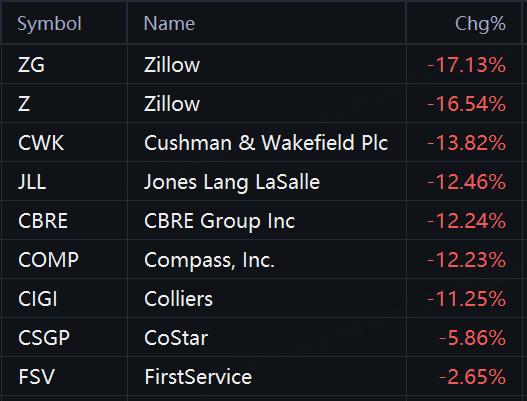
As of the close of trading that day, Zillow fell 17%; Cushman & Wakefield fell 14%; Jones Lang LaSalle fell 13%; CBRE Group and Compass fell 12%; Colliers fell 11%; CoStar fell 6%; FirstService fell 3%.
Among them, both CBRE and Cushman & Wakefield recorded their largest single-day drops since the market crash triggered by the COVID-19 pandemic in 2020.
Keefe, Bruyette & Woods analyst Jade Rahmani noted in a report that investors are accelerating their exit from companies characterized by high fees, labor intensity, and business models perceived as vulnerable to disruption by AI technology. However, she also suggested that this round of selling may have overstated AI’s short-term impact on complex transaction brokerage operations, and long-term effects remain to be observed.
The downturn has delivered another blow to the commercial real estate sector, which was already struggling to recover. The industry has remained mired in a slump since the pandemic reshaped office demand and high interest rates suppressed transaction volumes. Although the AI boom presents structural opportunities in areas such as data centers and premium office leasing, the market is beginning to reassess whether AI’s advances in process automation and transaction simplification will continue to erode the viability of traditional intermediary and brokerage businesses.
To cope with the industry downturn, major companies such as CBRE and JLL have in recent years continued to expand their business boundaries, gradually extending into areas such as property management, asset valuation, and cross-industry investment sales. Their business scope now includes hotels, warehousing, apartments, and life sciences laboratories, in an effort to diversify the cyclical risks associated with sole reliance on brokerage operations.
Rahmani characterized the sell-off as an extension of the latest wave of “AI panic trading.” Over the past week or more, stocks of software companies, private credit institutions, wealth management firms, and insurance brokers have already experienced successive capital outflows, with the real estate services sector becoming the latest target.
However, some institutions believe the market reaction has been excessive. Barclays analyst Brendan Lynch stated that, given the absence of significant new negative information that day, the magnitude of the declines in related stocks appeared overblown. He noted that part of the selling pressure stemmed from concerns that AI would impact employment and demand for commercial real estate—risks that did not emerge suddenly and were essentially unchanged from the previous trading day.
Jefferies analyst Joe Dickstein held a similar view, arguing that AI’s direct impact on leasing and capital markets businesses remains limited. He pointed out that CBRE and its peers possess significant scale advantages, including years of accumulated data assets and deep industry relationships. As core intermediaries in major leasing and large-scale transactions, their market positions are unlikely to be shaken in the short term.
Although analysts generally believe that market concerns over the short-term risks of AI may be exaggerated, Rahmani also acknowledged that the long-term impact of AI on the industry remains to be observed.
Recommended Articles







Comments (0)
Click the $ button, enter the symbol, and select to link a stock, ETF, or other ticker.