


Lee Jae-myung’s Victory Sparks “Korea Revaluation” — Is the Era of the “Korea Discount” Over?



TradingKey - The successful election of Lee Jae-myung, the presidential candidate from the ruling Democratic Party who pledged political stability and economic revitalization, has brought a wave of optimism to South Korea’s stock market and currency.
The Korea Composite Stock Price Index (KOSPI) has rebounded more than 20% from its April lows, entering a technical bull market.
On Wednesday (May 4), Lee Jae-myung was elected as South Korea’s 21st president, bringing an end to months of political uncertainty. The following day, the KOSPI rose 1.49% to close at 2,812.05, marking cumulative gains of over 4% in two days. So far this year, the index has gained 17%.
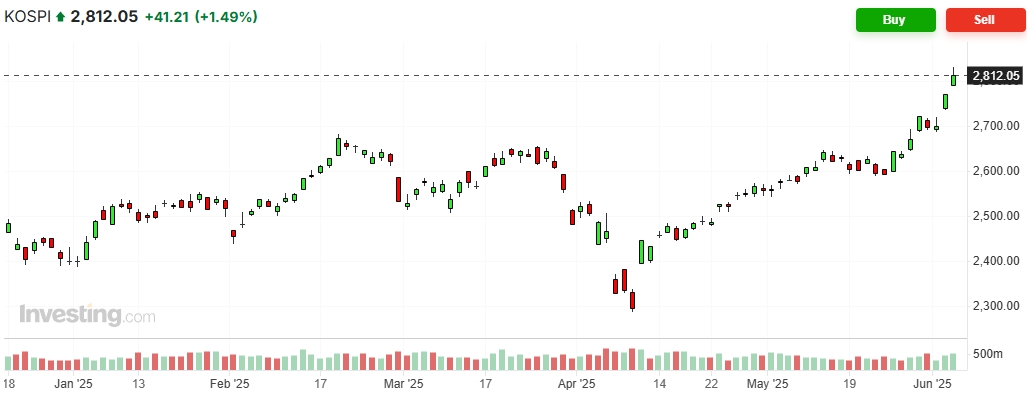
KOSPI Index, Source: Investing.com
Capital markets are reacting positively to Lee’s proposed policy agenda, which includes expansionary fiscal policies, improved corporate governance, stronger labor protections, and renewed efforts to advance trade negotiations with the United States.
Some analysts have noted that Lee is South Korea’s first president-elect to explicitly commit to strengthening board accountability to shareholders — a move seen as directly addressing one of the core causes of the Korea discount.
The term “Korea discount” refers to the persistent undervaluation of South Korean companies relative to their international counterparts. This discount has historically stemmed from geopolitical risks tied to inter-Korean tensions, as well as weaker corporate governance structures.
Lee has set a bold target of lifting the KOSPI to 5,000 points — a potential upside of nearly 78% from current levels — vowing to end the Korea discount once and for all. Corporate reforms, he argues, will pave the way for a fundamental revaluation of Korean equities.
Goldman Sachs analysts said that with Lee’s party now controlling both the executive and legislative branches, the new government can swiftly roll out large-scale fiscal stimulus, restart U.S.-South Korea trade talks, and push forward on wide-ranging corporate governance reforms — all of which could ultimately help reduce the long-standing valuation gap in South Korea’s equity and currency markets.
Recommended Articles





Comments (0)
Click the $ button, enter the symbol, and select to link a stock, ETF, or other ticker.