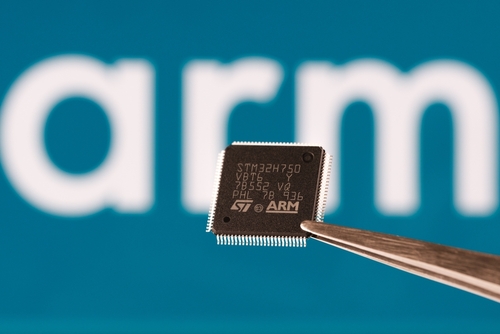
Hong Kong, China shares bounce on chip rally, potential state support

HONG KONG, April 11(Reuters) - Hong Kong and China stocks reversed earlier declines on Friday and narrowed the week's losses, thanks to rally led by chip shares and potential state buying, despite the escalating trade war with the U.S.
The Hang Seng Index .HSI jumped more than 2% in afternoon trading, reversing an earlier fall of as much as 1.2%. The tech subindex .HSTECH climbed 3%.
Chipmakers were among the biggest winners, with Hua Hong Semiconductor 1347.HK rallying as much as 20% and peer SMIC 0981.HK climbing more than 9%.
On the mainland, the Shanghai Composite Index .SSEC and the blue-chip CSI 300 Index .CSI300 also reversed losses to climb 0.6% and 0.5% respectively.
The CSI Semiconductor Industry Index .CSI931865 led gains onshore with a jump of more than 4%.
The gains in the afternoon session have helped both Hong Kong and mainland markets to recover some ground from a heavy selloff earlier in the week.
U.S. President Trump paused most of his "reciprocal" tariffs on Wednesday, though he has singled out China with eye-popping duties of 145% on its goods.
Despite the gains on Friday, the Hang Seng Index .HSI was still poised for a weekly loss of 7.7%, the biggest since October 2022, while the CSI 300 Index .CSI300 is on track to post the biggest weekly retreat in four months.
Hong Kong's bounce was following a move in mainland A shares that was widely believed to involve buying mainly by Chinese state funds known as the "national team", according to Steven Leung, director of institutional sales at UOB Kay Hian in Hong Kong.
Beijing stepped up efforts to stabilise mainland markets this week, with a state fund and state holding companies stepping into the market to buy stocks. A slew of listed firms have also announced share buybacks.
Liam Zhou, founder of Shanghai-based Minority Asset Management, said his $1 billion portfolio is now fully invested in China stocks and he was wagering on the country's economic resilience.
"China's retaliation against U.S. tariffs drew strength from the fact that China has reduced economic reliance on the U.S., it has proactively tamed property sector risks, made technology breakthroughs and is upgrading the manufacturing sector," he said.
Elsewhere, MSCI's broadest index of Asia-Pacific shares outside Japan .MIAPJ0000PUS also reversed earlier declines to trade 1.7% higher, while Japan's Nikkei .N225 narrowed losses to 3.6%.