This Is the Cardinal Sin Warren Buffett Says Investors Should Avoid

If you're picking individual stocks, it's inevitable that you are going to pick some poorly performing investments. Not all your stocks are going to be winners. Things can happen unexpectedly that impact a stock, whether it's the business's own doing or broader macroeconomic conditions. This year, for instance, many stocks are struggling due to tariffs, which are out of their control.
Billionaire investor Warren Buffett believes there's one particularly bad, "cardinal sin" that investors should avoid. Doing this is not only a waste of time but also a waste of money. This is a lesson he learned from the late Charlie Munger.
Where to invest $1,000 right now? Our analyst team just revealed what they believe are the 10 best stocks to buy right now. Learn More »
Own your mistakes and move on
There's nothing more discouraging for investors than to lose money on a stock that they thought had plenty of upside and room to grow.
However, what's potentially worse is hanging on and hoping the money losing investment eventually will turn around and rise in value, at least until you are able to recover the originally invested amount. But doing so -- assuming the original investment will turn around in the first place -- can be a waste of time if you're deep in the red, causing you to potentially miss out on other opportunities.
Buffett says that it was his longtime partner, the late Charlie Munger, who taught him about what he calls a "cardinal sin" to avoid in investing. "Delaying the correction of mistakes" and "thumb-sucking" are what retail investors today may refer to as simply "bag holding."
The primary danger retail investors face in such situations is they don't necessarily realize they were holding on to the bag for too long, blinded by hopes for a turnaround in the stock price that will at least reach break-even price. And when they do realize, it's probably too late.
This is why I believe technical analysis has value in investing, as resistance levels can be areas where prudent investors should be looking to unload a stock, especially if it has been struggling for a while.
Munger also pointed out that problems "cannot be wished away," which is sage advice for investors who may be hanging on to bad stocks in the hopes that they will recover. Selling a stock is effectively a finality, confirming that you've lost money on it and that it was a bad buy -- but it's also cutting your losses.
However, by holding on, you're still "wishing" the problem will go away and that the stock will one day recover.
Pivoting to an S&P 500 fund may be a much better option
A good strategy for investors may be to take money out of losing investments and put it into an exchange-traded fund (ETF) that mirrors the S&P 500. That can be a good place to park your money while you consider other opportunities. And, at least in the long run, you can be confident that it will rise in value.
One ETF which may be a popular option in this regard is the SPDR S&P 500 ETF Trust (NYSEMKT: SPY). It has been a great way to track the S&P 500. Its total returns (including dividends) are up more than 200% over the past decade.
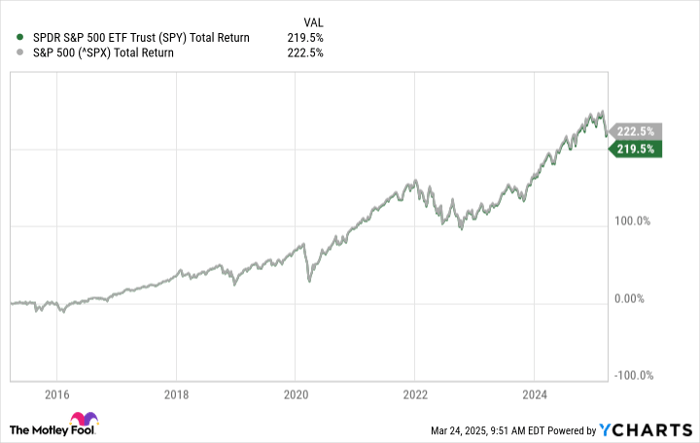
SPY Total Return Level data by YCharts.
For decades, the S&P 500 has averaged annual returns of around 10%. It can offer some great long-run stability, while allowing you to also grow your portfolio over the years. It's a much better option than simply holding money in a losing stock which may not have much hope of a recovery.
Cutting ties with bad stocks isn't easy, but it's often necessary
Unless you have a compelling reason to believe that an underperforming stock can turn things around, you may want to consider dumping it and deploying that money into a better investment, like an ETF that tracks the S&P 500, giving you exposure to the best stocks in the world. Simply hoping that things will improve can be a costly strategy.
Should you invest $1,000 in SPDR S&P 500 ETF Trust right now?
Before you buy stock in SPDR S&P 500 ETF Trust, consider this:
The Motley Fool Stock Advisor analyst team just identified what they believe are the 10 best stocks for investors to buy now… and SPDR S&P 500 ETF Trust wasn’t one of them. The 10 stocks that made the cut could produce monster returns in the coming years.
Consider when Nvidia made this list on April 15, 2005... if you invested $1,000 at the time of our recommendation, you’d have $739,720!*
Stock Advisor provides investors with an easy-to-follow blueprint for success, including guidance on building a portfolio, regular updates from analysts, and two new stock picks each month. The Stock Advisor service has more than quadrupled the return of S&P 500 since 2002*. Don’t miss out on the latest top 10 list, available when you join Stock Advisor.
*Stock Advisor returns as of March 24, 2025
David Jagielski has no position in any of the stocks mentioned. The Motley Fool has no position in any of the stocks mentioned. The Motley Fool has a disclosure policy.
Related Articles
National Debt Bomb Ignited? Musk Warns U.S. Will Be 1000% Bankrupt Without AI
TradingKey - Tesla (TSLA) CEO Elon Musk recently issued another warning regarding the rapidly ballooning U.S. national debt. He stated clearly that without artificial intelligence and robotics, the United States will inevitably head toward fiscal bankruptcy.
Tesla Stock Outlook: Competing With Rivian, Robotaxi Potential, and 2026 Prospects
There is much conversation about the prospect of investing in Tesla (TSLA) as we move closer to 2026. The volatility of its share price in 2025 is leading many investors to consider if they should purchase shares of Tesla given the alternatives available in terms of electric vehicles (Rivian, etc.).
A Crash After a Surge: Why Silver Lost 40% in a Week?
TradingKey - Spot silver (XAGUSD) prices continue to decline. Silver plunged 20% on Thursday, breaking below $71 per ounce, with the sell-off intensifying on Friday as prices fell further below $64. Compared to the all-time high set on January 29, silver prices have retraced more than 40%, wiping out nearly all gains accumulated over the previous month.
Is Bitcoin’s Four-Year Cycle Dead in 2026?
Is the Bitcoin 4-year cycle dead? After 2025 broke historical records with a red post-halving year, institutional analysts explore if the Bitcoin price has decoupled from the halving countdown. Analyze the impact of spot ETFs, global liquidity, and the roadmap to the 2028 halving in this 2026 market