


Canada Unemployment Rate set to remain unchanged in April



- The Canadian Unemployment Rate is seen holding steady in April.
- The BoC is expected to stay put at its June 10 meeting.
- The Canadian Dollar remains on the defensive vs the Greenback this week.
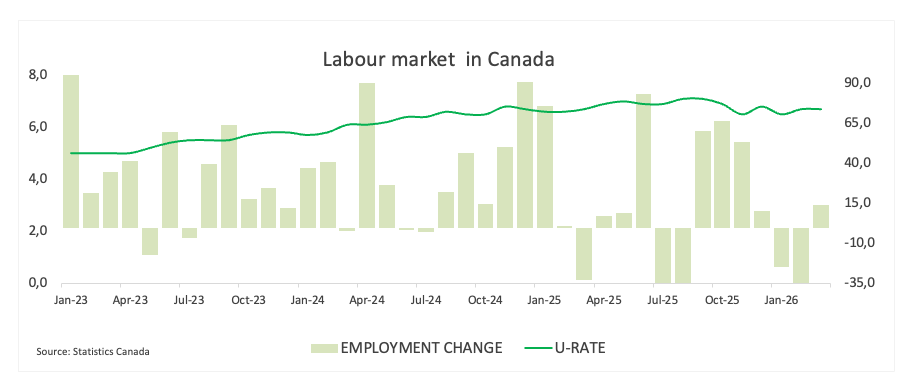
Statistics Canada will release its Labour Force Survey on Friday, and markets are bracing for quite a steady print. The Unemployment Rate is expected to remain at 6.7% in April, while the Employment Change is forecast to increase by 15K following a 14.1K gain in the previous month.
Despite the tone of the report, the bar for a change of direction by the Bank of Canada (BoC) should remain pretty high. Indeed, the central bank is expected to maintain its steady hand at its June 10 gathering, following four consecutive “on hold” decisions.
At its latest event, the BoC signalled an upbeat medium-term outlook for economic growth while revising inflation higher for the current year. In addition, Governor Tiff Macklem delivered a cautious message at his press conference, keeping the data-dependent stance well in place while leaving the door open to higher rates in case energy prices remain elevated.
So far, market participants expect around 45 basis points of tightening by the bank by year-end.
What can we expect from the next Canadian Unemployment Rate print?
Consensus among analysts sees Canada’s Unemployment Rate at 6.7% last month. Additionally, investors forecast the economy will add around 15K jobs in April, a tad higher than March’s 14.1K gain. It is worth recalling that Average Hourly Wages rose at an annualised 5.1% in March (from 4.9%), pointing to sticky wage inflation.
When is the Canada Unemployment Rate released, and how could it affect USD/CAD?
All eyes in Canada will be on Friday’s release of the jobs report, due at 12:30 GMT. A stronger print could give the Canadian Dollar (CAD) a quick lift, but don’t expect fireworks.
USD/CAD has been on a steady uptrend this week, almost entirely to the tune of developments from the Middle East and dynamics around the US Dollar (USD).
Pablo Piovano, Senior Analyst at FXStreet, points out that USD/CAD has been edging higher in the last few days, reclaiming the 1.3600 barrier and approaching 1.3650. Further up comes the weekly top at 1.3714 (April 24), an area reinforced by the provisional 55-day and 100-day SMAs around 1.3720. Further north emerges the always relevant 200-day SMA near 1.3815.
On the flip side, he highlights initial support at the May floor of 1.3549 (May 1), seconded by the March base at 1.3525 (March 9), the February valley at 1.3504 (February 11) and the 2026 bottom at 1.3481 (January 30).
“Momentum favours extra declines,” he adds, noting that the Relative Strength Index (RSI) is hovering near 43 and the Average Directional Index (ADX) just over 24 suggests the underlying trend appears to be gathering traction.
Economic Indicator
Participation Rate
The Participation Rate is the percentage of the total number of people of working age (15 years and over) that is in the labor force (either working or looking for a job). The data provided by Statistics Canada is monthly and seasonally adjusted; this eliminates the impact of seasonal variations and makes it possible to compare data throughout the year.
Last release: Fri Apr 10, 2026 12:30
Frequency: Monthly
Actual: 64.9%
Consensus: -
Previous: 64.9%
Source: Statistics Canada
Bank of Canada FAQs
The Bank of Canada (BoC), based in Ottawa, is the institution that sets interest rates and manages monetary policy for Canada. It does so at eight scheduled meetings a year and ad hoc emergency meetings that are held as required. The BoC primary mandate is to maintain price stability, which means keeping inflation at between 1-3%. Its main tool for achieving this is by raising or lowering interest rates. Relatively high interest rates will usually result in a stronger Canadian Dollar (CAD) and vice versa. Other tools used include quantitative easing and tightening.
In extreme situations, the Bank of Canada can enact a policy tool called Quantitative Easing. QE is the process by which the BoC prints Canadian Dollars for the purpose of buying assets – usually government or corporate bonds – from financial institutions. QE usually results in a weaker CAD. QE is a last resort when simply lowering interest rates is unlikely to achieve the objective of price stability. The Bank of Canada used the measure during the Great Financial Crisis of 2009-11 when credit froze after banks lost faith in each other’s ability to repay debts.
Quantitative tightening (QT) is the reverse of QE. It is undertaken after QE when an economic recovery is underway and inflation starts rising. Whilst in QE the Bank of Canada purchases government and corporate bonds from financial institutions to provide them with liquidity, in QT the BoC stops buying more assets, and stops reinvesting the principal maturing on the bonds it already holds. It is usually positive (or bullish) for the Canadian Dollar.
Recommended Articles








Comments (0)
Click the $ button, enter the symbol, and select to link a stock, ETF, or other ticker.